
The CELPIP Speaking test has eight tasks and takes 15 minutes. You get a short preparation time before each one, then a single recording with no second take. This guide shows you what every task asks for, how the 15 minutes is divided, and which tasks learners find hardest. We can tell you that last part with real numbers, because we checked more than 59,000 Speaking answers on HelloCelpip against what each task actually asks for.
#What is on the CELPIP Speaking test?
CELPIP Speaking is the last section of the test, and it is fully computer-delivered. You speak into a headset microphone, alone, with no examiner in the room. There are eight tasks, and each one gives you preparation time and then speaking time.
The eight Speaking tasks in order, with the preparation time and then the speaking time for each. Darker blocks take longer overall. Task 5 also gives you a separate minute to read its two options before preparation starts, which is what makes it the longest task.
Here is what each task asks you to do, and how its time is split.
| Task | Name | What you do | Prepare | Speak |
|---|---|---|---|---|
| 1 | Giving Advice | Help someone make a decision | 30 sec | 90 sec |
| 2 | Talking about a Personal Experience | Tell a story from your own past | 30 sec | 60 sec |
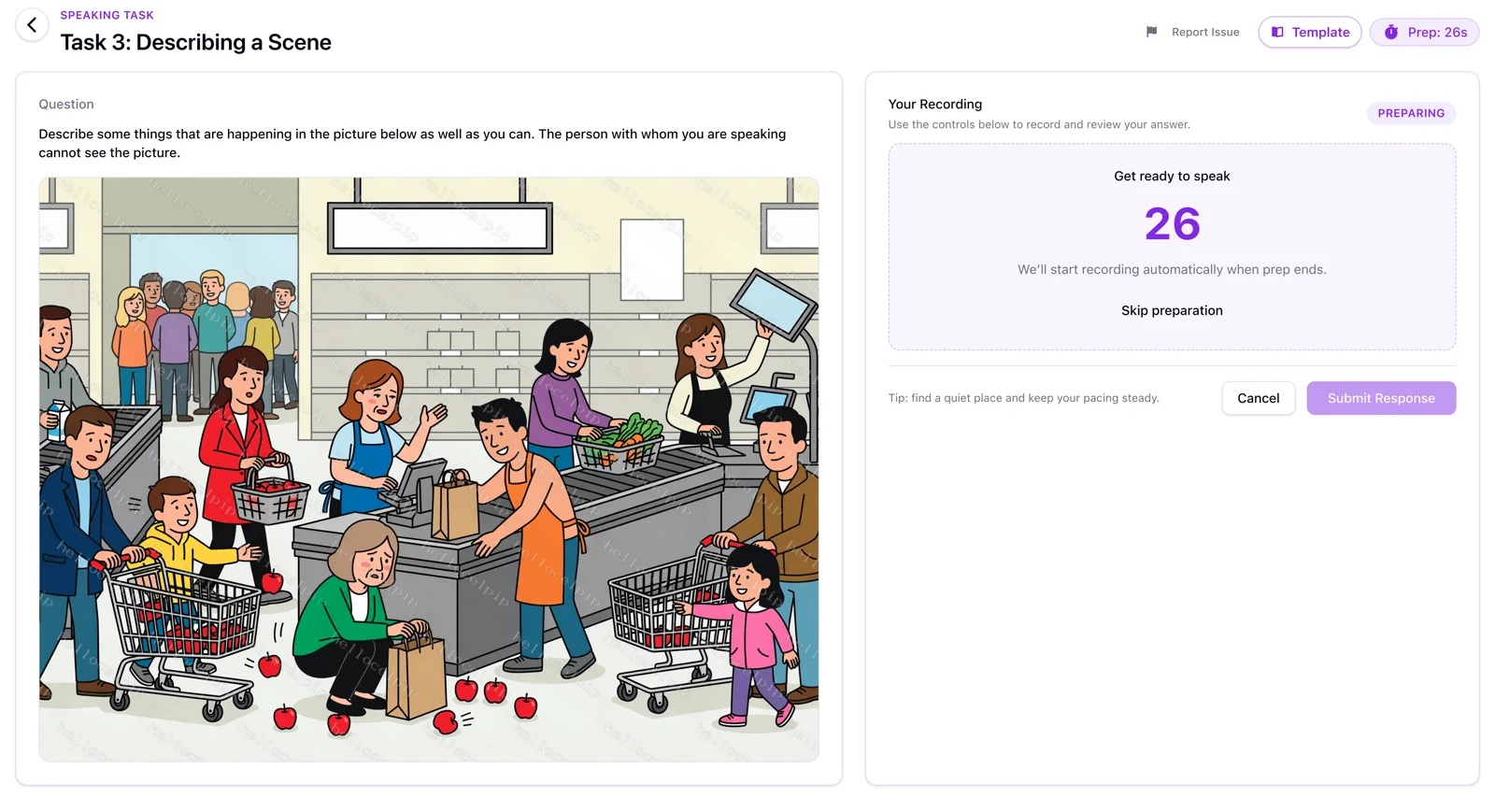
| 3 | Describing a Scene | Describe a picture to someone who cannot see it | 30 sec | 60 sec |
| 4 | Making Predictions | Say what happens next in that same picture | 30 sec | 60 sec |
| 5 | Comparing and Persuading | Choose between two options, then persuade someone | 60 + 60 sec | 60 sec |
| 6 | Dealing with a Difficult Situation | Make an awkward decision and explain it | 60 sec | 60 sec |
| 7 | Expressing Opinions | Take a position and support it | 30 sec | 90 sec |
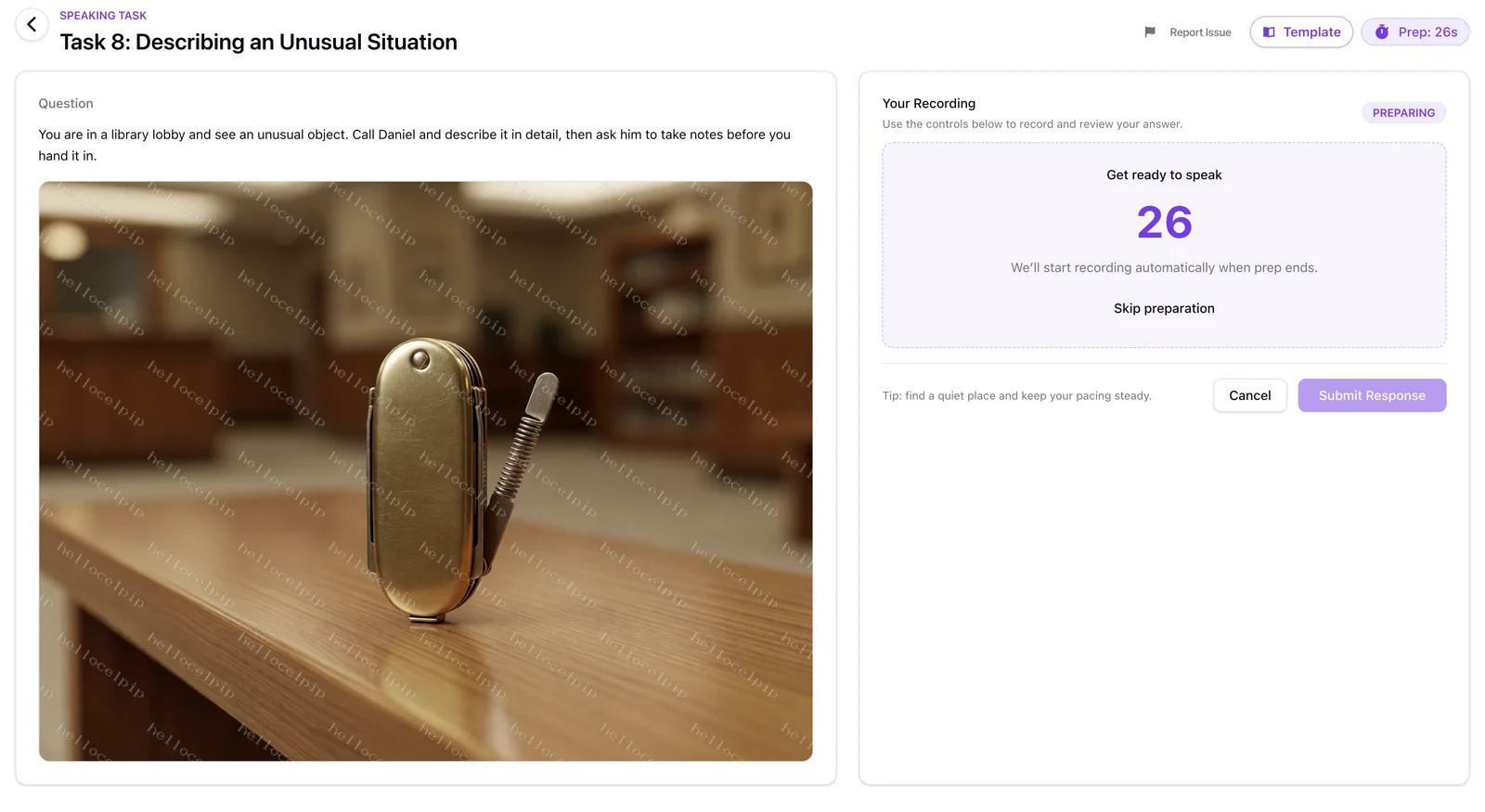
| 8 | Describing an Unusual Situation | Phone someone about an object you cannot name | 30 sec | 60 sec |
Two details in that table catch people out:
- Task 5 has an extra stage. Before the usual preparation minute, you get a full minute to read two options and silently pick one. That reading minute is not preparation time. Choose fast, because your real planning happens afterwards.
- Task 4 reuses the Task 3 picture. The image does not change, only the question does. So the 30 seconds before Task 4 can go entirely on the future, not on re-reading the scene.
You can confirm the current format on the official CELPIP Test Format page.
#How long is the CELPIP Speaking test really?
CELPIP publishes 15 minutes for Speaking, and the eight scored tasks come to exactly that. Add up every preparation and speaking window in the table above and you get 900 seconds, to the second. Plan for a little longer in the room, though: CELPIP's own Speaking study pack says the section takes about 15 to 20 minutes, because of the instruction screens and one extra task described below.
Six of the eight tasks give you 60 seconds to speak. Tasks 1 and 7 give you 90. There is no spare minute anywhere and no way to go back, so a long introduction costs you content you cannot recover.
#The Practice Task before Task 1
Speaking opens with an unscored Practice Task: 30 seconds to prepare, 60 seconds to speak, and nobody ever listens to it. It is optional, and skipping it is a small mistake.
Use it. It is your only chance to hear how your microphone is picking you up and to get your voice working before anything counts. Speak at a normal volume, since speaking too softly or too loudly affects listenability, which is one of the four areas you are scored on.
#Which CELPIP Speaking task is the hardest?
Describing a Scene is the hardest task by a wide margin, and the tasks that follow it are hard for the same reason. We checked Speaking answers on HelloCelpip against the specific things each task asks for, and the pattern across all eight is consistent: nearly everyone does the literal instruction, and far fewer develop it.
The full picture, task by task:
| Task | The requirement learners miss most | Met |
|---|---|---|
| 3 · Describing a Scene | Painted a picture the listener could see | about 14% |
| 8 · Describing an Unusual Situation | Described it for someone who cannot see it | about 34% |
| 7 · Expressing Opinions | Gave enough supported reasons | about 35% |
| 6 · Dealing with a Difficult Situation | Stayed considerate but firm | about 38% |
| 1 · Giving Advice | Gave a reason for each suggestion | about 56% |
| 2 · Talking about a Personal Experience | Kept the story in the past tense | about 63% |
| 4 · Making Predictions | Tied the predictions to the picture | about 87% |
| 5 · Comparing and Persuading | Compared both options | about 89% |
Read the table as a study plan rather than a scoreboard. These figures come from more than 59,000 anonymised, aggregated Speaking answers on HelloCelpip, and they are judged results: they describe what our evaluator saw, not a verdict on anyone. But the shape is hard to miss.
Tasks 3 and 8 are the two describing tasks, and they are both near the bottom. Both ask you to build a picture in someone else's head, and both are usually answered with a flat list of objects instead. Tasks 7 and 8 sit together at about a third, and Task 6 is close behind them.
Tasks 4 and 5 sit near the top, and the reason is instructive. Both give you something concrete to react to: a picture you have just described, or two options printed on the screen. When the material is in front of you, most people use it. It is the tasks that ask you to generate detail from nothing that fall away.
#Where do Speaking answers actually lose marks?
Every Speaking answer is scored on the four official CELPIP rated areas. Across Speaking answers on HelloCelpip, about a third of everything our evaluator flags is a vocabulary problem: the wrong word, or a phrase that is not how a native speaker would put it. The other three areas sit close together behind it.
That is good news for study planning, because vocabulary is the area that responds fastest to deliberate work. Collect the phrases that fit these eight situations, and you are working on the largest slice of the problem.
#How much do you actually need to say?
This is the question people most often get wrong in both directions. On HelloCelpip, a typical 60-second answer runs to roughly 125 to 135 words, and a 90-second answer to roughly 175 to 185 words. That is around 130 words a minute, which is an ordinary, unhurried speaking pace.
Treat those figures as calibration, not a target. They describe what learners actually produce, not what earns a particular level, and speaking faster to hit a word count is exactly the wrong response. The useful takeaway is smaller and more practical: 60 seconds holds about three developed sentences, not eight rushed ones. Plan for three.
- One sentence that answers the question directly, so the rater knows immediately what you chose or what you saw.
- Two or three sentences that develop it with a reason, a detail, or an example.
- One short closing line. If you run out of time mid-sentence, you have still delivered the answer.
#What does each Speaking task look like?
Below is each task, with what it asks for and the one habit that separates a strong answer. Our questions follow the exact CELPIP format, so what you practise here is what you will meet on test day. Each task also has its own full guide with a template and two worked answers.
#Task 1: Giving Advice
Someone describes a decision and asks what you would do. You get 30 seconds to prepare and 90 seconds to speak, one of only two tasks with the longer window. Most people give several suggestions; only about 56% give a reason for each one. A suggestion with no reason behind it reads as a list, not advice.
#Task 2: Talking about a Personal Experience
You tell a story about something that happened to you. The trap is grammatical rather than structural: about 63% of answers hold the past tense the whole way through, and the rest slip into the present partway. Choosing a real memory rather than inventing one makes the tense look after itself.
#Task 3: Describing a Scene
You describe an illustration to someone who cannot see it. This is the hardest task on the section by our numbers: about 93% describe what is happening, but only about 14% describe it so a listener could picture it. The difference is detail that carries information, such as colour, position, and what someone looks like they are about to do.
#Task 4: Making Predictions
The same picture returns, and the question becomes what will most probably happen next. This is one of the two tasks learners handle well: about 87% tie their predictions to something actually visible. The word that matters is probably, so read the scene rather than inventing a dramatic ending.
#Task 5: Comparing and Persuading
You read two options, silently choose one, then persuade a named person to agree. About 89% compare both options rather than only praising their own, the highest figure on the section. Naming the other option and saying why it loses is what turns a description into persuasion.
#Task 6: Dealing with a Difficult Situation
You choose which of two people to disappoint, tell them, and explain why. You get a full 60 seconds to prepare, double most tasks, because the choice is the hard part. Only about 38% manage to sound considerate and firm at the same time, which is the whole task.
#Task 7: Expressing Opinions
You take a position on a question and support it, with 90 seconds to speak. About 96% state a clear position, but only about 35% support it with enough developed reasons. The fix is arithmetic: two reasons developed properly beat four reasons listed.
#Task 8: Describing an Unusual Situation
You phone someone and describe an object you have no name for. About 87% remember to frame it as a phone call and about 73% say what makes the object strange, but only about 34% describe it well enough for the listener to picture it. Compare it to something ordinary, then say how it differs.
#How to practise a full Speaking test
Practising single tasks builds the skill. Practising a full sitting builds the stamina, and they are genuinely different things.
-
Start with one task and no timerAnswer it slowly and well, so you learn what a complete answer contains before you learn to fit it into 60 seconds.
-
Add the timer, then listen backPlaying your own recording is uncomfortable and it is the fastest feedback there is. You will hear the filler words and the tailing off long before anyone tells you.
-
Drill the two describing tasksTasks 3 and 8 hold the most points to gain for most learners. Describe the room you are in, out loud, for 60 seconds, until detail comes without effort.
-
Run all eight in one sittingTake a timed mock so you find out what your voice and concentration do by Task 7. That is the part single-task practice cannot teach you.
#What goes wrong across all eight tasks
The same handful of habits show up whichever task you are on.
- Answering, then stopping. This is the single biggest pattern in our data. Learners do the literal instruction and leave the developing step undone.
- The long introduction. Restating the question eats 10 of your 60 seconds and adds nothing. Start with your actual answer.
- Listing instead of describing. Naming five objects is not a description. One object described properly beats five named.
- Speeding up when the timer drops. It hurts listenability, which is one of the four rated areas, and it rarely fits in more content.
- Silence while you think. Pausing to plan mid-answer costs recorded seconds you never get back. Plan in the preparation window, not in the recording.
#How HelloCelpip helps you prepare for Speaking
HelloCelpip turns this format into focused study. You record answers to questions in the same computer-delivered style as the real test, across all eight tasks, and then you get a report on the four rated areas with specific points quoted from your own answer and a stronger version to compare against.
- A large set of Speaking questions across all eight tasks, written in the real test format at several levels of difficulty.
- A report on every attempt across the four CELPIP rated areas, with your own words quoted back and a stronger version beside them.
- Your recording played back with the report, so you can hear the pace and pausing the rater would hear.
- Full-length, timed mock tests that run all eight tasks end to end, in order.
A simple way to use it: record a few Speaking questions to find which rated area is costing you most, work through the task templates for the tasks you found hardest, then take a full mock test for a timed run of all eight.
#What your Speaking score means
CELPIP reports Speaking as a level from 0 to 12, not a percentage or a pass mark. That level lines up with the Canadian Language Benchmarks, so a Speaking 8 is CLB 8. It matters most if you need Speaking for immigration or citizenship, where programmes ask for a certain CLB in each skill.
To see what a level means for your goal, use the Score to CLB calculator. Requirements change, so always confirm the current one for your programme on the official IRCC site.
#CELPIP Speaking practice FAQ
How many tasks are on the CELPIP Speaking test?
How long is the CELPIP Speaking test?
Which CELPIP Speaking task is the hardest?
How long do you get to speak on each task?
How many words should I say in 60 seconds?
Can I re-record my answer on the CELPIP Speaking test?
Is there an examiner in the room for CELPIP Speaking?
Are these real CELPIP Speaking questions?
Will practising on HelloCelpip prepare me for the real Speaking test?
Start with the task our data says costs learners the most: the CELPIP Speaking Task 3 guide.
Confirm the current task list, section timing, and question counts on the official CELPIP Test Format page, and check the CELPIP Score Comparison Chart for CELPIP Level and CLB information. Per-task preparation and speaking times are published in the CELPIP Speaking Pro study pack. Your HelloCelpip level uses the same 0 to 12 CELPIP scale, so you can track real progress between now and test day. Your official score comes from Paragon Testing Enterprises on test day. HelloCelpip is an independent study resource and is not affiliated with CELPIP or Paragon Testing Enterprises.
Official sources:
- CELPIP Test Format
- CELPIP Score Comparison Chart
- Paragon Testing Enterprises, CELPIP Speaking Pro Target 9 Study Pack (per-task preparation and speaking times)
Last updated: July 27, 2026