
Use this CELPIP Speaking Task 2 template: set the scene in one sentence, tell what happened in order, and finish by saying how it made you feel. Task 2 is Talking about a Personal Experience. You get 30 seconds to prepare and 60 seconds to speak, once, with no second take.
Two things go wrong far more often than a weak story, and neither is what most guides warn you about. This guide gives you the template, two worked answers to the same question, and what our own learners show about where a Task 2 answer actually falls short.
#What does CELPIP Speaking Task 2 ask you to do?
Task 2 asks you to tell a story about your own past. The question names a kind of experience, gives you a few examples to choose from, and then asks two or three specific things about it, usually where you were, who was involved, and how you felt.
Because the whole task is set in the past, Task 2 is the one Speaking task where a single piece of grammar is built into the job itself. You cannot tell a past story without past tenses, and that turns out to matter more than most people expect.
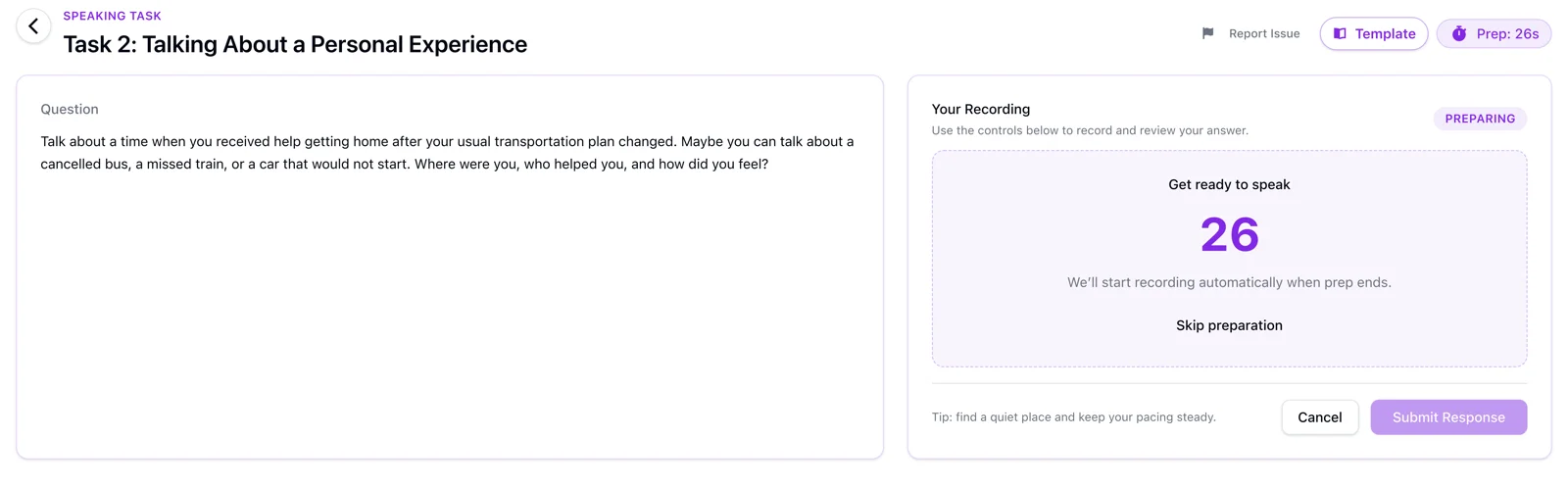
Notice how much the question hands you. It suggests possible situations, so you are never starting from nothing, and it lists the things to cover, which is your structure already written for you. The question stays on screen while you speak, and when the preparation clock reaches zero, recording starts on its own.
Try a Speaking Task 2 question →
#Which part of a Task 2 answer do learners actually miss?
Almost everyone tells a genuine past experience. Far fewer keep it in the past tense, and fewer still say how they felt.
We looked at over 29000 anonymised, aggregated Speaking Task 2 responses on HelloCelpip and checked each one against what the task asks for. Our evaluator judged that about 97% told a real past experience, but only about 71% included a personal detail or feeling, and only about 63% kept the story in the past tense throughout.
| What the task asks for | Share of responses that did it |
|---|---|
| Kept the story in the past tense | about 63% |
| Included a personal detail or feeling | about 71% |
| Told a real past experience | about 97% |
Both gaps are named in Paragon's own published strategies for this task, which lists using past tenses and trying to get your listener to feel how you felt. The requirements are not hidden. They are simply the two that slip when you are talking quickly under a clock.
The tense one is worth understanding rather than just noting. Grammar and sentence structure sit inside Listenability, one of the four rated areas, so drifting into the present tense halfway through a past story is not a small stylistic wobble. It is scored.
#Why does the tense slip?
Because storytelling out loud pulls you into the present. People naturally switch to "so I'm standing there and the bus just leaves" when a story gets exciting, and in casual conversation that sounds fine. Under a rated task it reads as inconsistent grammar.
The fix is not to memorise verb tables. It is to lock the first sentence into the past and let the rest follow.
#A CELPIP Speaking Task 2 template you can adapt
[When it happened], I was [where you were, and why].

[What went wrong, or what started the story.] [One detail you could see, hear, or feel.]

So I [what you did next]. [What the other person did or said.]

In the end, [how it turned out].

Honestly, I felt [the feeling], and [why it stayed with you].
The words in brackets are instructions to you, not lines to copy. Two things about this shape are doing the real work.
The first line starts with a time marker, "Last winter", "A couple of years ago", "One evening in March". That is not decoration. Naming the time forces the first verb into the past, and the rest of the story tends to stay there once it starts there.
The last line exists because of the 71% figure above. Ending on the feeling is the simplest way to guarantee you covered it, and the question almost always asks for it directly.
Sentence starters that fit almost any Task 2 question:
- Setting the time: "Last winter…", "About two years ago…", "One evening after work…"
- Setting the scene: "I was waiting for…", "I had just finished…", "We were about to…"
- The turn: "Then I realised…", "That was when…", "Out of nowhere…"
- What you did: "So I decided to…", "I ended up…", "I asked her whether…"
- The result: "In the end…", "By the time I got home…", "It worked out because…"
- The feeling: "I felt so relieved…", "I was embarrassed at first, but…", "It really stayed with me because…"
Do not memorise a finished answer. Memorise the shape, and let the question supply the story.
#What are the 30 seconds of preparation for?
Choosing the story, and nothing else. Thirty seconds is not enough to plan sentences, and trying to script one is the main reason people freeze when recording starts.
-
Take the first workable storyReal or invented, it does not matter. The question usually suggests two or three situations, so use one of those rather than searching your memory for something better.
-
Fix the time and the placeDecide when it happened and where you were. This gives you your opening line, and the time marker is what locks your first verb into the past.
-
Note three beats, not sentencesWhat went wrong, what you did, how it ended. Three words are enough to hold a story together for 60 seconds.
-
Pick the feeling before you startRelieved, embarrassed, grateful, proud. Choosing it now means you will not reach the end of the story and have nothing to close on.
Those thirty seconds are a separate skill from speaking, and you can train them on their own. Idea Coach walks you through an answer one piece at a time, so the shape is automatic before you ever start the clock.
#What does a weak Task 2 answer sound like?
It sounds like a real story told in the wrong tense, ending the moment the events end.
The question: Talk about a time when a neighbour or a stranger helped you with a problem. Where were you, who helped you, and how did you feel?
One time my car does not start in the morning and I have an important meeting. So I am standing outside and I try to call a taxi but nothing is available. Then my neighbour comes out and he sees me and he asks what is the problem. I explain him the situation and he says he can drive me. So we go together and I arrive on time for my meeting. It was a good thing that he helps me that day.
Why it falls short: The story itself is fine, and it answers the question. But almost every verb is in the present tense for an event that clearly happened in the past, and the one past-tense sentence at the end makes the inconsistency more obvious rather than less. There is nothing you could see or hear, and no feeling at any point. At about 83 words it also finishes well before the 60 seconds are up.
Nothing here is a vocabulary problem, which is what makes it a useful example. The words are ordinary and correct. The grammar is what a rater would notice.
#What does a strong Task 2 answer sound like?
The same story, held in the past tense, with two details you can picture and a feeling at the end.
The question: Talk about a time when a neighbour or a stranger helped you with a problem. Where were you, who helped you, and how did you feel?
This happened about two years ago, on a freezing Tuesday morning in February. I had an interview at nine, and when I turned the key in my car, it just clicked twice and died.
I stood in the driveway for a few minutes calling every taxi company I could find, and none of them had anything for at least forty minutes. I remember my hands going numb while I scrolled.
Then my neighbour Raymond came out to clear his windshield, saw me standing there in a suit, and asked what was wrong. I explained, and he just said, get in. He drove me across town and would not take any money for the gas.
I made it with about ten minutes to spare. Honestly, I felt enormously relieved, and a little embarrassed that I had never really spoken to him before that morning. We have been friends ever since.
Why it works: Every verb stays in the past, and the opening time marker is what sets that up. Two details do the picturing work: the key clicking twice, and hands going numb while scrolling. The feeling is not one word but two, relieved and slightly embarrassed, which is what makes it sound like a real memory rather than a required ending. At 149 words it comfortably fills 60 seconds.
Read both out loud and you will hear that the difference is not vocabulary or ideas. It is tense control and two sentences of detail.
#How much do you need to say in 60 seconds?
About 135 words, at an ordinary pace. That is roughly four or five sentences per section of the template.
Across Task 2 responses recorded on HelloCelpip, the average answer runs about 135 words and uses almost the full 60 seconds. That number is worth knowing because it removes a fear. You do not need to speak quickly to fill a minute. A story with a scene, two or three beats, and a closing feeling gets you there at a pace you can control, and rushing costs you under Listenability.
#What do CELPIP raters listen for?
Speaking responses are rated in four areas, and the official CELPIP Performance Standards give a plain question for each one.
There is a pattern in where marks go. Across more than 13,500 anonymised, aggregated Task 2 responses on HelloCelpip, about a third of everything our evaluator flags is a vocabulary problem, more than any other area. The other three sit close together behind it, each accounting for roughly a fifth to a quarter of what gets flagged.
It is worth being clear about what a vocabulary problem usually is, because it is rarely a missing advanced word. In a story it is most often the wrong everyday verb, or a phrase that is not quite how the idea is normally said. The answer above says the car "clicked twice and died", not that it "made a malfunction sound".
#Common Task 2 mistakes
- Drifting into the present tense once the story gets going. This is the single most common gap in our data.
- Ending when the events end, with no sentence about how you felt.
- Spending the preparation time hunting for a true story instead of taking the first workable one.
- Describing a general habit rather than one specific occasion. The task asks for a time something happened, not what usually happens.
- Giving so much background that the actual event arrives at 45 seconds.
- Running out of story at 30 seconds and leaving a long silence.
If you feel yourself drying up, do not start a second story. Go back and add what you saw, what someone said, or how it felt at that moment.
#How to practise Task 2
A simple way to use it: record two or three Speaking Task 2 questions and check only one thing, whether every verb about the event is in the past. When that is automatic, add the closing feeling, then take a full mock test when you want to hear yourself under real timing.
Task 1 comes just before this one and asks for something quite different, advice to a person rather than a story about yourself. The CELPIP Speaking Task 1 template covers that shape, including what to do with the extra 30 seconds it gives you.
#Frequently asked questions
What is CELPIP Speaking Task 2?
How long do you get for CELPIP Speaking Task 2?
Can I invent a story for Speaking Task 2?
What tense should I use in Speaking Task 2?
What do learners get wrong most often in Task 2?
How many words should a Task 2 answer be?
Should I tell a happy story or a difficult one?
Confirm the eight Speaking tasks and the 15-minute Speaking section on the official CELPIP Test Format page. Per-task timing of 30 seconds to prepare and 60 seconds to speak, and the Task 2 strategies quoted above, are published in Paragon’s CELPIP Speaking Pro study pack, and the four rated areas come from the CELPIP Speaking Performance Standards. Your HelloCelpip level uses the same 0 to 12 CELPIP scale, so you can track real progress between now and test day. Your official score comes from Paragon on test day. HelloCelpip is an independent study resource and is not affiliated with CELPIP or Paragon Testing Enterprises.
Official sources:
Last updated: July 24, 2026