
Use this CELPIP speaking template for Task 1: show that you understand the situation, give two or three pieces of advice, and add a reason to every one of them. The reason is what turns a suggestion into advice, and it is the step most answers leave out.
Task 1 is Giving Advice. You get 30 seconds to prepare and 90 seconds to speak, once, with no second take. Everything below is built around that shape: the template, two worked answers to the same question, and what our own learners show about where a Giving Advice answer usually falls short.
#What does CELPIP Speaking Task 1 ask you to do?
Task 1 asks you to help one person, either to make a decision or to get ready for something. The question appears on screen and describes the situation. You then speak directly to that person, the way you would talk to a friend who asked for your help.
The person is usually a friend, a neighbour, or a co-worker, and the situation is everyday: choosing between two options, starting something new, or preparing for an event. The tone is friendly and informal to neutral. You are helping a peer, not writing to an institution.
Because Task 1 gives you 90 seconds instead of 60, it is one of the two longest turns in the whole Speaking test. That is more room than most people expect, and running out of things to say is a real risk. The template below is designed to fill it.
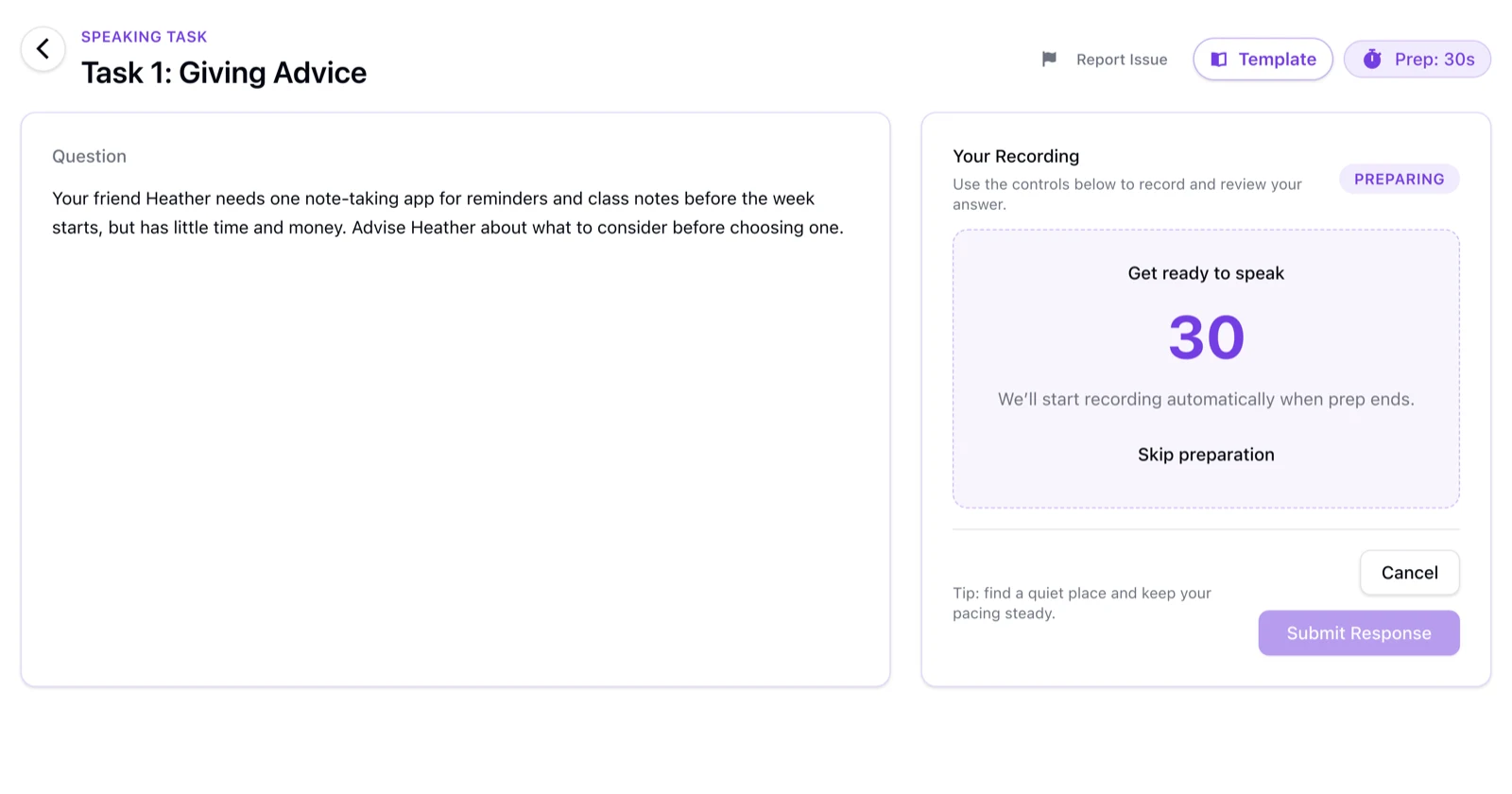
Two things in that screen surprise people the first time. The question stays visible while you speak, so you never have to memorise it. And when the preparation clock reaches zero, recording starts on its own. Nobody asks whether you are ready.
Try a Speaking Task 1 question →
#Which part of a Giving Advice answer do learners actually miss?
Almost everyone gives more than one suggestion. Far fewer explain why any of them would help.
We looked at over 10,000 anonymised, aggregated Speaking Task 1 responses on HelloCelpip and checked each one against what the task actually asks for. Nearly every answer spoke directly to the person, and most gave more than one suggestion. Only about 56% gave a reason for each suggestion.
| What the task asks for | Share of responses that did it |
|---|---|
| Spoke directly to the person | about 99% |
| Gave more than one suggestion | about 93% |
| Gave a reason for each suggestion | about 56% |
These are our evaluator's judgements rather than an official score, and they describe practice on HelloCelpip rather than the real test. But the shape of the gap is clear and it matches what the official task description asks for: a practical reason or example behind each suggestion.
So the useful takeaway is narrow and easy to act on. You almost certainly already do the hard-looking parts. Spend your practice time on the word because - that is, on giving a clear reason for every suggestion you make.
#A CELPIP Speaking Task 1 template you can adapt
Hi [name], [one line that names their situation back to them].

First, [suggestion 1], because [what it will do for them].

Second, [suggestion 2]. [One detail that makes it concrete: a number, a time, a thing to bring.] That way, [the result].

One last thing. [Suggestion 3], because [what it prevents or makes easier].

[One warm closing line about how it will go.]
The words in brackets are instructions to you, not lines to copy. Every suggestion has two jobs: say what to do, then say what it gives them. If you do only the first job, you have made a list, not given advice.
Sentence starters that fit almost any Task 1 question:
- Naming the situation: "I know the first week feels like a lot.", "I remember doing exactly this last year."
- First suggestion: "First, I would…", "The main thing I would do is…"
- Next suggestion: "Second…", "Another thing that helps is…", "One last thing…"
- The reason: "because it means…", "so you can…", "that way you will not…"
- Closing: "You will be fine.", "Let me know how it goes."
Do not memorise a finished answer. Memorise the shape, and let the question supply the content.
#How do you turn a suggestion into advice?
Finish the sentence. A suggestion becomes advice the moment you say what it will do for the person, and there are only three endings you need.
| Suggestion only | Suggestion with a reason |
|---|---|
| You should arrive early. | You should arrive about 15 minutes early, because it gives you time to breathe instead of walking in flustered. |
| Write down their names. | Write down their names in your phone, so you can use them the next day. |
| Ask questions. | Ask questions on the first day, that way nobody expects you to already know. |
The three endings are because it…, so you…, and that way you…. Pick one and keep going. They are short, they sound natural out loud, and they cost you about three seconds each.
This also solves the silence problem. When you feel yourself running out, you are usually one reason short, not one idea short. Go back to the suggestion you just made and say what it prevents.
#What are the 30 seconds of preparation for?
Thirty seconds is enough to choose your ideas, and nowhere near enough to write sentences. Trying to script an answer is the main reason people freeze when recording starts.
-
Read the question twice and find the personGet the name and what they are trying to do. You will speak to them by name in your first sentence.
-
Pick two or three suggestions, fastThe obvious, practical ones are fine. Task 1 rewards useful advice, not clever advice.
-
Say because in your head for each oneThis is the step worth the most. If a suggestion has no reason attached, drop it and take the next idea.
-
Note words, not sentencesTwo or three nouns are enough to hold a plan. A written script you cannot finish reading is worse than no note at all.
Those thirty seconds are a separate skill from speaking, and you can train them on their own. Idea Coach walks you through a Task 1 answer one piece at a time, acknowledge the problem, then a suggestion and its reason, then the next, so the shape is automatic before you ever start the clock.
Build your points for Task 1 →
#What does a weak Task 1 answer sound like?
It sounds like a list of good ideas with nothing behind them, and it stops early.
The question: Your friend Daniel starts his first job in Canada next week and is nervous about the first day. Give Daniel some advice about how to prepare.
Hi Daniel, congratulations on the new job. Do not worry too much about it. First, you should arrive early. Second, you should be friendly with your co-workers and try to remember their names. Also, you should ask questions if you do not understand something. I think you will be fine. Good luck on your first day, and try to relax.
Why it falls short: Three sensible suggestions, no reason behind any of them, and no detail that could only apply to Daniel. It is also short. At a normal speaking pace this runs out after about half a minute, which leaves a full minute of silence in a 90-second recording.
Nothing here is wrong. That is what makes it a useful example: this is what most answers look like, and the fix is not more ideas.
#What does a strong Task 1 answer sound like?
The same three suggestions, each finished with a reason and one concrete detail, comfortably filling the time.
The question: Your friend Daniel starts his first job in Canada next week and is nervous about the first day. Give Daniel some advice about how to prepare.
Hi Daniel, congratulations on the new job. I know the first day feels like a big one, so let me tell you what helped me.
First, plan your trip the evening before and add twenty extra minutes to it. That way, if the bus is late you are still early, and you walk in calm instead of rushing.
Second, write the names of the people you meet into your phone, along with what they do. It takes ten seconds, and nobody remembers eight new names on day one. Using someone’s name on day two makes you sound like you already belong there.
One last thing. Ask questions whenever something is unclear, even the small things. New people often stay quiet because they do not want to look slow, but a question on the first day is completely normal, and a mistake in the first week is much harder to undo.
You already got the job, so they want you there. Be friendly, listen carefully, and you will be fine. You have handled harder things than a first day.
Why it works: Every suggestion is finished. Arrive early because the bus might be late. Write names down so you can use them tomorrow. Ask questions because a mistake is harder to fix later. The words are ordinary and precise, the sentences are short enough to say out loud without tangling, and the closing line is warm rather than a repeated apology. At 178 words it fills the 90 seconds without hurrying.
Read both out loud and you will hear the difference is not vocabulary. It is that the second answer keeps answering the question why without being asked.
#How much do you need to say in 90 seconds?
About 180 words, at an ordinary pace. That is roughly three sentences per piece of advice.
Across more than 10,000 + anonymised, aggregated Task 1 responses recorded on HelloCelpip, the average answer runs about 180 words and uses about 87 of the 90 seconds available. Learners are not stopping early on average, and they are not racing either.
That number is worth knowing because it removes a fear. You do not need to speak quickly to fill 90 seconds, and speaking quickly makes you harder to follow, which costs you in Listenability. Three explained suggestions get you there at a pace you can control.
#What do CELPIP raters listen for?
Speaking responses are rated in four areas, and the official CELPIP Performance Standards give a plain question for each one.
There is a pattern in where marks go. Across more than 35000 anonymised, aggregated Task 1 responses on HelloCelpip, about a third of everything our evaluator flags is a vocabulary problem, more than any other area. The other three sit closer together behind it.
| Rated area | Share of flagged issues |
|---|---|
| Vocabulary | about 33% |
| Listenability | about 24% |
| Task Fulfillment | about 22% |
| Content / Coherence | about 20% |
It is worth being clear about what a vocabulary problem usually is, because it is rarely a missing advanced word. It is the wrong everyday word, or a phrase that is not quite how the idea is normally said. Reaching for an impressive word you are unsure of creates the problem it is meant to solve.
#Common Task 1 mistakes
- Giving your opinion about the situation instead of telling the person what to do.
- Listing suggestions with no reason attached to any of them.
- Running out of material at 40 seconds and leaving a long silence.
- Speaking about the person rather than to them, as if reporting to someone else.
- Using formal, written-sounding language with a friend.
- Trying to write a full script in the 30 seconds, then reading it too fast.
If you feel yourself drying up, do not start a new idea. Add a reason, a small detail, or one thing the person should avoid, and stay on the suggestion you already made.
#How to practise Task 1
A simple way to use it: record two or three Speaking Task 1 questions and check only one thing, whether every suggestion has a reason. When that is automatic, open the task templates for the other Speaking tasks, and take a full mock test when you want to hear yourself under real timing.
#Frequently asked questions
What is CELPIP Speaking Task 1?
How long do you get for CELPIP Speaking Task 1?
What is a good CELPIP Speaking Task 1 template?
How many pieces of advice should I give?
What is the difference between advice and an opinion?
Can I write my answer during the preparation time?
Confirm the eight Speaking tasks and the 15-minute Speaking section on the official CELPIP Test Format page. Per-task timing of 30 seconds to prepare and 90 seconds to speak is published in CELPIP's official Speaking Pro study pack, and the four rated areas come from the CELPIP Speaking Performance Standards. Your HelloCelpip level uses the same 0 to 12 CELPIP scale, so you can track real progress between now and test day. Your official score comes from Paragon Testing Enterprises on test day. HelloCelpip is an independent study resource and is not affiliated with CELPIP or Paragon Testing Enterprises.
Official sources:
Last updated: July 24, 2026