
Use this CELPIP Speaking Task 8 template: say why you are calling, say what makes the object strange in one sentence, then describe it part by part from the outside in. Task 8 is Describing an Unusual Situation. You get 30 seconds to prepare and 60 seconds to speak, once, with no second take.
Task 8 is the last thing you do on the CELPIP test, and it has two jobs hidden inside one instruction. You have to make the object clear, and you have to make it odd. Our data shows a quarter of answers never do the second one at all.
#What does CELPIP Speaking Task 8 ask you to do?
Task 8 shows you a picture of something unusual and asks you to telephone someone about it. A typical instruction: you are in a library lobby and you see an unusual object, so call Daniel, describe it in detail, and ask him to take notes before you hand it in.
Two things follow from the phone-call framing, and both are easy to miss under time pressure.
The person cannot see what you are looking at, so every detail has to arrive in words. And the instruction usually contains a small second request, like asking them to take notes or to meet you somewhere. That request is part of the task, and leaving it out costs marks under completeness.
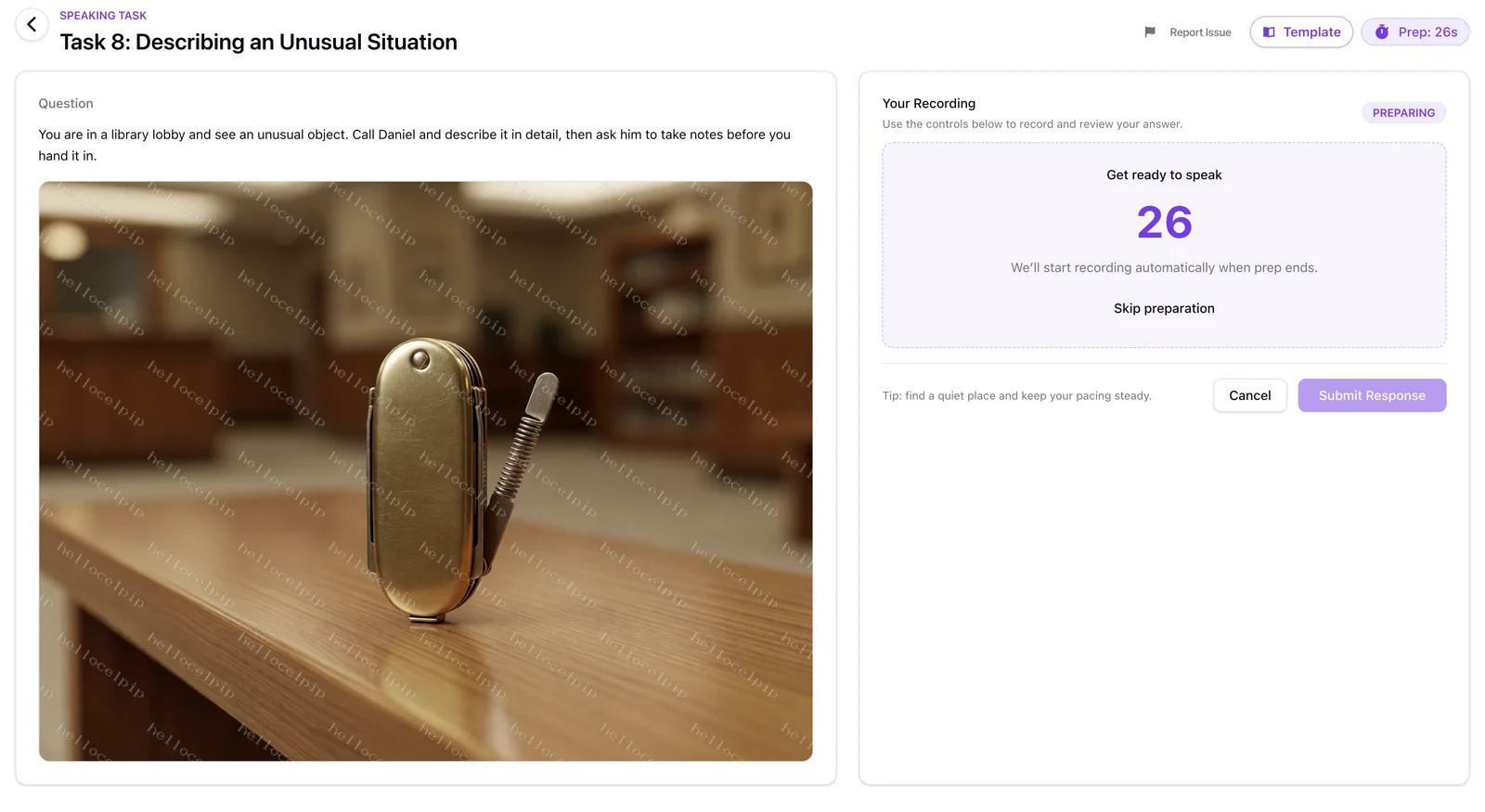
The objects are deliberately hard to name. That is the point of the task: you have to describe something when the obvious word for it is not available to you. Notice that you would struggle to say what the thing above actually is, and that you could still describe it completely.
Try a Speaking Task 8 question →
#Which part of a Task 8 answer do learners actually miss?
The unusual part. Most answers describe the object competently and never explain what is strange about it.
We looked at 15430 anonymised, aggregated Speaking Task 8 responses on HelloCelpip and checked each one against what the task asks for. Our evaluator judged that about 87% framed the answer as a phone call, and about 73% described what makes the object unusual. Only about 34% described it well enough that someone who cannot see it could picture it.
| What the task asks for | Share of responses that did it |
|---|---|
| Described it for someone who cannot see it | about 34% |
| Described what makes it unusual | about 73% |
| Framed it as a phone call | about 87% |
Look at the middle row rather than the lowest one. About one answer in four describes an object and never establishes why it is worth a phone call in the first place. That is the failure specific to this task, and it is invisible to the person making it, because the description itself often sounds perfectly good.
The task is not called Describing an Object. Something has to be odd about it, and saying so out loud is what turns a description into an answer.
The lowest row is a familiar problem: it is the same visibility gap that Task 3 measures, and if you have read our guide on describing a scene, the fix is the same one. Position, size, colour, material, and comparison to something ordinary.
#How do you say what makes something unusual?
Compare it to what you expected. Strangeness is a difference, so it only exists next to something familiar.
| Describing only | Establishing the oddity |
|---|---|
| It is made of brass and has a blade folding out of it. | It looks like an ordinary pocket knife at first, except the blade has no edge on it at all, so it cannot actually cut anything. |
| There is a spring on the side. | There is a small coiled spring sticking out of one side, which is the sort of thing you would expect inside a machine rather than left on the outside where it can catch on something. |
| It is quite small. | It is about the size of a bar of soap, which is far too small for the weight of it. It feels like holding a stone. |
Each right-hand version does the same work: it names an expectation and then breaks it. That is all "unusual" means, and one sentence of it early in the answer satisfies the requirement that a quarter of responses miss.
#A CELPIP Speaking Task 8 template you can adapt
Five short moves. The second one is the whole task, and the last one is the part people forget.
Hi [name], it is [you]. I am at [place] and I have found something I cannot work out, so I wanted to describe it to you.

The strange thing about it is [what breaks the expectation].

It is about [size, compared to something ordinary], made of [material], and [colour]. On the [top or one side] there is [feature one]. Underneath, or at the other end, there is [feature two].

I think it might be [your best guess], but honestly I am not sure.

Could you [the second request in the instruction] before I [what you have been asked to do with it]?
The guess matters more than it looks. Saying what you think it might be shows you can speculate in English, and it gives you a natural sentence when the object genuinely defeats you.
#How should you order the description?
Outside in, largest to smallest. A listener assembling something from words needs the shape before the details.
Start with overall size and material, because those set the scale for everything after. Then take the parts in a fixed physical order: top to bottom, or left to right. Then finish with the small features.
Jumping between details is what makes an answer hard to follow, and difficulty following you is scored under Listenability. A route through the object is worth more than an extra adjective.
#Two worked answers
Both answers below describe the object pictured above, so you can check each detail against the image yourself.
Hi Daniel, I am calling because I found something in the library. It is a brass object and it is quite heavy. It has a metal part sticking out of the side and there is a small round thing on the top. The colour is gold and it looks quite old. There are some scratches on it. I found it on the counter near the entrance and I am going to hand it in at the desk. Can you please write this down? Thanks a lot, bye.
Why it loses marks: nothing here says why this object is worth a phone call. Every detail is accurate and none of them establishes strangeness, so the listener has no idea whether this is a lost lighter or something genuinely puzzling. It is also hard to picture, because there is no size to anchor it and the parts arrive in no particular order.
Hi Daniel, it is me. I am in the library lobby and I have found something I genuinely cannot work out, so I wanted to describe it to you.
The strange thing is that it looks like a pocket knife at first, except the blade that folds out of it has no edge on it at all, so it cannot actually cut anything.
It is about the size of a bar of soap, and it is far heavier than something that small should be, like holding a stone. The body is brass, a dull gold rather than shiny, and it is shaped like a flattened oval standing upright on the counter. Near the top there is a small round stud, like a rivet. Out of the right-hand side there is that blunt metal blade, and next to it a little coiled spring sitting on the outside where you would normally expect it to be hidden inside.
I think it might be some sort of old tool, but honestly I am not sure.
Could you write all that down before I hand it in at the desk?
Why it works: the oddity arrives in the second sentence and is stated as a broken expectation. The size is anchored to a familiar object, the weight is compared to something ordinary, and the description moves in one direction, from the whole shape down to the small parts. The guess is offered honestly, and the second request from the instruction is not forgotten.
#What are the 30 seconds of preparation for?
Finding the one thing that is wrong with the object, and choosing a comparison for its size.
Those two decisions carry most of the answer. Everything else you can generate as you speak, because the object is in front of you and you are simply reading it aloud in order.
If nothing about the object strikes you as strange in the first ten seconds, ask what it looks like it should be, and then what stops it being that. There is always an answer, because these pictures are built that way.
Do not spend the preparation naming the object. You are not expected to know what it is, and the instruction asks you to describe it, not identify it.
#How much do you need to say in 60 seconds?
There is no word requirement, since it is a spoken task. As a guide, Task 8 answers on HelloCelpip average about 130 words across the 60 seconds, which is an ordinary, unhurried pace.
That is enough for the full template: a greeting, the oddity, four or five described features, a guess and the closing request. If you are short of time, cut features rather than the oddity or the request, because those two are the parts being checked.
#What do CELPIP raters listen for?
Every Speaking response is rated in four areas, published in the CELPIP Speaking Performance Standards.
Across more than 12,200 anonymised, aggregated Task 8 responses on HelloCelpip, about a third of everything our evaluator flags is a vocabulary problem, which is the wrong word or a phrase that is not how a native speaker would put it. The other three areas sit close together behind it. Vocabulary matters more here than on most tasks, for a structural reason. When you cannot name a thing, you have to reach for shape, material and comparison instead, and that is precisely the vocabulary being measured. Practising the language of size and texture pays off on this task faster than anywhere else.
#Common Task 8 mistakes
- Never saying what is unusual. About one answer in four describes the object and skips the oddity entirely.
- Trying to name the object. You are not expected to know what it is, and guessing early wastes the description.
- Giving no size. Compare it to something ordinary so the listener has a scale.
- Jumping between details. Move in one direction through the object, and finish each part before starting the next.
- Forgetting it is a phone call. Greet the person, use their name, and close the call properly.
- Dropping the second request. Instructions usually ask you to have them take notes or meet you, and completeness is rated.
- Rushing because it is the last task. Task 8 ends the whole test, and answers here often sound tired. Slow down.
#How to practise Task 8
Practise on ordinary objects with the name removed. Pick something in the room, and describe it in 60 seconds without ever saying what it is. That is the exact skill Task 8 measures, and you do not need a picture to train it.
Then check your recordings for one sentence only: the one that says what is strange. If you cannot find it, that is the quarter of responses our data describes, and it is a one-sentence fix.
#Frequently asked questions
What is CELPIP Speaking Task 8?
How long do you get for CELPIP Speaking Task 8?
What do learners get wrong most often in Task 8?
Do I need to know what the object is?
How is Task 8 different from Task 3?
Should I sound formal on the phone in Task 8?
How many words should a Task 8 answer be?
Confirm the eight Speaking tasks and the 15-minute Speaking section on the official CELPIP Test Format page. Per-task timing of 30 seconds to prepare and 60 seconds to speak is published in CELPIP’s own Speaking Pro study pack, and the four rated areas come from the CELPIP Speaking Performance Standards. Your HelloCelpip level uses the same 0 to 12 CELPIP scale, so you can track real progress between now and test day. Your official score comes from Paragon Testing Enterprises on test day. HelloCelpip is an independent study resource and is not affiliated with CELPIP or Paragon Testing Enterprises.
Official sources:
Last updated: July 27, 2026