
The CELPIP Reading test has four parts and 38 scored questions, and you get about 43 to 56 minutes to finish. The four parts are Reading Correspondence, Reading to Apply a Diagram, Reading for Information, and Reading for Viewpoints, and they get a little harder as you go. This guide shows you what each part looks like, the three question types behind almost every question, and the parts that give learners the most trouble. We can tell you that last part with real numbers, because we looked at how thousands of learners actually do on HelloCelpip.
#What is on the CELPIP Reading test?
CELPIP Reading is fully computer-delivered. It has four parts, and the passages get a little harder as you move through them. Here is the shape of the whole section.
Your 43 to 56 minutes, part by part. The bars are sized by time, and the parts get harder from left to right.
| Part | Name | What you read | Questions | Suggested time |
|---|---|---|---|---|
| 1 | Reading Correspondence | A friendly email, then a short reply with blanks to fill in | 11 | ~11 min |
| 2 | Reading to Apply a Diagram | A diagram (a schedule, flyer, or table) plus a short email about it, with blanks | 8 | ~9 min |
| 3 | Reading for Information | A four-paragraph factual passage; you match facts to the right paragraph | 9 | ~10 min |
| 4 | Reading for Viewpoints | An opinion article with two or more views, then a reader comment with blanks | 10 | ~13 min |
Two things surprise a lot of test-takers:
- Parts 1, 2, and 4 have a second text with blanks. After the main text, you complete a short reply or comment. Each blank is a drop-down with four choices. So you are not only answering questions about the passage. You are also finishing a piece of writing that has to fit it.
- A live test may include extra, unscored questions. They look exactly like the scored ones, so you cannot tell them apart. The safe habit is to treat every question as if it counts.
You can confirm the current format on the official CELPIP Test Format page.
#What are the three CELPIP Reading question types?
Almost every Reading question is one of three types. Once you can spot the type, you know how to look for the answer.
- General meaning is the big picture. It asks about a whole paragraph or the whole text, like the main idea or the writer’s purpose. Read for the general point, not one detail.
- Specific information is one small fact. It asks you to find a single date, name, number, or detail from one sentence. Scan for a keyword and read closely around it.
- Inference is what the text does not say directly. It asks you to work out tone, attitude, or what someone would probably do. Look for clues and opinion words, not a sentence that states the answer.
One habit helps on every type: the answer is almost never in the same words as the text. The test likes to reword things. If a question says "at your earliest convenience" and the passage says "as soon as you can", those match. You are looking for the same idea, not the same words.
#Which question type do learners find hardest?
Inference is the hardest question type, by a clear margin. We looked at more than 150,000 answered Reading questions on HelloCelpip and sorted every question by its type. Learners get inference questions right about 72% of the time, compared with 79% for specific information and 81% for general meaning. Finding a fact on the page is the easier skill. Working out what the writer only suggests is the one that separates scores.
When we look closer, the same skill keeps coming up. The inference questions learners miss most are the ones that ask you to hold a small rule in your head:
| The hardest questions ask you to… | Answered correctly |
|---|---|
| Handle a "not" or "except" (what is not allowed) | 69% |
| Apply a rule to a new case | 73% |
| Track an order or a timing | 75% |
| Notice a condition or exception ("if", "unless") | 76% |
These are all small logic steps. The good news is that they are learnable, and later in this guide we show you how to handle each one.
#Which parts are the hardest, and why?
The parts that lean most on inference are the ones learners find hardest. On HelloCelpip, learners answer 85% of Part 2 questions correctly and 80% of Part 1, but only 70% of Part 3 and 68% of Part 4.
| Reading part | Answered correctly |
|---|---|
| Part 2: Reading to Apply a Diagram | 85% |
| Part 1: Reading Correspondence | 80% |
| Part 3: Reading for Information | 70% |
| Part 4: Reading for Viewpoints | 68% |
This is not a coincidence. Parts 1 and 2 mostly ask you to match facts, a schedule, or a request. Parts 3 and 4 ask you to weigh ideas, follow rules, and read opinions. If your study time is short, this is where to spend it first.
#Does practising actually help?
Yes, and we can see it in the numbers. When we follow learners across their attempts on HelloCelpip, accuracy on a part climbs from about 74% on the first try to about 80% by the fourth, and then it settles. In plain terms, a few focused rounds on a weak part tend to lift your accuracy by several points before it levels off.
One honest note: learners who keep practising are often the more motivated ones, so treat this as a hopeful trend rather than a promise. Still, the direction is clear. Reading is a skill, and it responds to practice.
#What does each part look like?
Below is each Reading part as it appears on HelloCelpip. Our questions follow the exact CELPIP format, so what you practise here is what you will meet on test day. Open any part and try one.
#Part 1: Reading Correspondence
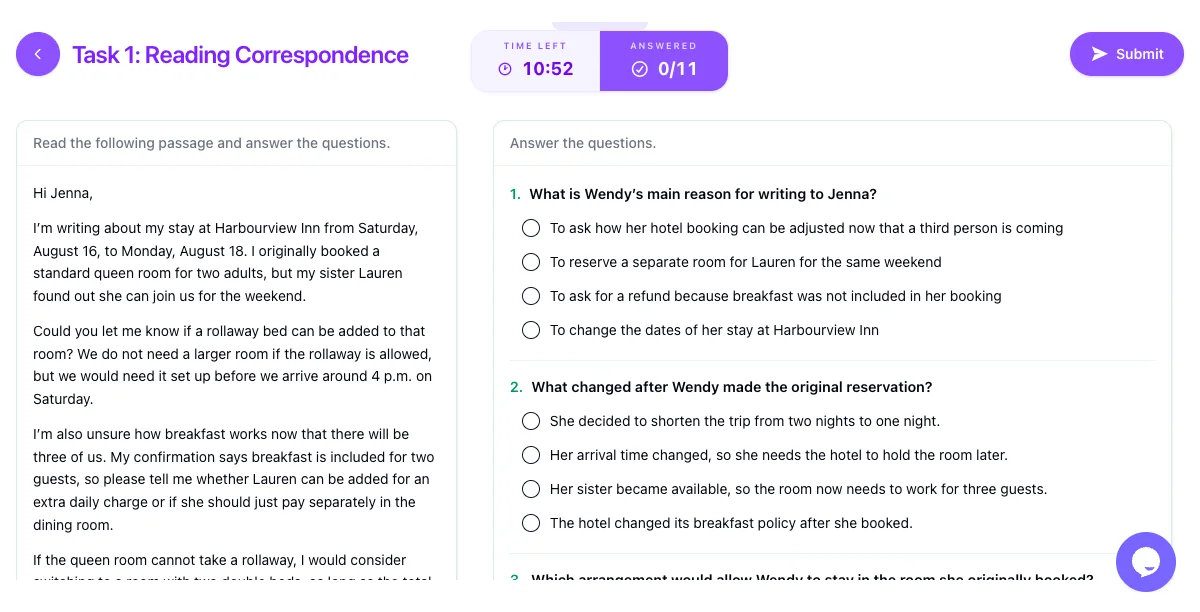
You read a short, friendly email and answer 11 questions about it. Most ask for specific information, like a date, a request, or a detail, with a few inference questions about the writer’s tone or intent. You then finish a short reply, so read for the writer’s purpose, not only single facts. In the screenshot below, the email sits on the left and the questions on the right, with a timer and a progress counter at the top.
#Part 2: Reading to Apply a Diagram
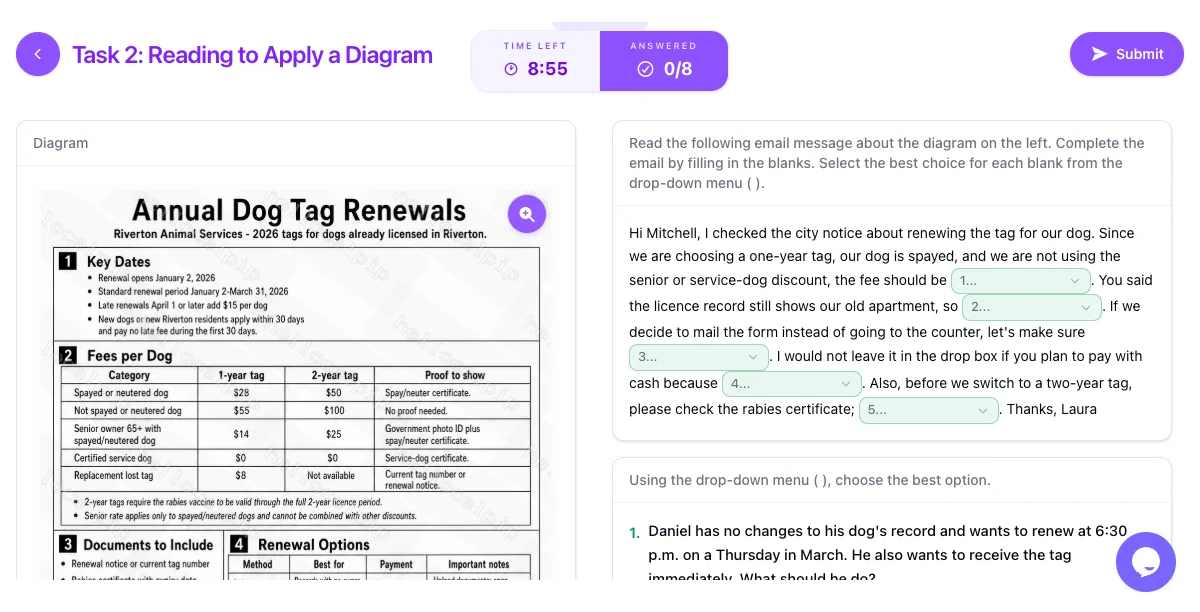
You read a diagram, such as a schedule, flyer, or table, and then a short email about it with drop-down blanks to complete. The questions are mostly specific information, but the detail is split between the diagram and the email. The trick is to read the diagram and its small print first, then use both texts to fill each blank. The screenshot shows the diagram on the left and the email with drop-downs on the right.
#Part 3: Reading for Information
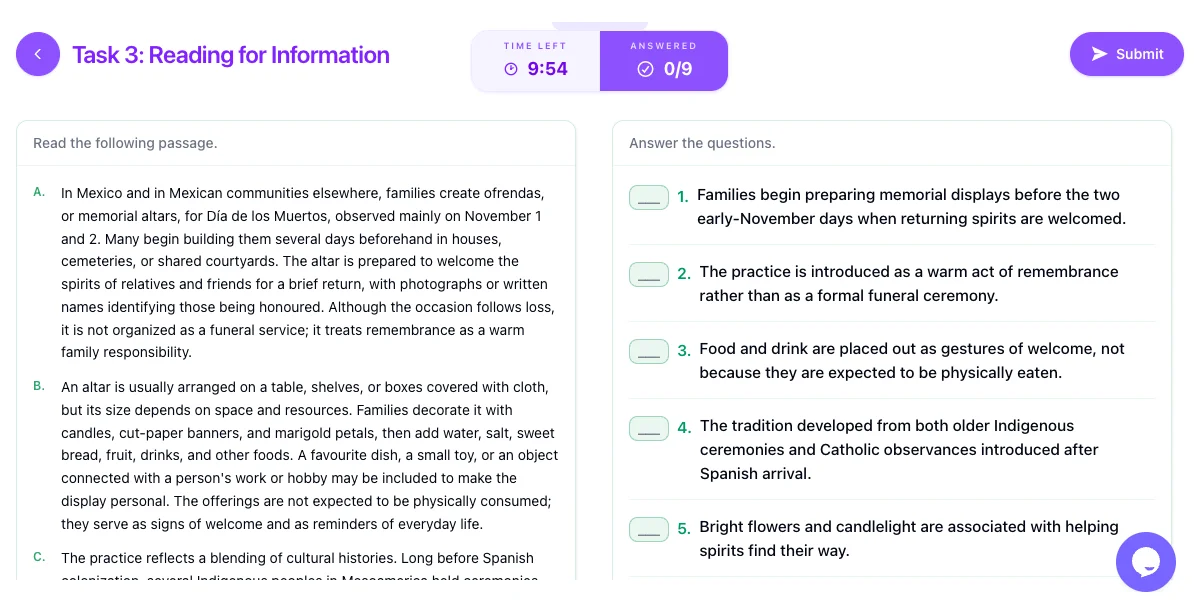
You read a four-paragraph factual passage, labelled A to D, and match each statement to the paragraph that states it. There is also an E, "not given", for statements the passage never makes. This is where careful reading pays off. Only pick a paragraph when the text truly says it, and choose E when it does not. The screenshot shows the passage on the left and the statements to match on the right.
#Part 4: Reading for Viewpoints
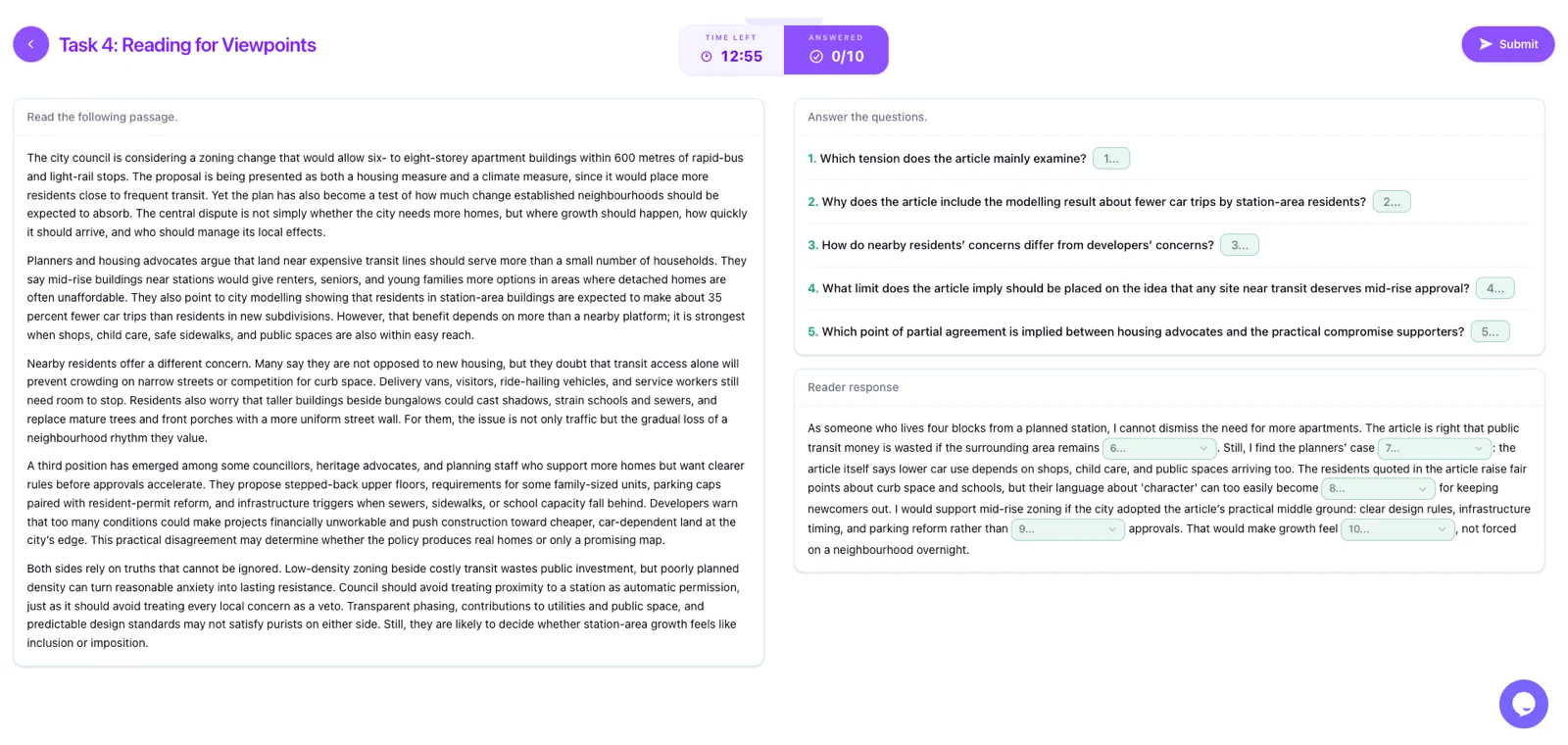
You read an opinion article with two or more points of view, then complete a reader response with drop-down blanks. These questions lean the most on inference. Before you answer, it helps to note who holds each opinion and why. The screenshot shows the article on the left and the questions plus the reader response on the right.
#How to handle each question type
Because inference is where most points are lost, it helps to have a plan for each type before you sit down.
-
General meaningRead the whole paragraph before you look at the options. Ask yourself, in one sentence, what this part is mostly about. Then pick the option that matches that sentence, not a small detail inside it.
-
Specific informationFind a keyword from the question, then scan for it or a reworded version of it. Read the sentence around it slowly. The correct option usually says the same thing in different words.
-
InferenceLook for the clue, then take one small step. Watch for words like not, only, except, if, and unless, because they change the meaning. Be careful of options that sound right but say more than the text supports.
The hardest inference questions, the ones about a "not", a rule, or a timing, all reward the same move: slow down on the small words. A single "except" or "unless" often decides the answer.
#Common traps, and how to avoid them
Wrong options are written to look tempting. These are the traps that catch learners most often on HelloCelpip.
- The reworded answer. The correct option rarely repeats the text word for word. If an option copies the passage exactly, be a little suspicious.
- The nearby detail. An option may use a true fact from the wrong paragraph. Make sure the detail answers this question, not just that it appears in the text.
- The too-strong conclusion. On inference questions, an option may go further than the text allows, using words like always, never, or everyone. Pick the careful option, not the dramatic one.
- The half-right option. One part of the option matches the text and the other part does not. Read the whole option before you choose it.
#How to pace the Reading test
You have about 43 to 56 minutes for 38 questions, which is a little over one minute per question on average. Some questions are quick, and others need care. The per-part times below are a suggested budget, not official limits.
-
Part 1 · about 11 minutesFirst find the writer, the reader, and the purpose. Answer the questions, then complete the reply so it fits the email.
-
Part 2 · about 9 minutesRead the diagram and its small print first. Then read the email and use both texts to fill each blank.
-
Part 3 · about 10 minutesLearn the topic of each paragraph, then scan for each statement. Choose the not-given option only when the text truly does not say it.
-
Part 4 · about 13 minutesNote who holds each opinion before you answer. Watch the opinion and contrast words, then complete the reader response.
#How to study Reading with practice
Doing questions is good. Reviewing them well is what raises your score.
-
First try it without a timerSee what you can get right when you are not rushing. That shows the gap between your reading skill and your speed.
-
Label the type you missedFor each wrong answer, decide if it was general meaning, specific information, or inference. A pattern points you to the exact skill to work on.
-
Drill your weakest typeFor most learners that is inference, especially the negative, rule, and timing questions inside it. Slow down on the small words there.
-
Keep a vocabulary journalWrite down new words from the passages and use them in your own writing and speaking. A bigger vocabulary speeds up every part.
#How HelloCelpip helps you prepare for Reading
HelloCelpip turns this format into focused study. You work through questions in the same computer-delivered style as the real test, across all four parts, and then you see exactly where your points are going. That way, every session targets your weakest spot instead of guessing.
- A large set of Reading questions across all four parts, written in the real test format and set at several levels of difficulty.
- A result on every attempt, mapped to an estimated CELPIP level, so you can see your progress over time.
- Feedback broken down by part and by question type, so your weakest area, usually inference, is clear at a glance.
- Full-length, timed mock tests that recreate the real Reading section from the first question to the last.
A simple way to use it: start with a few Reading questions to find your weakest type, take a full mock test when you want a timed run under real conditions, and check the Reading score chart to see how your level maps to CLB.
#What your Reading score actually means
CELPIP reports Reading as a level from 0 to 12, not a percentage. That level lines up with the Canadian Language Benchmarks (CLB), so a Reading 8 is CLB 8. This matters most if you need Reading for immigration, where programs ask for a certain CLB in each skill.
To see what a score means for your goal, use the Score to CLB calculator, and read the full CELPIP Reading score chart. Requirements change, so always confirm the current one for your program on the official IRCC site.
#CELPIP Reading practice FAQ
Which CELPIP Reading question type is the hardest?
Which CELPIP Reading part is the hardest?
Does practising really improve my reading score?
Are these real CELPIP Reading questions?
How many questions are in CELPIP Reading?
How long is the CELPIP Reading test?
How is CELPIP Reading scored?
Will practising on HelloCelpip prepare me for the real Reading test?
Learn how Reading levels map to CLB in the CELPIP Reading scoring guide.
Confirm current timing, parts, question counts, and unscored-item rules on the official CELPIP Test Format page, and check the CELPIP Score Comparison Chart for CELPIP Level and CLB information. Your HelloCelpip level uses the same 0 to 12 CELPIP scale, so you can track real progress between now and test day. Your official score comes from Paragon Testing Enterprises on test day. HelloCelpip is an independent study resource and is not affiliated with CELPIP or Paragon Testing Enterprises.
Official sources:
Last updated: July 24, 2026