

In CELPIP Reading Part 4, you read an article where people give different opinions. To do well, write down who thinks what, and why, before you answer. Then you answer five questions about the article and fill five blanks in a short reader comment. You have about 13 minutes for all 10 questions.
This guide gives you a simple table for your notes, a rule for every blank, the mistakes that cost the most marks, and one full example.
#What is CELPIP Reading Part 4?
Part 4 is the last part of the Reading test. Its full name is Reading for Viewpoints. A viewpoint is a person's opinion about an issue.
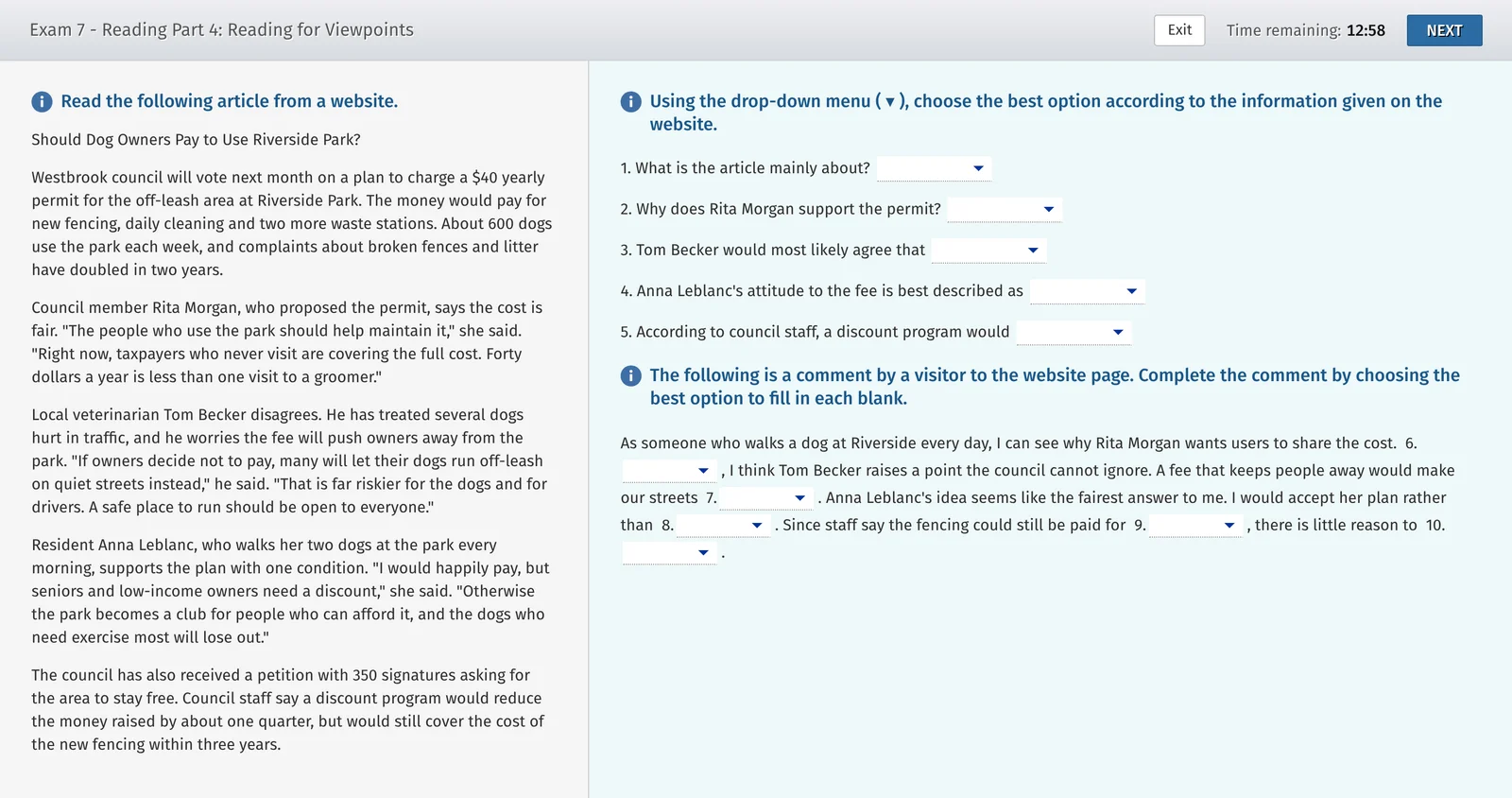
Part 4 has 10 questions and about 13 minutes. Each question has four options. Everything is on one screen. The article is on the left. The questions and the reader comment are on the right.
| What you see | What you do | |
|---|---|---|
| Questions 1 to 5 | A news article about a local issue. Two to four people give their opinion. | Choose the best answer to five questions about the article. |
| Questions 6 to 10 | A short comment from a reader of the article, with five blanks. | Choose the option that completes each blank. |
The article usually starts with one paragraph about the issue, for example a new fee or a building plan. Then it gives the opinions of different people, often with their exact words in quotation marks. Usually one person is for the plan, one is against it, and one is partly for it.
Two rules from the test are important. First, a wrong answer does not lose marks, so answer every question. Second, when the time ends, the test goes to the next part. You cannot go back to Part 4.
#Why is Part 4 the hardest Reading part?
Part 4 has the lowest score of the four Reading parts. On hellocelpip.com, learners answer 66.0% of Part 4 questions correctly, from 271,560 answered Reading questions. In Part 2 they answer 80.3% correctly, in Part 1 78.5%, and in Part 3 68.5%.
The main reason is the type of question. Most Part 4 questions are inference questions. In an inference question, the answer is not written in the text. You must use the clues in the text to find what the person thinks. For example, the article does not say "Tom Becker thinks the fee makes the area less safe". It says he is worried that dogs will run on streets. From that clue, you decide what he would agree with.
When we studied CELPIP's published practice tests, about six of every ten article questions were inference questions. To answer them, you must keep several opinions in your head and connect each opinion to the correct person.
The blanks are the second reason. Many learners think the blanks test grammar or vocabulary. They do not. Usually, all four options are correct grammar. The correct option is the one that agrees with the opinion of the person who wrote the comment.
You can learn to do both of these things. The rest of this guide shows you how.
#How should you use the 13 minutes?
Use this plan. It comes from CELPIP's own Reading study pack, and it is the plan we teach.
-
About 1 minute: read questions 1 to 5Read the questions before the article. Write the names of the people and the key words on your paper. A name is always the same in the text, so it helps you find the correct place quickly.
-
About 3 minutes: read the article and write notesWrite the issue in one line. Then write one line for each person: who they are, what they think, and why. The next section shows you how.
-
About 4.5 minutes: answer questions 1 to 5Use your notes to answer. Then find the correct place in the article to make sure. Check that each answer is about the correct person.
-
About 4 minutes: fill the comment blanksRead all of the comment first. Find what the writer of the comment thinks, and where their opinion changes. Then choose each blank.
-
About 30 seconds: checkMake sure that all 10 questions have an answer. A guess is better than no answer.
In the real test, you cannot highlight text on the screen. Write your notes on paper. Keep them short. They only need to help you remember.
#How do you keep track of who thinks what?
Use an opinion table. An opinion table is a short note with one line for each person in the article. Each line has four parts: the name, the person's role, their opinion, and their reason.
This is the most useful habit for Part 4. The most common wrong answer is a real opinion from the article that belongs to a different person. The table stops this mistake.
Issue: the plan or problem, in one line
| Name | Role | Opinion | Reason |
|---|---|---|---|
| Person 1 | official, owner, expert or resident | for, against or partly | 3 to 5 words |
| Person 2 | role | for, against or partly | 3 to 5 words |
| Person 3 | role | for, against or partly | 3 to 5 words |
Learners often forget the partly opinion, but it is very important. A person is "partly for" or "partly against" in two cases:
- They agree only with a condition, for example "only if" or "as long as".
- They accept one point from the other side, for example "I agree the noise is a problem, but...".
Questions about a person's attitude often test this difference. Attitude means how a person feels about the issue.
The opinion table is our own method. It is not an official CELPIP template. CELPIP's study pack tells you to note who believes what and why. The table gives that advice a simple shape that you can fill quickly.
#A worked example, from start to finish
This example uses the article in the screenshot below. It is our own article, and it has the same format as the real test.
The issue: a $40 yearly fee to use the dog park.
- Rita Morgan | council member | for | park users should pay
- Tom Becker | veterinarian | against | dogs will run on streets
- Anna Leblanc | resident | partly for | only with discounts
Now answer two of the article questions with the table.
Question 3: Tom Becker would most likely agree that…
- A) park users should pay for repairs.
- B) the fee could make the area less safe.
- C) a fee is fine with discounts.
- D) the park should be fenced right away.
How to decide: A is the opinion of Rita Morgan, and C is the opinion of Anna Leblanc. They are real opinions from the article, but they belong to different people. Nobody says D. B is one small step from Becker’s words “far riskier”. The answer is B.
Question 4: Anna Leblanc’s attitude to the fee is best described as…
- A) enthusiastic.
- B) hostile.
- C) cautiously supportive.
- D) indifferent.
How to decide: She says she will pay, so she supports the fee. She also gives a condition, so her support is careful. “Enthusiastic” means very happy, which is too strong. “Hostile” means strongly against, which is the wrong direction. “Indifferent” means she does not care, but she has a clear opinion. The answer is C.
Then fill two blanks in the reader comment.
The comment: “As someone who walks a dog at Riverside every day, I can see why Rita Morgan wants users to share the cost. (6) ____, I think Tom Becker raises a point the council cannot ignore. … I would accept her plan rather than (8) ____.”
Blank 6 options:
- Therefore
- Even so
- For example
- Similarly
How to decide: The writer agrees with Morgan. Then the writer moves to the other side and agrees with Becker. So the blank must show a change of direction. “Therefore” and “Similarly” continue in the same direction. The answer is “Even so”.
Blank 8 options:
- a discount for seniors
- a cleaner park
- a flat fee for everyone
- new waste stations
How to decide: “Rather than” comes before the thing that the writer does not want. The writer accepts Leblanc’s plan, which is a fee with discounts. So the writer does not want the same fee for everyone. “A discount for seniors” is what the writer wants, so it is the wrong direction. The answer is “a flat fee for everyone”.
#How do you answer the five article questions?
First, decide the type of question. Then use the rule for that type. Part 4 uses the same three types of question as the rest of the Reading test.
| If the question asks… | The type is | Do this |
|---|---|---|
| What the article is mainly about, or the best title | General meaning (the big idea) | Say the issue in one sentence first. The correct answer names the disagreement. It does not name only one side or one example. |
| What a person proposes, or what the article says about a fact | Specific information (one fact) | Find the name, then find the sentence. The correct option has the same meaning in different words. |
| What a person would most likely agree with, suggests or feels, or how two opinions are different | Inference (a clue, not a direct answer) | Use your opinion table. Go one small step from what the person said, and no further. Check the name. |
For inference questions, do two checks:
- Is it the correct person? An option that is true for a different person is wrong.
- Is it the correct strength? If a person says a plan "might cause problems", an option that says they want to "ban it immediately" is too strong.
#How do you fill the reader comment blanks?
Read all of the comment before you choose any blank. The writer of the comment often says who they are, for example "As a parent of two". Usually they agree with one person in the article and disagree with another. Often their opinion changes in the middle of the comment. You must know all of this before you choose a blank.
Then do these four steps for each blank.
-
Find who the writer isHow does the issue affect the writer? A dog owner, a shop owner and a parent care about different things.
-
Find where the opinion changesLook for these words: but, however, even so, still, although. Usually, the opinion after these words is the important one.
-
Read the full sentence and the next sentenceThe words after the blank often give the answer. A blank can look positive, but the next sentence can show that it must be negative.
-
Decide what the blank must say, then read the optionsDoes the writer agree or disagree here? Is this something they want or something they do not want? Decide first. Then the options cannot confuse you.
A blank usually has one of four jobs. When you know the job, you know what to look for.
- A linking word, for example "even so", "therefore" or "for example". It must match the direction of the next idea: the same direction, a change of direction, or an example.
- An attitude word, for example "doubtful", "supportive" or "worried". It must match how strongly the writer feels.
- The same opinion in different words. The writer repeats the opinion of a person from the article. The correct option has the same meaning as that person's words, but not the same words.
- The next step in the writer's reasoning. It must follow from the sentence before it.
Some small words show the direction of a blank:
- "Rather than" and "instead of" come before something that the writer does not want.
- "Provided that", "as long as" and "only if" give a condition.
A very common mistake is to choose what the writer wants after "rather than".
#Which mistakes cost the most marks?
The wrong options in Part 4 are made to look correct. These are the mistakes that learners make most often. Each one has a question you can ask yourself.
| Mistake | What it looks like | Ask yourself |
|---|---|---|
| Wrong person | A real opinion from the article, but from a different person. | Who said this? |
| Too strong | Words like all, always, ban or immediately, or a stronger opinion than the person has. | Did they say this, or something softer? |
| One detail as the big idea | You answer a "mainly about" question with one example or one side. | Is this the whole article, or only one paragraph? |
| Same words, wrong meaning | The option repeats words from the article. The correct option uses different words with the same meaning. | Which option has the same meaning? |
| Wrong direction | After "rather than" or "instead of", you choose what the writer wants. | Does the writer want this, or not want it? |
| All or nothing | You choose full agreement or full disagreement, but the writer agrees only partly. | Where is the "but"? |
| Similar attitude words | You mix up words like doubtful and hostile, or careful and unwilling. | How strong is the feeling, and is it for or against? |
| No time | You rush or leave answers empty at the end. | Did the article take more than about 3 minutes? |
Be careful with options that use the same words as the article. In our study of CELPIP's published practice tests, the correct answer was not often the option with the most words from the article. In this part, the same words are often a trap. Choose the option with the same meaning.
#Which words show a person's opinion?
A small group of words shows most of the opinions in Part 4. Learn these words, and you will see quickly when an opinion changes.
Verbs that show how a person speaks: argues, insists, warns, admits, concedes, doubts, questions, welcomes, rejects. "Admits" and "concedes" are the most important. They mean that the person accepts part of the other side. Usually, that person is "partly" in your opinion table.
Words that change the direction of an opinion: however, but, even so, still, nonetheless, although, while, admittedly.
Words that show what a blank must say: "rather than" and "instead of" show something the writer does not want. "Provided that", "as long as", "only if" and "unless" give a condition.
Attitude words, from most against to most for:
| Against | Not sure | For |
|---|---|---|
| hostile (strongly against), opposed, sceptical (does not believe it), doubtful | cautious (careful), undecided, indifferent (does not care) | conditionally supportive (for it, with a condition), supportive, enthusiastic (very happy about it) |
"Indifferent" is often a wrong answer. It means the person does not care at all. A person with a mixed opinion still has an opinion, so they are not indifferent.
#How should you practise Part 4?
Use real Part 4 sets, and practise one skill in each set. You do not need to find your own articles. Every step below uses one Part 4 set on hellocelpip.com.
-
Step 1: Fill the opinion table firstOpen a Part 4 set. Read the article and fill your opinion table on paper before you look at questions 1 to 5. Give yourself 3 minutes.
-
Step 2: Answer from your tableAnswer questions 1 to 5 with your table. Then check each answer in the article. If your table was wrong, find the sentence that you missed.
-
Step 3: Find the direction of each blankBefore you choose an option, read the full comment. Mark the words that change direction, such as but, however, rather than and instead of.
-
Step 4: Learn from each wrong answerAfter the set, read the explanation for each wrong answer. Find your mistake in the mistakes table above. Write it down.
-
Step 5: Add the timerWhen you get most answers correct without a timer, do the next sets in 13 minutes. Then do a full Reading mock test, so you practise Part 4 at the end of the test, when you are tired.
If you make the same mistake two times, practise only that mistake in your next set. For example, if you choose "indifferent" too often, look only at the attitude questions in the next set.
#How hellocelpip.com helps you prepare for Part 4
hellocelpip.com has more than 1,100 Reading Part 4 questions, in over 100 full sets. Each set is in the real CELPIP format: an article with several opinions, five questions, and a reader comment with five blanks.
- More than 100 Part 4 sets, from easy to hard, so you never run out of new articles.
- An explanation for every option, correct and wrong, so you can see why you made a mistake.
- Your score for each type of question, so you can see if inference questions cost you marks.
- Reading mock tests with the real time limits, so you practise Part 4 at the end of the test.
- Full exams with all four skills, the closest practice to test day.
- Ask Alyssa, your AI CELPIP coach, who can go through a wrong answer with you and tell you what to practise next.
Start with a Part 4 set. When you are ready for the real time limit, take a Reading mock test. To see how Part 4 fits with the other three parts, read the CELPIP Reading practice test guide. To go through a wrong answer, use Ask Alyssa, your AI CELPIP coach. She reads your answers and explains what to practise next.
#CELPIP Reading Part 4 FAQ
How many questions are in CELPIP Reading Part 4?
How long do I have for Reading Part 4?
What is an inference question?
Why is Reading Part 4 so hard?
Are the Part 4 blanks a grammar test?
What does rather than mean in a Part 4 blank?
Should I read the questions or the article first?
Can I go back to Part 4 after the time ends?
Confirm the Part 4 format, number of questions and time on the official CELPIP Test Format page and in CELPIP’s own Reading study pack. Your hellocelpip.com level uses the same 0 to 12 CELPIP scale, so you can track real progress between now and test day. Your official score comes from Paragon Testing Enterprises on test day. hellocelpip.com is an independent study resource and is not affiliated with CELPIP or Paragon Testing Enterprises.
Official sources:
Last updated: November 14, 2026