

In CELPIP Reading Part 3, you read a factual passage with four paragraphs, A to D. Then you read nine short statements. For each statement, you choose the paragraph that gives that information. If no paragraph gives it, you choose E, not given. You have about 10 minutes for all nine statements.
This guide gives you a simple map for the four paragraphs and a check for every statement. It also gives a clear rule for E, the mistakes that cost the most marks, and one full example.
#What is CELPIP Reading Part 3?
Part 3 is the third part of the Reading test. Its full name is Reading for Information. The passage gives facts about one subject, for example a place, an object, an event or a person from history. It is for a general reader, not for an expert.
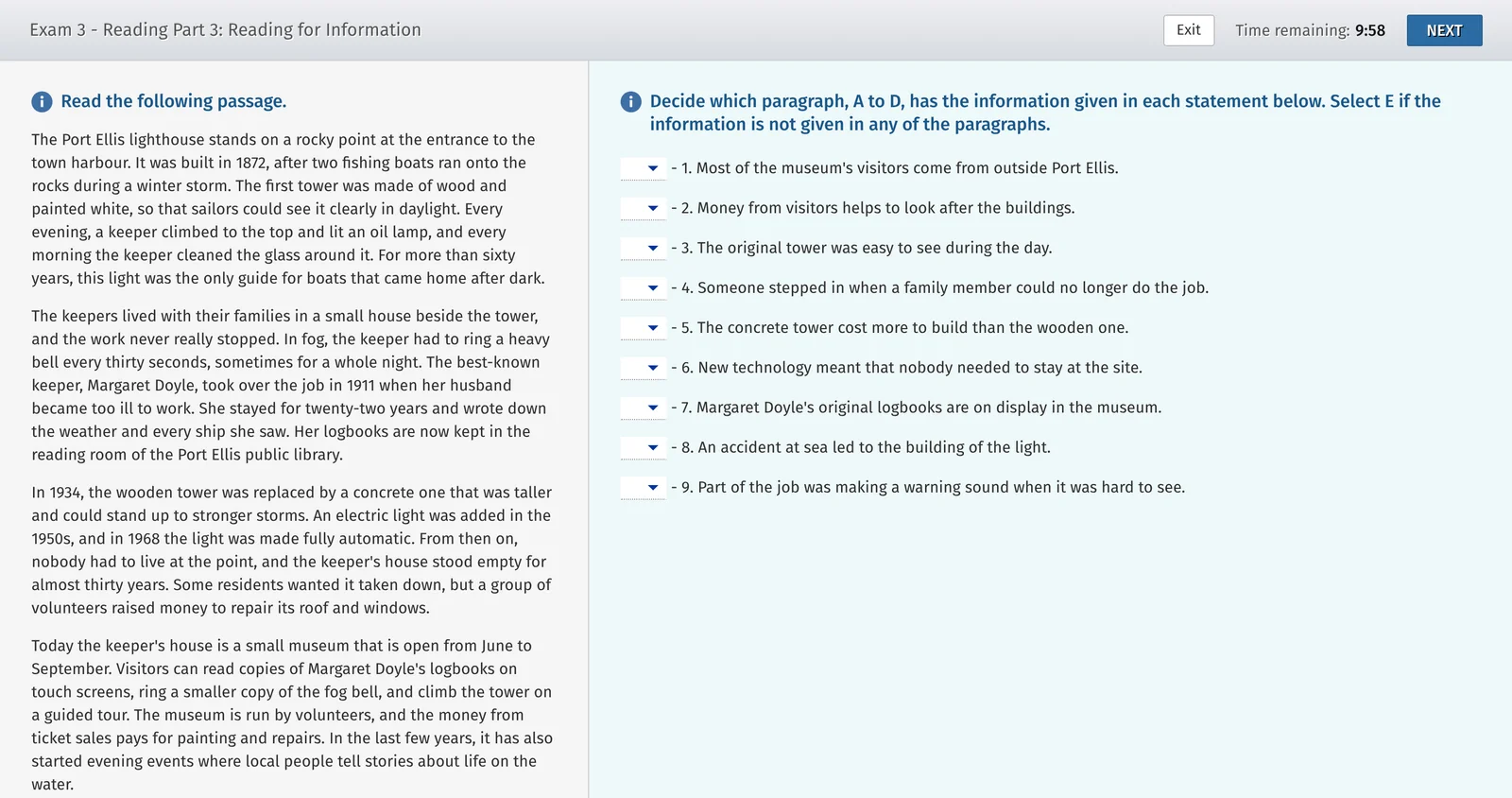
Part 3 has 9 questions and about 10 minutes. Each question is one short statement. Everything is on one screen. The passage is on the left. The statements are on the right, and each statement has a drop-down list with five options.
| What you see | What you do | |
|---|---|---|
| The passage | Four paragraphs, labelled A, B, C and D. Each paragraph is about one part of the same subject. | Learn the topic of each paragraph. |
| Questions 1 to 9 | Nine short statements, in a random order. | For each statement, choose the paragraph that gives the information: A, B, C or D. If no paragraph gives it, choose E. |
Part 3 is the only Reading part with five options. The fifth option, E, means "the information is not given in any of the paragraphs". In this guide we call it not given. On hellocelpip.com, the drop-down list shows E as “Not stated in the reading”. It means the same thing.
E is a real answer. A set is one passage with its nine statements. On hellocelpip.com, E is correct for some statements in every set.
Two rules from the test are important. First, a wrong answer does not lose marks, so answer every statement. Second, when the time ends, the test goes to the next part. You cannot go back to Part 3.
#Why is Part 3 hard?
Part 3 is the second-hardest of the four Reading parts. On hellocelpip.com, learners answer 68.5% of Part 3 questions correctly. In Part 2 they answer 80.3% correctly, in Part 1 78.5%, and in Part 4 66.0%.
There are three reasons.
1. The statements use different words. A statement almost never copies the paragraph. It gives the same meaning in other words, and often in a more general way. For example, the paragraph says "two fishing boats ran onto the rocks", and the statement says "an accident at sea". If you look only for the same words, you will often choose the wrong paragraph.
2. The four paragraphs are about the same subject. Several paragraphs can mention the same person, place or thing. So two or three paragraphs can look correct. Only one paragraph gives all of the information in the statement.
3. Option E is difficult in two directions. Some learners choose a paragraph when the information is not really there. Other learners choose E when the information is there, but in different words. Both mistakes are common.
Many Part 3 statements are inference questions. An inference question asks about something the text does not say directly. You use clues in the text to work it out. In Part 3, you use the clues to decide if a paragraph gives the statement. You can learn to do this. The rest of this guide shows you how.
#How should you use the 10 minutes?
Use this plan. It comes from CELPIP's own Reading study pack, and it is the plan we teach.
-
About 1 minute: make a paragraph mapRead the passage quickly. For each paragraph, write its topic on your paper in three to five words. The next section shows you how.
-
About 8.5 minutes: match the statementsFor each statement, use your map to find the most likely paragraph. Then read that paragraph carefully. Check that it gives every part of the statement. If no paragraph does, choose E.
-
About 30 seconds: checkMake sure that all 9 statements have an answer. A guess is better than no answer.
You spend most of the time on the statements, not on the passage. Do not try to remember all the details in the passage. Your map tells you where to look. Then you read only that paragraph carefully.
In the real test, you cannot highlight text on the screen. Write your map on paper. Keep it short.
#How do you make a paragraph map?
A paragraph map is a short note with one line for each paragraph. Each line has the paragraph letter and its topic in three to five words. The topic is what the paragraph is mainly about.
This is the most useful habit for Part 3. The statements come in a random order, so you must find the correct paragraph quickly every time. The map does this for you. It also helps with E. If the topic is on your map but the detail is in no paragraph, the answer is E.
Subject: what the whole passage is about, in a few words
| Paragraph | Topic | Key names, numbers or dates |
|---|---|---|
| A | 3 to 5 words | names or dates, if any |
| B | 3 to 5 words | names or dates, if any |
| C | 3 to 5 words | names or dates, if any |
| D | 3 to 5 words | names or dates, if any |
Often, the paragraphs follow a simple order. For example, the first paragraph says how something started, the next ones say how it changed, and the last one says how it is today. When you see this order, your map is easy to write.
The paragraph map is our own method. It is not an official CELPIP template. CELPIP's study pack tells you to learn the topic and main idea of each paragraph first. The map gives that advice a simple shape that you can fill quickly.
#How do you check a statement?
A statement is correct for a paragraph only if the paragraph gives every part of it. A paragraph that is about the same topic is not enough.
So before you choose, break the statement into its parts. Most statements have a who or what, an action, and one detail. The detail can be an amount, a comparison, a cause or a time. The detail is often the part that decides the answer.
| Part of the statement | Ask yourself | Words that often show it |
|---|---|---|
| Who or what | Is it the same person or thing? | a name, the first tower, the museum |
| Action | Does the paragraph say this happened? | built, replaced, helped, stopped |
| Amount | Is it the same amount, or is it stronger? | all, most, only, never, always |
| Comparison | Does the paragraph really compare the two things? | more, less, cheaper, better than |
| Cause | Does the paragraph say that one thing caused the other? | because, so, led to, as a result |
| Time | Is it the same time or the same order? | first, later, today, after, until |
If every part is in one paragraph, choose that paragraph. If one part is missing from all four paragraphs, the answer is E. If the passage says something different about one part, the answer is also E, because the paragraph does not give the statement.
A paragraph can show a cause without the word “because”. If the paragraph gives one event as the only reason for the next event, that is enough.
#When is the answer E, not given?
Choose E when no paragraph gives the full statement. There are two kinds of E statement. When you know them, E becomes much easier.
| Kind of E statement | What it looks like | How to spot it |
|---|---|---|
| A detail that is never given | The statement is about the correct topic, but it adds a fact that the passage does not give. For example, a cost, a reason, a number of people, or what most people do. | The topic is on your map, but the detail is in no paragraph. Do not use what you already know. Use only the text. |
| A statement that is too strong or wrong | The statement compares two things, says one thing caused another, or uses "all", "only" or "most", but the passage does not. Or the passage says something different. | Look for comparison, cause and amount words. Then check if the paragraph really says them. |
Both kinds look correct on purpose. The statement uses names and words from the passage, so it feels familiar. A familiar word is not proof. Check every part.
E is a normal answer, and it can be correct for more than one statement in a set. Do not avoid it, and do not choose it only because a statement uses different words. Choose E when your check shows that no paragraph gives the full statement.
#A worked example, from start to finish
This example uses the lighthouse passage in the screenshot below. It is our own passage, and it has the same format as the real test.
Subject: the Port Ellis lighthouse.
- A | why it was built | 1872, wooden tower, oil lamp
- B | the keepers and their work | fog bell, Margaret Doyle, logbooks in library
- C | new tower, then no keeper | 1934 concrete, 1968 automatic, volunteers
- D | the museum today | June to September, tickets, evening events
Now match four statements. Two have a paragraph as the answer, and two are E.
Statement 8: An accident at sea led to the building of the light.
How to decide: The word “accident” is in no paragraph. But the map says paragraph A is about why the lighthouse was built. Paragraph A says it was built “after two fishing boats ran onto the rocks during a winter storm”. Boats on the rocks are an accident at sea. The paragraph gives no other reason for the building, so the accident is the reason. The answer is A.
Statement 6: New technology meant that nobody needed to stay at the site.
How to decide: Paragraph B talks about the keepers who lived there, so B looks possible. But B does not say why the keepers stopped. Paragraph C says the light became “fully automatic” and “from then on, nobody had to live at the point”. An automatic light is the new technology. Every part of the statement is in C. The answer is C.
Statement 5: The concrete tower cost more to build than the wooden one.
How to decide: Paragraph C is about the concrete tower. It says the new tower was “taller” and “could stand up to stronger storms”. It says nothing about cost. No other paragraph gives the cost of either tower. This statement adds a comparison that the passage never makes. The answer is E.
Statement 7: Margaret Doyle’s original logbooks are on display in the museum.
How to decide: This statement is a trap, because two paragraphs talk about the logbooks. Paragraph D says visitors read copies of the logbooks on touch screens. Paragraph B says the logbooks are kept in the public library. So the passage says the originals are not in the museum. One part of the statement (“original”) is wrong. The answer is E.
Here are all nine answers: 1 E, 2 D, 3 A, 4 B, 5 E, 6 C, 7 E, 8 A, 9 B. The order is random, as in the real test. In this set, E is correct three times, and each paragraph is correct once or twice. The other five statements work like this:
- Statement 1 says that most visitors come from outside the town. The passage never says where the visitors come from. It is a detail that is never given, so the answer is E.
- Statement 2 says money from visitors helps to look after the buildings. Paragraph D says ticket money pays for painting and repairs, so the answer is D.
- Statement 3 says the original tower was easy to see during the day. Paragraph A says the wooden tower was painted white so sailors could see it in daylight, so the answer is A.
- Statement 4 says someone stepped in when a family member could no longer do the job. Paragraph B says Margaret Doyle took over when her husband became too ill to work, so the answer is B.
- Statement 9 says part of the job was making a warning sound when it was hard to see. Paragraph B says the keeper rang a bell in fog, so the answer is B.
#How do you match statements that use different words?
Look for the same meaning, not the same words. In Part 3, the statement and the paragraph often say the same thing in different ways. These are the most common changes.
| The paragraph says | The statement says | The change |
|---|---|---|
| two fishing boats ran onto the rocks | an accident at sea | A specific event becomes a general idea. |
| she took over the job in 1911 when her husband became too ill to work | someone stepped in when a family member could no longer do the job | Names become general words. |
| in fog, the keeper had to ring a heavy bell | making a warning sound when it was hard to see | One example becomes the purpose of the action. |
| money from ticket sales pays for painting and repairs | money from visitors helps to look after the buildings | Two details become one general phrase. |
The statement is often more general than the paragraph. So when you read a statement, ask: "What would this look like as a real example?" Then look for that example in the paragraph that your map points to.
Be careful with the opposite trap. A statement can repeat many words from one paragraph and still be wrong for it. Statement 7 in the example uses "Margaret Doyle", "logbooks" and "museum". All three are in the passage. But the statement is still E, because the museum has only copies of the logbooks.
#Which mistakes cost the most marks?
The wrong options in Part 3 look correct on purpose. These are the mistakes that learners make most often. Each one has a question that you can ask yourself.
| Mistake | What it looks like | Ask yourself |
|---|---|---|
| Same topic, missing part | You choose a paragraph about the correct topic, but it does not give the detail in the statement. | Does this paragraph give every part? |
| Same words, wrong paragraph | You choose the paragraph that repeats the words of the statement. | Is the meaning the same, or only the words? |
| E because of different words | The paragraph gives the information in different words, but you choose E. | What would this statement look like as an example? |
| Too strong | The statement says all, only, most, always or never, but the paragraph is weaker. | Is it the same amount? |
| A comparison or cause that is not there | The statement says more, cheaper or because, but the paragraph does not compare or give a cause. | Does the paragraph really say this? |
| What you already know | You know the statement is true in real life, so you choose a paragraph. | Does this passage say it? |
| Order | You expect statement 1 to be paragraph A, statement 2 to be B, and so on. | The order is random. Did I use my map? |
| No time | You read every paragraph again for every statement, and you do not finish. | Did I make a map in the first minute? |
#How should you practise Part 3?
Use real Part 3 sets, and practise one skill in each set. You do not need to find your own passages. Every step below uses one Part 3 set on hellocelpip.com.
-
Step 1: Make the paragraph map firstOpen a Part 3 set. Read the passage. Write your map on paper. Do not look at the statements yet. Give yourself 1 minute.
-
Step 2: Match with the mapUse your map to choose a paragraph for each statement. Then read that paragraph. Check every part of the statement.
-
Step 3: Find the E statementsFor each E answer, say which kind it is: a detail that is never given, or a statement that is too strong or wrong. If you cannot say which kind, check the paragraphs again.
-
Step 4: Learn from each wrong answerAfter the set, read the explanation for each wrong answer. Find your mistake in the mistakes table above. Write it down.
-
Step 5: Add the timerWhen you get most answers correct without a timer, do the next sets in 10 minutes. Then do a full Reading mock test, so you practise Part 3 after Parts 1 and 2.
If you make the same mistake two times, practise only that mistake in your next set. For example, you may often choose E when the answer is a paragraph. Then, before you choose E, ask what the statement would look like as a real example. Look for that example in the paragraph.
#How hellocelpip.com helps you prepare for Part 3
hellocelpip.com has more than 1,000 Reading Part 3 questions, in over 100 full sets. Each set is in the real CELPIP format: a passage with four paragraphs, nine statements, and an E option for information that is not given.
- More than 100 Part 3 sets, from easy to hard, about many different subjects, so you never run out of new passages.
- An explanation for every option, correct and wrong, so you can see why a paragraph does or does not give the information.
- Your score for each type of question, so you can see if inference questions cost you marks.
- Reading mock tests with the real time limits, so you practise Part 3 in its real place in the test.
- Full exams with all four skills, the closest practice to test day.
- Ask Alyssa, your AI CELPIP coach, who can go through a wrong answer with you and tell you what to practise next.
Start with a Part 3 set. When you are ready for the real time limit, take a Reading mock test. To see how Part 3 fits with the other three parts, read the CELPIP Reading practice test guide. For the part that comes next, read the Reading Part 4 guide. To go through a wrong answer, use Ask Alyssa, your AI CELPIP coach. She reads your answers and explains what to practise next.
#CELPIP Reading Part 3 FAQ
How many questions are in CELPIP Reading Part 3?
How long do I have for Reading Part 3?
What does E mean in Reading Part 3?
Can E be the answer more than once?
What is an inference question?
Are the statements in the same order as the paragraphs?
Should I read the statements or the passage first?
Can I go back to Part 3 after the time ends?
Confirm the Part 3 format, number of questions and time on the official CELPIP Test Format page and in CELPIP’s own Reading study pack. Your hellocelpip.com level uses the same 0 to 12 CELPIP scale, so you can track real progress between now and test day. Your official score comes from Paragon Testing Enterprises on test day. hellocelpip.com is an independent study resource and is not affiliated with CELPIP or Paragon Testing Enterprises.
Official sources:
Last updated: November 14, 2026