

In CELPIP Reading Part 1, you read a message, usually an email. Then you answer six questions about it. After that, you read a short reply to the message and fill five blanks in it. You have about 11 minutes for all 11 questions.
To do well, find four things before you answer: who writes, to whom, why, and what they ask for. This guide shows you how to find them. It also gives a rule for numbers, a method for the reply, the mistakes that cost the most marks, and one full example.
#What is CELPIP Reading Part 1?
Part 1 is the first part of the Reading test. Its full name is Reading Correspondence. Correspondence means letters and emails that people send to each other.
Part 1 has 11 questions and about 11 minutes. Each question has four options. Everything is on one screen. The message is on the left. The questions and the reply are on the right.
| What you see | What you do | |
|---|---|---|
| Questions 1 to 6 | A short message, usually an email or a letter. | Choose the best option to complete each sentence about the message. |
| Questions 7 to 11 | A short reply to the message, from the person who received it. The reply has five blanks. | Choose the option that completes each blank. |
Most questions are sentence completions. A sentence completion is the start of a sentence, for example "Emily is writing mainly to". You choose the option that ends the sentence correctly.
A set is one message with its reply and its 11 questions. The greeting is the first line of a message, for example “Dear Mr. Thompson”. The sign-off is the last line, with the writer’s name. Some messages are friendly, for example a note to a neighbour. Others are formal, for example a complaint to a building manager or a letter from a company. Do not expect every message to be friendly.
Two rules from the test are important. First, a wrong answer does not lose marks, so answer every question. Second, when the time ends, the test goes to the next part. You cannot go back to Part 1.
#Is Part 1 easy?
Part 1 is one of the two easier Reading parts, but learners still lose marks in it. On hellocelpip.com, learners answer 78.5% of Part 1 questions correctly. In Part 2 they answer 80.3% correctly, in Part 3 68.5%, and in Part 4 66.0%.
Part 1 is the first part of the Reading test, so a good start helps you stay calm for the rest. And because it is one of the easier parts, every mark you lose here is a mark that was easy to keep.
Learners lose most Part 1 marks in three places:
- Options that use words from the message. Wrong options can use words from the message too. So the option with the same words is not always correct. You must choose by meaning.
- Inference questions. An inference question asks about something the text does not say directly. You use clues in the text to work it out. In Part 1, these questions ask, for example, why the writer mentions a detail, or what will most likely happen next.
- The reply blanks. The reply answers the points in the message. Learners often choose an option that fits the sentence but does not agree with the message.
#How should you use the 11 minutes?
Use this plan. The order comes from CELPIP's own Reading study pack, and it is the plan we teach.
-
About 30 seconds: find the four thingsLook at the greeting, the first paragraph, the last paragraph and the sign-off. Find who writes, to whom, why, and what they ask for. The section about the message card shows you how.
-
About 1.5 minutes: read the message and questions 1 to 6Read the message. Then read questions 1 to 6. Write the key words on your paper. Key words are the few words that show what a question asks about, for example a name, a time or a place.
-
About 4 minutes: answer questions 1 to 6For each question, find the correct place in the message. Check the meaning of each option, not only its words.
-
About 4.5 minutes: fill the reply blanksRead all of the reply first. Then, for each blank, find the point in the message that the reply answers.
-
About 30 seconds: checkMake sure that all 11 questions have an answer. A guess is better than no answer.
Notice that the plan gives the reply more time than questions 1 to 6. The five blanks need you to look back at the message, and that takes time. Do not spend all your time on the first six questions.
In the real test, you cannot highlight text on the screen. Write your notes on paper. Keep them short.
#How do you find who writes, to whom and why?
Use a message card. A message card is a short note with four lines: the writer, the reader, the purpose, and the request. The purpose is the reason for the message. The request is what the writer asks the reader to do.
This is the most useful habit for Part 1. A question can ask why the person is writing. Other questions, and the reply blanks, also depend on the purpose and the request. If you know these four things, many questions become easy.
| Line | Your note | Where to look |
|---|---|---|
| Writer | name and role, for example tenant or customer | The sign-off at the end |
| Reader | name and role, for example manager or friend | The greeting at the start |
| Purpose | why they write, in a few words | The first paragraph, often after “I am writing about” |
| Request | what they ask the reader to do | The last paragraphs, often a question or “could you” |
Be careful with the purpose. The first paragraph often gives the topic, for example a repair. But the purpose is often what the writer wants, for example help with a problem that the repair causes. The request near the end usually shows the real purpose.
The message card is our own method. It is not an official CELPIP template. CELPIP's study pack tells you to find the writer, the reader, the purpose and any request first. The card gives that advice a simple shape that you can fill quickly.
#A worked example, from start to finish
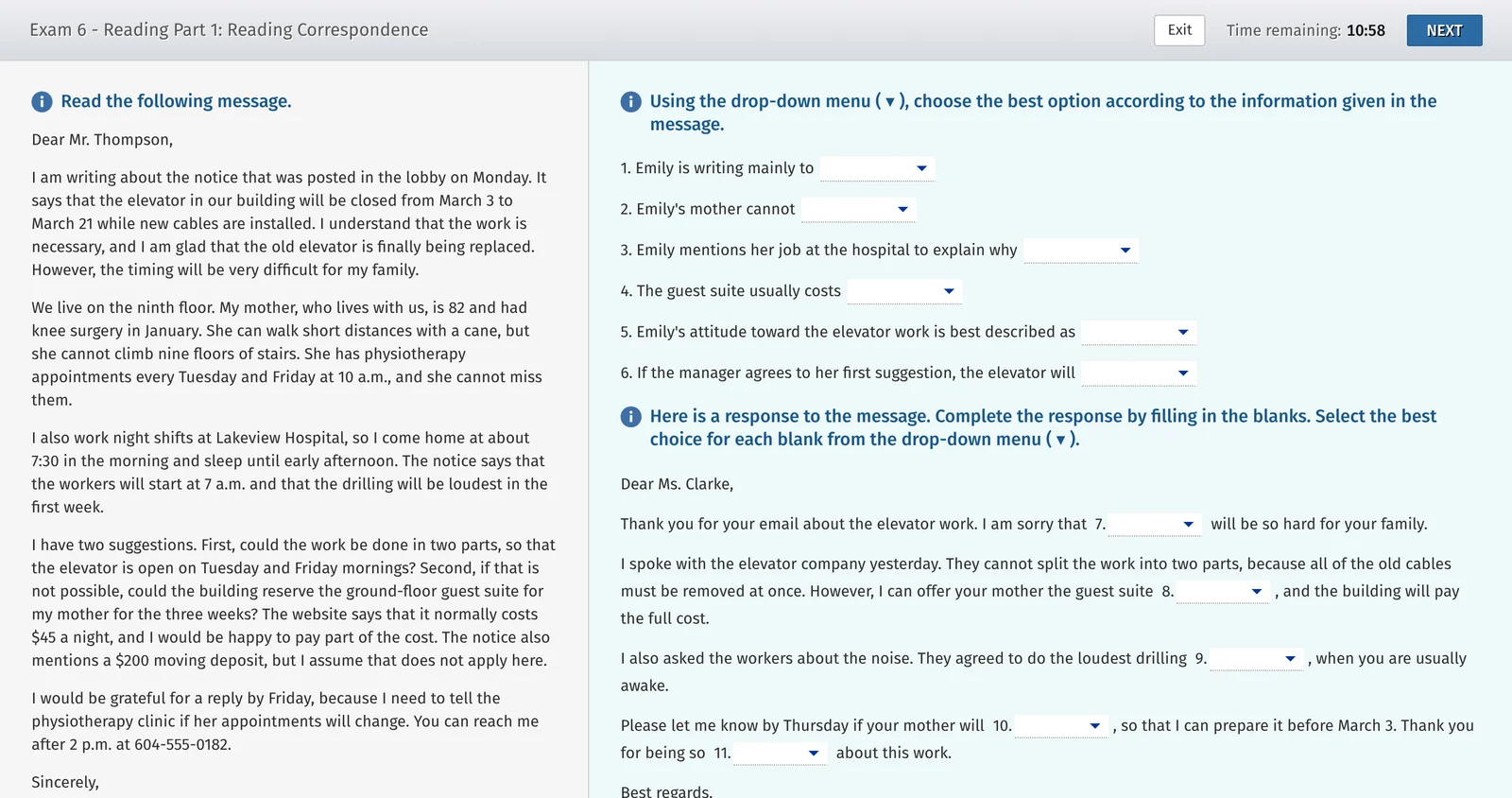
This example is one CELPIP Reading Part 1 set, from start to finish. It uses the email in the screenshot below. It is our own email, and it has the same format as the real test.
In the email, Emily Clarke writes to Mr. Thompson, the building manager. The elevator in her building will be closed from March 3 to March 21. Her mother, who is 82, cannot climb the stairs to the ninth floor, and Emily works night shifts. She asks for two things: keep the elevator open on Tuesday and Friday mornings, or let her mother stay in the ground-floor guest suite.
- Writer: Emily Clarke, a resident in Unit 905
- Reader: Mr. Thompson, the building manager
- Purpose: the elevator repair is a problem for her family
- Request: keep the elevator open on two mornings, or give her mother the guest suite
Now answer two of the message questions in the Part 1 example with the card.
Question 1: Emily is writing mainly to…
- A) complain about noisy workers.
- B) ask for help with a problem the repair creates.
- C) cancel her mother’s appointments.
- D) ask why the elevator is being replaced.
How to decide: The card says her purpose is a problem for her family, and her request is two suggestions. That is asking for help. She mentions the noise, but only as one detail, so A is too small. She wants to keep the appointments, not cancel them, so C is the opposite. She says the work is necessary, so D is wrong. The answer is B.
Question 6: If the manager agrees to her first suggestion, the elevator will…
- A) open on two mornings each week.
- B) stay closed for 21 days.
- C) be repaired after March 21.
- D) be used only by the workers.
How to decide: This is an inference question. It asks what will most likely happen next. Find her first suggestion: do the work in two parts, so that the elevator is open on Tuesday and Friday mornings. Tuesday and Friday are two mornings each week. B is the plan in the lobby notice, not her suggestion. C and D are not in the message. The answer is A.
Then fill two blanks in the reply from Mr. Thompson, the building manager.
The reply, first blank: “I am sorry that (7) ____ will be so hard for your family.”
Blank 7 options:
- the new cables
- the cost of the suite
- the timing of the work
- your night shifts
How to decide: Find the point in Emily’s email that this sentence answers. In her first paragraph she wrote that the work is necessary, but “the timing will be very difficult for my family.” The manager repeats her point. The new cables are the reason for the work, not the problem. Her night shifts are one detail, not the whole problem. The answer is “the timing of the work”.
The reply, later: “They agreed to do the loudest drilling (9) ____, when you are usually awake.”
Blank 9 options:
- in the early morning
- after 2 p.m.
- on Tuesdays and Fridays
- before 7 a.m.
How to decide: The words after the blank say “when you are usually awake”. Emily comes home at about 7:30 in the morning and sleeps until early afternoon. She says people can call her after 2 p.m. The workers start at 7 a.m., so “before 7 a.m.” is not possible. “In the early morning” is when she sleeps, so that option gives the opposite of what she wants. The answer is “after 2 p.m.”
#How do you answer questions 1 to 6?
First, decide the type of question. Then use the rule for that type. Part 1 uses the same three types of question as the rest of the Reading test.
| If the question asks… | The type is | Do this |
|---|---|---|
| Why the person is writing, or what the message is mainly about | General meaning (the big idea) | Use your message card. The correct answer matches the purpose and the request, not one detail. |
| A fact, a time, a place or an amount | Specific information (one fact) | Find the key word in the message. Read the full sentence around it. The correct option has the same meaning, often in different words. |
| Why a detail is mentioned, how the writer feels, or what will most likely happen | Inference (a clue, not a direct answer) | Read the sentences before and after the clue. Go one small step from what the text says, and no further. |
#Numbers: check what each number belongs to
Number questions in Part 1 look easy, but they have a trap. A message can have several numbers, and a wrong option can use another number from the same message. So do not choose a number only because you saw it in the text. Check what the number belongs to.
This table shows the main numbers in the worked example, Emily Clarke’s email about the elevator repair, and what each one belongs to. Question 4 asks how much the guest suite usually costs.
| Number in the message | What it belongs to |
|---|---|
| March 3 to March 21 | the dates when the elevator is closed |
| 82 | the age of Emily’s mother |
| 10 a.m. | the time of the physiotherapy appointments |
| 7 a.m. | when the workers start |
| $45 a night | the normal cost of the guest suite (the answer to question 4) |
| $200 | a moving deposit, which Emily thinks does not apply |
The options for question 4 are "$200 a night", "$45 a night", "$200 for three weeks" and "nothing for residents". Two options use the $200 from the moving deposit. The answer is "$45 a night".
#How do you fill the reply blanks?
In CELPIP Reading Part 1, read all of the reply before you choose any blank. The reply is from the person who received the message. In the worked example, Mr. Thompson, the building manager, answers Emily Clarke’s email about the elevator repair. Each part of the reply answers a point in the message: a question, a problem or a suggestion.
So for each blank, do these four steps.
-
Find the point that the sentence answersWhich question, problem or suggestion from the message does this sentence answer? Go back to that place in the message.
-
Read the words after the blankThe rest of the sentence often gives the answer. In the example, the words when you are usually awake decide blank 9.
-
Decide what the blank must sayIs it a time, an amount, a thing, or a feeling? Does the reply say yes or no to the point? Decide this before you read the options.
-
Check the option against the messageThe correct option agrees with the facts in the message. An option can fit the grammar and still be wrong.
Some blanks ask about a person’s feelings or attitude. Attitude means how a person feels about something. In the example, blank 11, the manager describes Emily’s attitude. Blank 11 says "Thank you for being so ____ about this work." Emily said that the work is necessary and gave helpful suggestions. So the answer is "understanding", not "demanding" or "surprised".
#Which mistakes cost the most marks?
The wrong options in Part 1 look correct on purpose. These are the mistakes that learners make most often. Each one has a question that you can ask yourself.
| Mistake | What it looks like | Ask yourself |
|---|---|---|
| Same words, wrong meaning | You choose the option that uses words from the message. | Does this option have the same meaning as the message? |
| Topic instead of purpose | For "writing mainly to", you choose the topic, for example the repair, not what the writer wants. | What does the writer ask for? |
| Wrong number | You choose a number that is in the message but belongs to something else. | What does this number belong to? |
| One detail as the big idea | You answer a "mainly" question with one small detail. | Is this the whole message, or one sentence? |
| Too far | For an inference question, you choose an option that goes far beyond the text. | Is this one small step from the text? |
| Blank that fits the grammar only | The option makes a correct sentence but does not agree with the message. | Which point in the message does this answer? |
| Wrong direction (the opposite) | You choose the opposite of what the message says, for example a time when the writer is asleep. | Does the writer want this, or not want it? |
| No time for the reply | You spend too long on questions 1 to 6 and rush the five blanks. | Did I keep about 4.5 minutes for the reply? |
#How should you practise Part 1?
Use real Part 1 sets, and practise one skill in each set. You do not need to find your own emails. Every step below uses one Part 1 set on hellocelpip.com.
-
Step 1: Make the message card firstOpen a Part 1 set. Read the greeting, the first paragraph, the last paragraph and the sign-off. Write your message card on paper. Give yourself 30 seconds.
-
Step 2: Answer questions 1 to 6Answer with your card and the message. For each number question, check what the number belongs to.
-
Step 3: Link each blank to the messageFor each reply blank, write the paragraph of the message that it answers. Then choose the option.
-
Step 4: Learn from each wrong answerAfter the set, read the explanation for each wrong answer. Find your mistake in the table in the section about the mistakes that cost the most marks. Write it down.
-
Step 5: Add the timerWhen you get most answers correct without a timer, do the next sets in 11 minutes. Then do a full Reading mock test. A mock test is a practice test with all four Reading parts and the real time limits.
If you make the same mistake two times, practise only that mistake in your next set. For example, if you often choose the wrong number, make a quick list of the numbers for every set before you answer.
#How hellocelpip.com helps you prepare for Part 1
hellocelpip.com has more than 1,300 Reading Part 1 questions, in over 120 full sets. Each set is in the real CELPIP format: a message, six questions, and a reply with five blanks.
- More than 120 Part 1 sets, from easy to hard, with friendly and formal messages, so you never run out of new emails.
- An explanation for every option, correct and wrong, so you can see why you made a mistake.
- Your score for each type of question, so you can see if inference questions cost you marks.
- Reading mock tests with the real time limits, so you practise Part 1 in its real place in the test.
- Full exams with all four skills, the closest practice to test day.
- Ask Alyssa, your AI CELPIP coach, who can go through a wrong answer with you and tell you what to practise next.
Start with a Part 1 set. When you are ready for the real time limit, take a Reading mock test. To see how Part 1 fits with the other three parts, read the CELPIP Reading practice test guide. For the harder parts later in the test, read the Reading Part 3 guide and the Reading Part 4 guide. To go through a wrong answer, use Ask Alyssa, your AI CELPIP coach. She reads your answers and explains what to practise next.
#CELPIP Reading Part 1 FAQ
How many questions are in CELPIP Reading Part 1?
How long do I have for Reading Part 1?
What is an inference question?
Is the message in Part 1 always a friendly email?
How do I fill the blanks in the reply?
Should I choose the option with the same words as the message?
Can I go back to Part 1 after the time ends?
Confirm the Part 1 format, number of questions and time on the official CELPIP Test Format page and in CELPIP’s own Reading study pack. Your hellocelpip.com level uses the same 0 to 12 CELPIP scale, so you can track real progress between now and test day. Your official score comes from Paragon Testing Enterprises on test day. hellocelpip.com is an independent study resource and is not affiliated with CELPIP or Paragon Testing Enterprises.
Official sources:
Last updated: November 14, 2026