

In CELPIP Reading Part 2, you see a diagram, for example a schedule, a price list or a flyer. Next to it is an email about the diagram. The email has five blanks. You fill them with facts from the diagram. Then you answer three questions. You have about 9 minutes for all 8 questions.
To do well, you must link each blank to one place on the diagram. This guide shows you how. It also shows how to read the rules and notes on a diagram, how to do time and money sums, the mistakes that cost the most marks, and one full example.
#What is CELPIP Reading Part 2?
Part 2 is the second part of the Reading test. Its full name is Reading to Apply a Diagram. A diagram here means a page of information with a clear layout, for example a timetable, a table of prices, a map or an advertisement. To apply the diagram means to use its facts to solve a problem in the email.
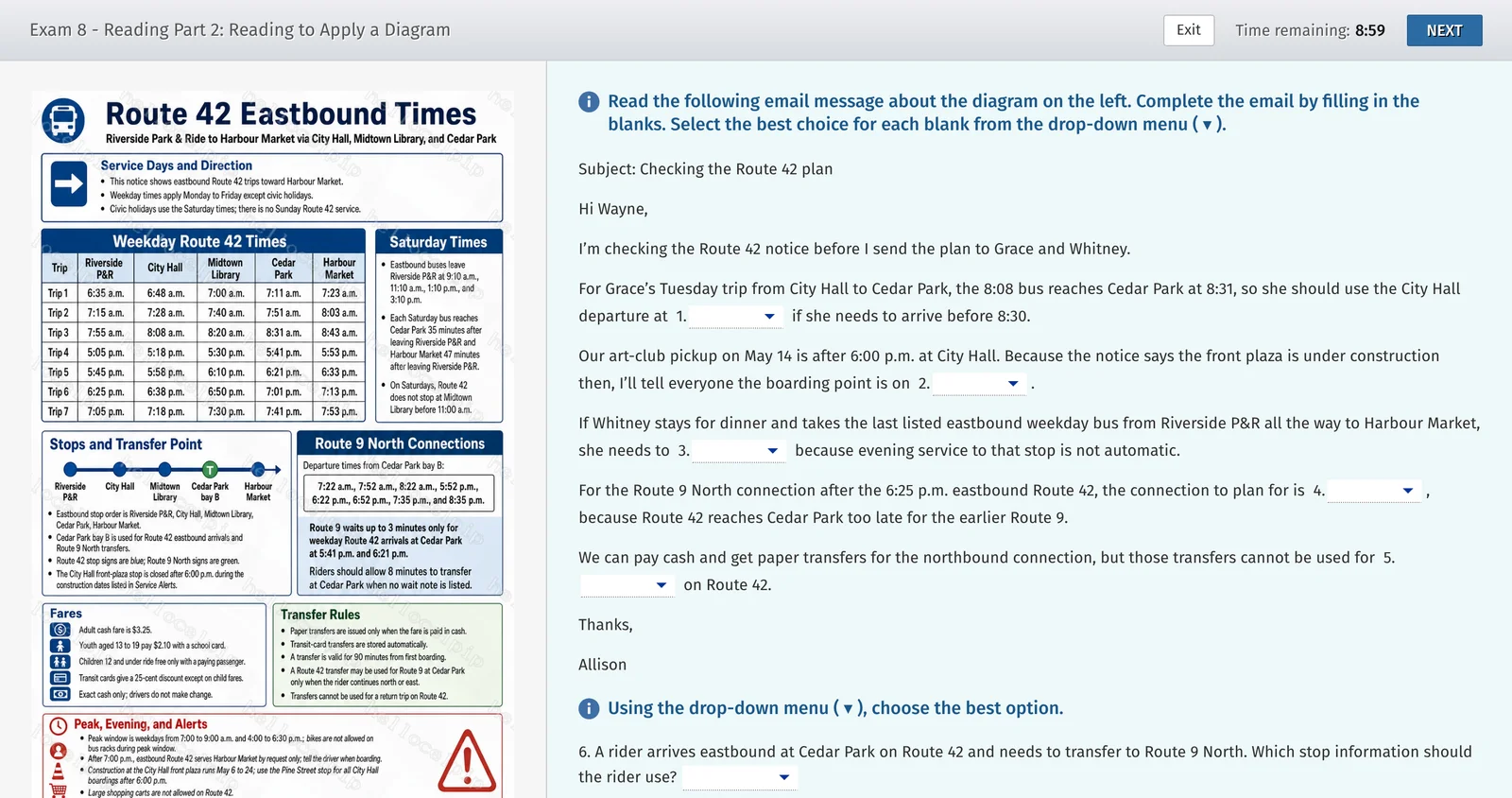
Part 2 has 8 questions and about 9 minutes. Each question has four options. Everything is on one screen. The diagram is on the left. The email and the questions are on the right.
| What you see | What you do | |
|---|---|---|
| Questions 1 to 5 | An email from one person to another. The writer uses the diagram to make a plan or a choice. The email has five blanks. | Choose the option that completes each blank. The answer comes from the diagram and the email together. |
| Questions 6 to 8 | Three questions about the diagram. | Choose the best option to answer each question. |
A set is one diagram with its email and its 8 questions. The diagram can be about many everyday topics: a bus timetable, a phone plan, a course, a sports program or a community event.
Two rules from the test are important. First, a wrong answer does not lose marks, so answer every question. Second, when the time ends, the test goes to the next part. You cannot go back to Part 2.
#Is Part 2 easy?
On hellocelpip.com, Part 2 is the Reading part that learners answer correctly most often, but they still lose marks in it. Learners answer 80.3% of Part 2 questions correctly. In Part 1 they answer 78.5% correctly, in Part 3 68.5%, and in Part 4 66.0%.
Part 2 has only 8 questions, so each lost mark is a large part of the score for this part. Because learners answer most Part 2 questions correctly, Part 2 is a good place to collect easy marks before the harder parts.
Learners can lose Part 2 marks in three places:
- The rules and notes. A diagram can have boxes of rules or short notes next to the main table, for example "After 7:00 p.m., … by request only". These rules change the facts in the table. Learners who read only the table can choose the wrong option.
- Time and money sums. Some questions need you to add or take away numbers, for example 47 minutes after 11:10 a.m., or a fare (the price of a bus ride) with a discount. It is easy to stop after the first number.
- Inference questions. An inference question asks about something the text does not say directly. You use clues in the email and the diagram to work it out. In Part 2, these questions can ask, for example, what a rider must do in a new situation, or which time still works.
#How should you use the 9 minutes?
Use this plan. It follows the advice in CELPIP's own Reading study pack: understand the diagram first, then use it for the email.
-
About 1 minute: read the diagramRead the title and the headings. Then read every box of rules and every note. Do not read only the main table.
-
About 1 minute: read the emailFind who writes, to whom, and what they want to plan. Write the facts for each blank on your paper, for example a day, a time or a place.
-
About 4.5 minutes: fill blanks 1 to 5For each blank, find the fact in the email. Then find the place on the diagram that matches that fact.
-
About 2 minutes: answer questions 6 to 8Each question gives a new situation. Find the rule on the diagram that matches it.
-
About 30 seconds: checkMake sure that all 8 questions have an answer. A guess is better than no answer.
Notice that the plan gives the diagram a full minute before you read the email. If you know where the facts are on the diagram, each blank is faster. Do not start with blank 1 before you know the diagram.
In the real test, you cannot highlight text on the screen. Write your notes on paper. Keep them short.
#How do you link each blank to the diagram?
Use a blank-to-diagram table. It is a short table on your paper with one row for each blank. In each row, you write two things: the fact from the email, and the place on the diagram that matches it.
This habit is the core of our Part 2 method. The email gives you the facts of a plan: a day, a time, a place or a need. The diagram gives you the rules. The answer to each blank is where the facts of the plan meet the rules of the diagram.
| Blank | Fact from the email | Place on the diagram | What the diagram says |
|---|---|---|---|
| 1 | the day, time, place or need | the table, box or note that matches | the rule or number there |
| 2 | … | … | … |
| 3 | … | … | … |
| 4 | … | … | … |
| 5 | … | … | … |
Be careful with the "Place on the diagram" column. Sometimes the correct place is not the main table. It can be a box of rules or a short note. Always ask: is there a rule that changes this fact?
The blank-to-diagram table is our own method. CELPIP's study pack tells you to understand the diagram and then find the information in it that answers the email. The table gives that advice a simple shape that you can fill quickly.
#A worked example, from start to finish
This example is one CELPIP Reading Part 2 set, from start to finish. It is a real Part 2 set that you can try on hellocelpip.com after you read this section. Here it is in the full exam.
And here is the diagram, larger.
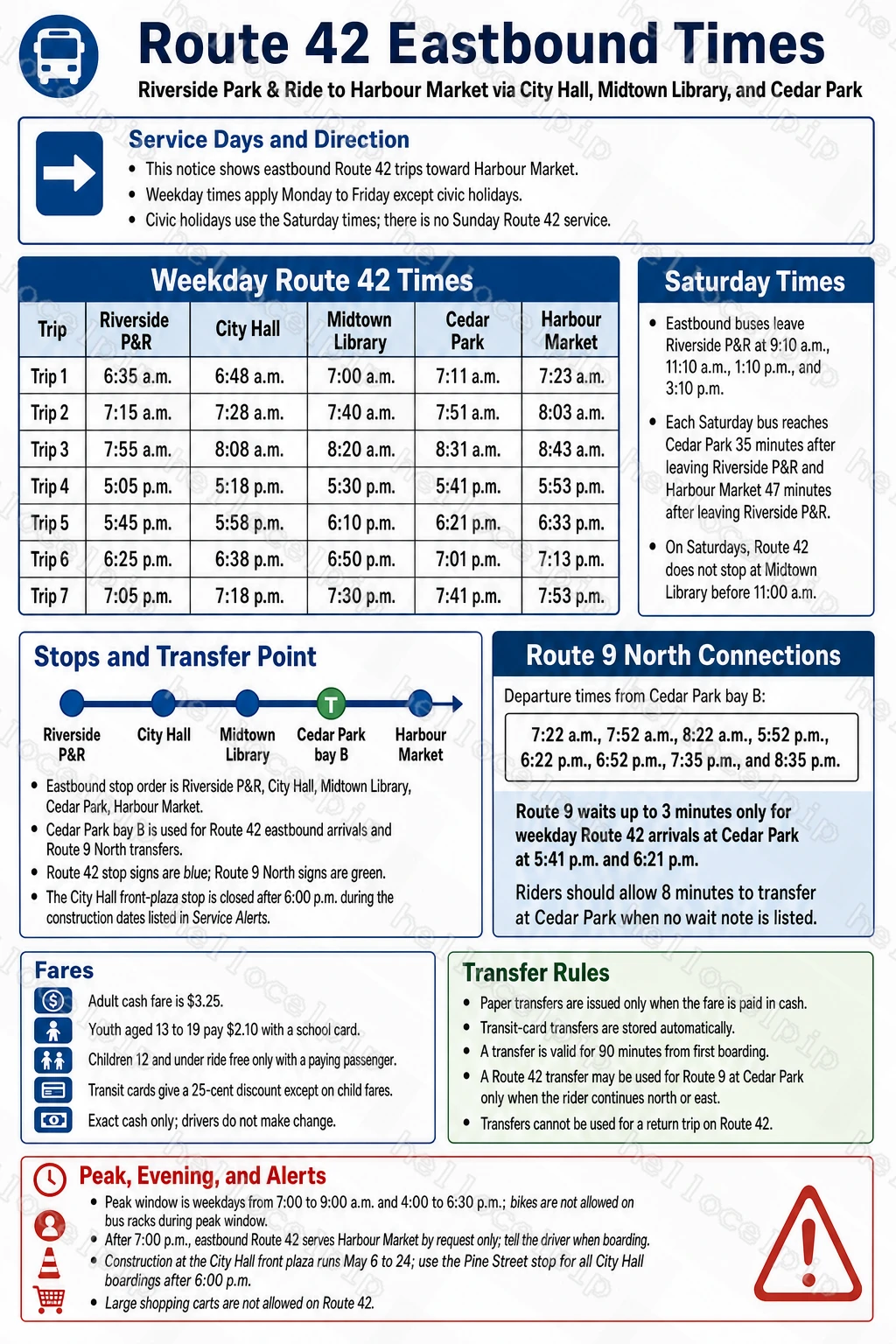
The diagram is a notice called “Route 42 Eastbound Times”. Eastbound means going east. The first stop is Riverside P&R, which means Riverside Park and Ride, a parking lot next to the bus stop. A box at the top, “Service Days and Direction”, says which days use which times. A main table shows seven weekday bus trips and the time at each of five stops.
Other boxes give the Saturday times, the stop where riders change to Route 9 North (bay B at Cedar Park, one of the bus bays there), the Route 9 times, the fares and the transfer rules. A transfer is a ticket that lets you change to another bus without paying again. The last box, “Peak, Evening, and Alerts”, gives rules for busy times, for the evening and for construction. The peak window is the busy time of day, when special rules apply.
In the email, Allison writes to Wayne about bus plans for two people, Grace and Whitney, and for an art-club pickup.
| Blank | Fact from the email | Place on the diagram | What the diagram says |
|---|---|---|---|
| 1 | Grace, Tuesday, City Hall to Cedar Park, before 8:30 | Weekday table, City Hall and Cedar Park columns | 7:28 leaves City Hall, reaches Cedar Park at 7:51. 8:08 reaches it at 8:31. |
| 2 | City Hall, May 14, after 6:00 p.m. | “Peak, Evening, and Alerts” box | Front plaza closed May 6 to 24. Use the Pine Street stop after 6:00 p.m. |
| 3 | Whitney, last weekday bus, to Harbour Market | Weekday table (Trip 7) and the “Peak, Evening, and Alerts” box | Trip 7 leaves at 7:05 p.m. After 7:00 p.m., Harbour Market is by request only. |
| 4 | Route 9 after the 6:25 p.m. Route 42 | Weekday table (Trip 6) and Route 9 North box | Reaches Cedar Park at 7:01 p.m. Route 9 leaves at 6:52, 7:35 and 8:35 p.m. |
| 5 | Paper transfers, what they cannot do | Transfer Rules box | Transfers cannot be used for a return trip on Route 42. |
Now fill three blanks with the table.
Blank 1: “For Grace’s Tuesday trip from City Hall to Cedar Park, the 8:08 bus reaches Cedar Park at 8:31, so she should use the City Hall departure at (1) ____ if she needs to arrive before 8:30.”
- A) 8:08 a.m.
- B) 6:48 a.m.
- C) 8:20 a.m.
- D) 7:28 a.m.
How to decide: Tuesday is a weekday, so use the weekday table. Read the City Hall column. The 8:08 bus is too late, because it reaches Cedar Park at 8:31. The bus before it leaves City Hall at 7:28 and reaches Cedar Park at 7:51. The 6:48 bus also arrives in time, but the email compares the answer with the 8:08 bus, so it means the bus just before that one. 8:20 is a time in the Midtown Library column, not the City Hall column. The answer is D, 7:28 a.m.
Blank 2: “Our art-club pickup on May 14 is after 6:00 p.m. at City Hall. Because the notice says the front plaza is under construction then, I’ll tell everyone the boarding point is on (2) ____.”
- A) Harbour Market
- B) the City Hall front plaza
- C) Pine Street
- D) Cedar Park bay B
How to decide: The table does not answer this. The “Peak, Evening, and Alerts” box at the bottom does: construction at the City Hall front plaza runs May 6 to 24, so use the Pine Street stop for all City Hall boardings after 6:00 p.m. May 14 is inside those dates. Cedar Park bay B is a real place on the diagram, but it is for changing to Route 9. The answer is C, Pine Street.
Blank 4: “For the Route 9 North connection after the 6:25 p.m. eastbound Route 42, the connection to plan for is (4) ____, because Route 42 reaches Cedar Park too late for the earlier Route 9.”
- A) 7:35 p.m.
- B) 8:35 p.m.
- C) 6:52 p.m.
- D) 6:22 p.m.
How to decide: Find the 6:25 p.m. bus in the weekday table. It is Trip 6, and it reaches Cedar Park at 7:01 p.m. Now read the Route 9 North box. The 6:52 p.m. bus has already left. The next one is 7:35 p.m. The box also says to allow 8 minutes to change buses, and 7:35 is more than 8 minutes after 7:01. 8:35 p.m. also works, but it is not the first one. 6:22 p.m. is before the 6:25 bus even leaves. The answer is A, 7:35 p.m.
To answer these three blanks, you needed three different places on the diagram: the main table, the “Peak, Evening, and Alerts” box and the Route 9 box. That is why the 9-minute plan for Part 2 gives you a full minute for the diagram.
#How do you answer blanks 1 to 5?
In CELPIP Reading Part 2, first find the fact in the email. Then find the rule on the diagram. Do not read the options first. Wrong options can use real facts from the same diagram, so each one can look correct.
| If the blank needs… | Look at | Do this |
|---|---|---|
| A choice, for example a bus, a plan or a course | The rows of the main table | Check every condition: day, time, place. The correct row matches all of them, not only one. |
| A time or a place | The column headings and the boxes | Find the correct column first. A time from the wrong column can be a wrong option. |
| A warning or a limit | The boxes of rules and the notes | Look for words like “only”, “except”, “after” and “cannot”. They change the facts in the table. |
| A sum of time or money | The table, the boxes and the notes | Do the full sum on your paper. See the rule for sums below. |
#Rules and notes: the words that change the facts
In Part 2, a rule in a box can decide the answer. A rule can add a condition, add a cost, or take something away. In the worked example, the Route 42 timetable, the “Peak, Evening, and Alerts” box moves the City Hall stop after 6:00 p.m., and makes Harbour Market “by request only” after 7:00 p.m.
So when you read the main table, also read every box near it. Write each rule on your paper in a few words.
Blank 3 in the worked example depends on one of these rules. Allison writes: “If Whitney stays for dinner and takes the last listed eastbound weekday bus from Riverside P&R all the way to Harbour Market, she needs to (3) ____ because evening service to that stop is not automatic.” The options are:
- get off at Cedar Park because Harbour Market is not served in the evening
- tell the driver when boarding that she wants Harbour Market
- avoid bringing a bike because the trip is inside the peak window
- ask Route 9 North to wait at Cedar Park
The last weekday bus is Trip 7. It leaves Riverside P&R at 7:05 p.m. The “Peak, Evening, and Alerts” box says: “After 7:00 p.m., eastbound Route 42 serves Harbour Market by request only; tell the driver when boarding.” The bus still goes to Harbour Market, so the first option is too strong. The evening peak window ends at 6:30 p.m., so the bike rule does not apply. Route 9 is not part of Whitney’s trip, so asking it to wait does not help. So the answer is “tell the driver when boarding that she wants Harbour Market”.
#Sums: do every step on paper
Some Part 2 questions need a sum of time or money. It is easy to stop after the first step. Write each step on your paper.
| Step | Where it comes from | Result |
|---|---|---|
| Which times apply? | Service Days and Direction box | Civic holidays use the Saturday times. |
| Saturday departures | Saturday Times box | 9:10 a.m., 11:10 a.m., 1:10 p.m., 3:10 p.m. |
| Time to Harbour Market | Saturday Times box | 47 minutes after leaving |
| Check the 11:10 bus | your own sum | 11:10 + 47 minutes = 11:57 a.m. Before noon. |
| Check the 1:10 bus | your own sum | 1:57 p.m. Too late. |
The options for question 7 are 9:10 a.m., 11:10 a.m., 1:10 p.m., and “No Route 42 service because civic holidays use Sunday service”. The 9:10 bus also arrives before noon, but it is not the latest one. The last option is wrong because the “Service Days and Direction” box says civic holidays use the Saturday times. The answer is 11:10 a.m.
#How do you answer questions 6 to 8?
Questions 6 to 8 in CELPIP Reading Part 2 give you a new situation, and ask you to apply the diagram to it. In the worked example, the Route 42 timetable, all three questions describe a rider and ask what is true for that rider. They are not about the email.
| If the question asks… | The type is | Do this |
|---|---|---|
| Where to go, or which time or price applies | Specific information (one fact) | Find the box or column that matches. Check the rules and notes. Do the full sum. |
| What a person must do, or what is allowed, in a new situation | Inference (a clue, not a direct answer) | Match each fact in the question to one rule on the diagram. Go one small step, and no further. |
Question 8 in the worked example asks: “A rider wants to board at Riverside P&R with a bike on the 6:25 p.m. weekday eastbound trip. What should the rider know?” The options are:
- The bike cannot be placed on the rack because the trip starts during the peak window.
- The bike is allowed because the bus reaches Cedar Park after the peak window.
- The bike is allowed only if the rider tells the driver when boarding.
- The rider must use Saturday times because bikes are not allowed on weekdays.
The “Peak, Evening, and Alerts” box says that one weekday peak window is 4:00 to 6:30 p.m., and that bikes are not allowed on bus racks in the peak window. The rider gets on at 6:25 p.m. That is inside the peak window. “Tell the driver” is a rule for Harbour Market after 7:00 p.m., not for bikes. The bike rule is only for the peak window, so Saturday times are not needed. The answer is the first option: the bike cannot go on the rack.
#Which mistakes cost the most marks?
The wrong options in CELPIP Reading Part 2 can use real facts from the diagram. That is why they look correct. These are the kinds of mistakes that cost marks in Part 2. Each one has a question that you can ask yourself.
| Mistake | What it looks like | Ask yourself |
|---|---|---|
| Table only | You answer from the main table and miss a rule in a box. | Is there a rule that changes this fact? |
| Wrong column | You choose a time from the column next to the correct one. | Is this the column for the right stop or place? |
| One condition only | You choose a row that matches the time but not the day. | Does this row match every fact in the plan? |
| Works, but not the best | You choose a time that works, but the question asks for the latest or the first. | Does the question ask for the first, the last, or any? |
| Half a sum | You stop before the last step, for example before the travel time or the discount. | Did I do every step of the sum? |
| Wrong rule | You use a real rule from the diagram, but it is for a different situation. | Is this rule about the same thing as the question? |
| Options first | You read the options before you know the answer, and a real fact from the diagram looks correct. | What did I decide before I read the options? |
#How should you practise Part 2?
Use real Part 2 sets. Practise one skill in each set. You do not need to find your own flyers or price lists. Every step below uses one Part 2 set on hellocelpip.com.
-
Step 1: Read the whole diagram firstOpen a Part 2 set. Read the title, the headings, every box of rules and every note. Give yourself 1 minute.
-
Step 2: Fill the blank-to-diagram tableDraw the table on paper. For each blank, write the fact from the email and the place on the diagram. Then choose the option.
-
Step 3: Write every sum on paperFor each question about time or money, write each step. Include every travel time, fee and discount.
-
Step 4: Learn from each wrong answerAfter the set, read the explanation for each wrong answer. Find your mistake in the Part 2 mistakes table. Write it down.
-
Step 5: Add the timerWhen you get most answers correct without a timer, do the next sets in 9 minutes. Then do a full Reading mock test. A mock test is a practice test with all four Reading parts and the real time limits.
If you make the same mistake two times, practise only that mistake in your next set. For example, if you often miss a rule in a box, read only the boxes first in your next set. Then write each rule on paper.
#How hellocelpip.com helps you prepare for Part 2
hellocelpip.com has more than 950 Reading Part 2 questions, in over 120 full sets. Each set is in the real CELPIP format: a diagram, an email with five blanks, and three questions.
- More than 120 Part 2 sets, from easy to hard, with schedules, price lists, flyers and plans, so you always have a new diagram to practise with.
- An explanation for every option, correct and wrong, so you can see why you made a mistake.
- Your score for each type of question, so you can see if inference questions cost you marks.
- Reading mock tests with the real time limits, so you practise Part 2 in its real place in the test.
- Full exams with all four skills, the closest practice to test day.
- Ask Alyssa, your AI CELPIP coach, who can go through a wrong answer with you and tell you what to practise next.
Start with a Part 2 set. When you are ready for the real time limit, take a Reading mock test. To see how Part 2 fits with the other three parts, read the CELPIP Reading practice test guide. For the part before it, read the Reading Part 1 guide. For the harder parts after it, read the Reading Part 3 guide and the Reading Part 4 guide. To go through a wrong answer, use Ask Alyssa, your AI CELPIP coach. She reads your answers and explains what to practise next.
#CELPIP Reading Part 2 FAQ
How many questions are in CELPIP Reading Part 2?
How long do I have for Reading Part 2?
What is a diagram in CELPIP Reading Part 2?
What is an inference question?
Why do I lose marks in Part 2 when the answers are on the diagram?
Should I read the options before I look at the diagram?
Can I go back to Part 2 after the time ends?
Confirm the Part 2 format, number of questions and time on the official CELPIP Test Format page and in CELPIP’s own Reading study pack. Your hellocelpip.com level uses the same 0 to 12 CELPIP scale, so you can track real progress between now and test day. Your official score comes from Paragon Testing Enterprises on test day. hellocelpip.com is an independent study resource and is not affiliated with CELPIP or Paragon Testing Enterprises.
Official sources:
Last updated: November 14, 2026