
The safest CELPIP Writing Task 2 template is a clear choice in the first sentence, one paragraph for each reason, a concrete example inside every reason, and a closing line that ties it together. Task 2 is called Responding to Survey Questions. You get 26 minutes, you write about 150 to 200 words, and you must pick one of two options and explain why.
This guide gives you the template, two full sample answers to the same question, and the one habit that separates a complete survey response from a strong one. We can name that habit precisely, because we checked what learners actually do.
#What does CELPIP Writing Task 2 ask you to do?
Task 2 gives you a short situation, then asks you to choose between two options and explain your reasons. The official CELPIP Test Format lists it as Task 2: Responding to Survey Questions, the second of two Writing tasks in a 53 minute section.
The question always gives you four things:
- A situation. A few sentences describing something being decided, usually at work, in a building, or in a community.
- A survey asking your opinion. You are one of several people being consulted.
- Two options, labelled A and B. You must pick one.
- An instruction to explain your reasons, and a length of about 150 to 200 words.
Read both options before you choose. There is no correct option, and no rater is checking which one you picked. What gets scored is how well you explain the choice you made.
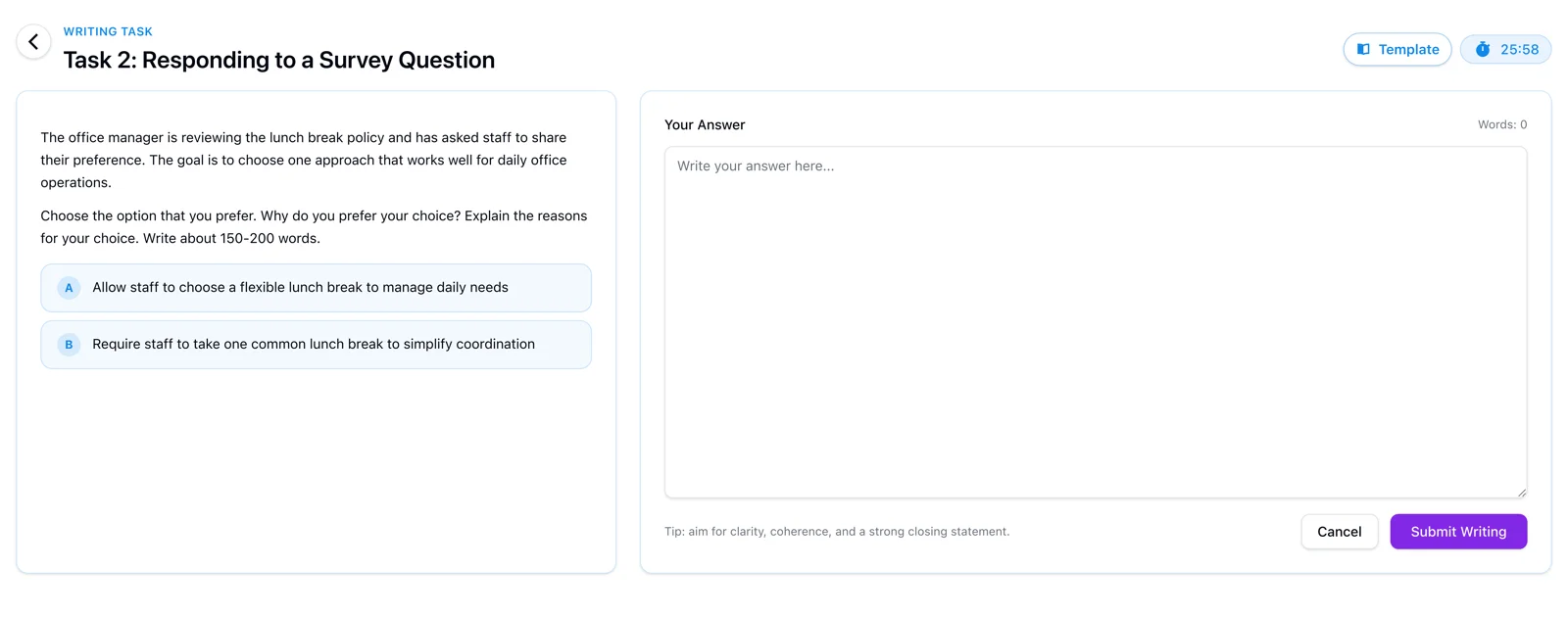
Two things on that screen are worth knowing before test day. Both options stay visible the whole time, so you can refer back to the one you rejected without remembering it. And the word count updates as you type, so you can stop guessing whether you are near 150 or past 200.
Try a Task 2 survey question →
#How long do you get for Task 2?
You get 26 minutes for Task 2 and 27 minutes for Task 1, which is where the 53 minute Writing section comes from. CELPIP's own official Writing study pack recommends spending about four to five minutes planning before you write, and about three minutes checking afterwards.
A workable split of the 26 minutes you get for Task 2. The planning and checking times follow CELPIP's published study-pack advice.
Choosing takes seconds, and it is worth doing fast. The minutes matter for finding your examples, not for weighing up which option is better.
#A CELPIP Writing Task 2 template you can adapt
Use one template for every survey question and change only the content. The structure below covers two reasons, which fits 150 to 200 words comfortably.
I would choose [Option A or B], [restate the option in your own words].

First, [reason 1]. [A specific example: a time, a place, a person, a number.] [What that would mean for the people affected.]

Second, [reason 2]. [A second specific example.] [The result it would produce.]

[One or two sentences on why the other option is weaker, without dismissing it.]

For these reasons, [restate your choice and what it would achieve].
The words in brackets are instructions to you, not text to copy. Notice that every body paragraph has three jobs: state the reason, give an example, then say what it means. Most answers do the first job only, and the next section shows what that costs.
The hardest part is not the wording. It is finding two reasons and an example for each while the clock runs. Idea Coach drills exactly that: it gives you a survey question and asks for your choice, then one reason at a time, in note form rather than full sentences.
Build your reasons for Task 2 →
Sentence starters that fit almost any survey question:
- Your choice: "I would choose Option A…", "In my view, the better option is…"
- First reason: "The main reason is…", "First, it would allow…"
- Adding the example: "For example…", "In my own experience…", "Last winter, for instance…"
- Second reason: "Second…", "Another benefit is…", "It would also mean…"
- The comparison: "Option B would be simpler, but…", "While the other option has some appeal…"
- Closing: "For these reasons…", "On balance, I believe…"
Do not memorise a finished response. Memorise the shape, and let the question supply the content.
#Which part of Task 2 do learners actually get wrong?
Developing the reasons with examples, by a very wide margin. We looked at 10,000 + anonymised, aggregated Task 2 survey responses written on HelloCelpip and checked each one against the requirements of the task. Our evaluator judged that about 36% developed their reasons with examples, while about 98% stated their opinion clearly and about 97% chose one option and stated it.
| What the response had to do | Judged met |
|---|---|
| Develop the reasons with examples | 36% |
| Compare it with the other option | 81% |
| Write in paragraphs rather than a list | 87% |
| Use a tone suited to a survey response | 89% |
| Stay focused on reasons | 96% |
| Hold the same position throughout | 96% |
| Choose one option and state it | 97% |
| State the opinion clearly | 98% |
Read the shape of that list rather than any single number. Everything that is about following the instruction sits high. The one thing that is about developing the answer sits about sixty points lower. Learners pick a side, give their reasons, and stop.
What makes the finding worth acting on is that CELPIP asks for the missing step directly. CELPIP's official Writing study pack lists "support each main idea with at least one concrete detail or example" and "mention real places, people, and situations" among its Task 2 strategies, and Content/Coherence is scored partly on examples and supporting details. The requirement is published. It is just the one most people skip.
#How do you develop a reason?
Take each reason you have written and ask one question: could this sentence appear in anyone else's answer? If yes, it is a general claim, not a developed reason. Add one concrete thing.
-
Give one exampleA moment, not a category. Not people are often busy at noon, but someone on morning client calls cannot leave at 12:00 sharp. One invented but plausible situation is enough, and it is what the study pack means by making details concrete.
-
Say who it affectsName the group the decision lands on: parents on school pickup, staff without a car, residents on the top floor. A reason with a person attached is much harder to wave away.
-
Add a numberA time, a cost, a count, a delay. Numbers make a survey answer sound like it came from someone who has thought about the actual decision.
-
Compare with the other optionSay plainly what the option you rejected would do less well. Only about 81% of responses do this, and it is the second easiest gap to close after examples.
Compare these two sentences. Both give the same reason.
Flexible breaks would be better because they suit people's schedules.
Flexible breaks would let someone finishing a report for a 1 p.m. deadline eat at 11:30 and come back focused, instead of stopping work at the worst possible moment.
The second is longer, and it does three extra jobs: it names a person, it gives a time, and it shows the consequence. That is the difference the data above is describing.
#Sample answer 1: the reasons are there, the examples are not
This is an original HelloCelpip practice situation, written to match the format of a real question.
Situation: Your building management is surveying residents about the shared laundry room. Option A: extend the opening hours until 11 p.m. Option B: add two more machines but keep the current hours.
I would choose Option A, extending the laundry room hours until 11 p.m.
First, longer hours would be more convenient for residents. Many people are busy during the day and cannot use the laundry room at the current times. Extending the hours would give them more choice and make their lives easier.
Second, longer hours would reduce crowding. If people can come at different times, there will be fewer residents waiting for a machine. This would make the laundry room a more pleasant place for everyone in the building.
For these reasons, I think Option A is the better choice for our building.
Why it falls short. Nothing here is wrong. The choice is clear, the position never wavers, there are two real reasons, and the paragraphing is correct. But every sentence could appear in any resident's answer: no time, no person, no number, nothing that shows this writer thought about the actual building. The other option is never mentioned. At 103 words it is also well under the range, which costs marks under Task Fulfillment on its own. This is what most Task 2 responses look like.
That answer would meet seven of the eight requirements in the table above. It misses the one that carries the marks.
#Sample answer 2: the same reasons, developed
Same question, same choice, same two reasons. The only thing added is evidence.
I would choose Option A, keeping the current number of machines but extending the laundry room hours until 11 p.m.
First, later hours would fit the people who currently cannot use the room at all. Our building has several nurses and restaurant staff who finish after 9 p.m., and by the time they are home the room is already locked. Two extra hours would give them a realistic window on a weeknight rather than pushing all of their laundry onto Saturday.
Second, spreading people across a longer evening would ease the crowding better than new machines would. On Sunday afternoons I have waited about forty minutes for a free dryer, and that queue forms because everyone arrives in the same four-hour window. Adding two machines would shorten that wait, but it would not change the reason the queue exists.
Option B is the simpler fix, and it does add capacity. My concern is that it costs money for equipment while leaving the busiest hours just as busy.
For these reasons, I believe extending the hours would help more residents, at a lower cost, than buying more machines.
Why it works. The reasons have not changed. What changed is that each one now carries something specific: the nurses and restaurant staff finishing after 9 p.m., the forty-minute Sunday wait, the four-hour window that creates the queue. The rejected option gets a fair paragraph instead of being ignored, which is the requirement only about 81% of responses meet. The tone is a resident answering a survey, not a student writing an essay. The response is 187 words, inside the 150 to 200 range.
Read the two answers back to back and you will hear that the second is not more advanced English. It is the same English with evidence attached.
#What do CELPIP raters reward?
CELPIP Writing is scored by trained human raters against four rated dimensions. Each has its own guiding question in the official Performance Standards.
Where do marks actually go? Across more than 12,300 anonymised, aggregated Task 2 responses on HelloCelpip, readability and vocabulary together account for about six in every ten issues our evaluator flags.
| Rated area | Share of flagged issues |
|---|---|
| Readability | about 35% |
| Vocabulary | about 27% |
| Content / Coherence | about 22% |
| Task Fulfillment | about 16% |
That split held when we rebuilt our evaluator from scratch, which is why we are willing to quote it. In plain terms: the small mechanical things, sentence structure, punctuation, transitions, and word choice, are where most of the damage happens, even in responses that pick a side and defend it.
That is not in tension with the finding above. They describe two different failures. Missing examples are what stop a complete response from becoming a strong one. Readability and vocabulary errors are what quietly cost marks in every response, including the good ones.
#How much do you need to write?
About 150 to 200 words, and the on-screen instruction says so directly. Task 2 responses written on HelloCelpip average about 180 words, which sits comfortably inside the range.
Almost nobody runs out of things to say once they have two reasons and an example for each. The risk is the opposite: writing 200 general words instead of 180 specific ones. Word count is also listed under Task Fulfillment, so a response well under the range loses marks for length on top of everything else.
#Common Task 2 mistakes
- The reasons have no examples behind them. This is the most common gap by a wide margin, and it is the easiest one to fix.
- The choice is never actually stated. Name your option in the first sentence, in your own words.
- The position changes halfway through. Pick one side and stay on it, even if you can see the appeal of the other.
- The other option is never mentioned. One short paragraph comparing them is enough.
- The response is a list of bullet points. Paragraphing is scored under Readability, so write in paragraphs.
- It reads like an academic essay. A real person is reading a survey about a real decision.
- It is well under 150 words. Word count sits inside Task Fulfillment.
A quick final pass, in this order: choice, reasons, examples, comparison, tone, length. It takes about three minutes and it catches nearly everything on that list.
#How to practise Task 2
Writing more survey responses is only half of it. The gains come from checking each one against the same short list every time.
-
Write one response under 26 minutesUse the real clock from the start. Plan for about five minutes, write for around eighteen, and leave three to check.
-
Underline your examplesGo through each body paragraph and underline the specific detail. If a paragraph has none, that is the paragraph to rewrite. This single check targets the biggest gap in the data above.
-
Read the feedback by dimensionFind out whether your marks are going on content, vocabulary, readability, or task fulfillment. The fix for each one is different, and guessing wastes weeks.
-
Rewrite the same response onceKeep your choice and your reasons, and add only the examples. Rewriting one response properly teaches more than writing three new ones badly.
A simple way to use it: write two or three Task 2 survey questions and check only whether every reason has an example, then take a full mock test when you want a timed run across both Writing tasks.
The other half of the Writing section works differently: Task 1 gives you a reader and a list of points to cover rather than a choice to defend. The CELPIP Writing Task 1 email guide has the template for that one, and the same underlying habit turns out to decide both.
#Frequently asked questions
What is the best CELPIP Writing Task 2 template?
How long should a CELPIP Writing Task 2 response be?
Does it matter which option I choose in Task 2?
Do I have to mention the other option?
What do learners get wrong most often in Task 2?
Can I write my Task 2 response in bullet points?
How is CELPIP Writing scored?
Will practising Task 2 on HelloCelpip prepare me for the real test?
Confirm the Writing task names and the 53-minute section timing on the official CELPIP Test Format page, and the four rated dimensions on the CELPIP Results page. Per-task timing of 27 and 26 minutes, the 150 to 200 word instruction, and the Task 2 strategies quoted above are published in Paragon's CELPIP Writing Pro study pack. Your HelloCelpip level uses the same 0 to 12 CELPIP scale, so you can track real progress between now and test day. Your official score comes from Paragon Testing Enterprises on test day. HelloCelpip is an independent study resource and is not affiliated with CELPIP or Paragon Testing Enterprises.
Official sources:
Last updated: July 24, 2026