
The safest CELPIP Writing Task 1 template is a purpose line, one short paragraph for each point the question lists, a clear request, and a polite sign-off. Task 1 is called Writing an Email. You get 27 minutes, you write about 150 to 200 words, and the question tells you exactly which points to cover. This guide gives you the template, two full sample answers, and the one habit that separates a complete email from a strong one. We can name that habit precisely, because we looked at how hundreds of learners actually perform on Task 1.
#What does CELPIP Writing Task 1 ask you to do?
Task 1 asks you to write one email, to one named reader, covering a set list of points. The official CELPIP Test Format lists it as Task 1: Writing an Email, the first of two Writing tasks in a 53 minute section.
The question always gives you four things:
- A situation. A few sentences describing what has happened.
- A reader, named by role. A store manager, a bank, a librarian, a professor, a customer service department, a building manager.
- A list of points your email must include. Usually three, sometimes four. The question introduces them with a line like "your email should do the following things".
- A length. About 150 to 200 words.
Count the points before you write anything. Your email is not finished until each one has been answered, and the count is the only part of the question that changes the shape of your answer.
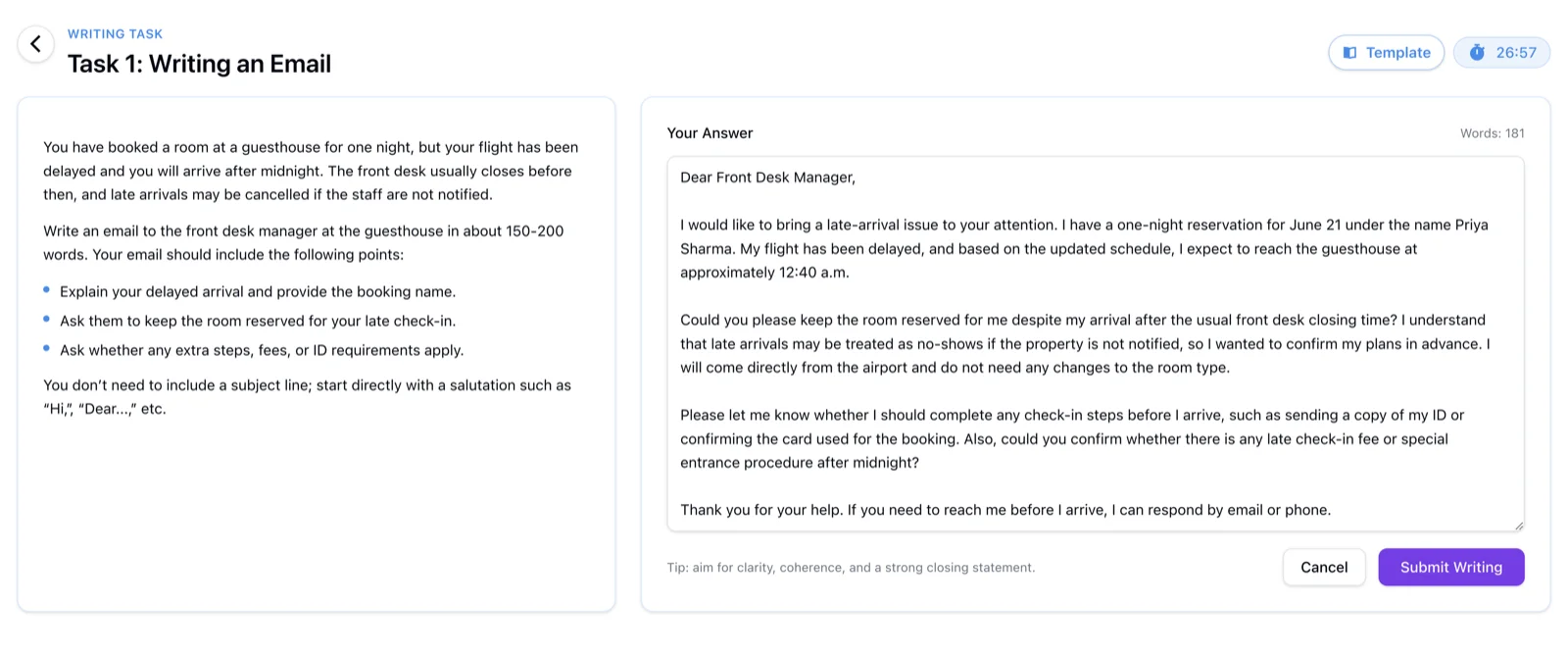
Two things on that screen are worth knowing before test day. The points stay visible the whole time, so you never have to remember them, which is why counting them first costs you nothing. And the word count updates as you type, so you can stop guessing whether you are near 150 or past 200. The answer shown here is 181 words, comfortably inside the range.
#How long do you get for Task 1?
You get 27 minutes for Task 1 and 26 minutes for Task 2, which is where the 53 minute Writing section comes from. That is more time than most people expect, and it is enough to plan properly. CELPIP's own official Writing study pack recommends spending about four to five minutes planning before you write, and about three minutes checking afterwards.
A workable split of the 27 minutes you get for Task 1. The planning and checking times follow CELPIP's official published study-pack advice.
You can confirm the section timing and task names on the official CELPIP Test Format page.
#A CELPIP Writing Task 1 template you can adapt
Use one template for every question and change only the content. The structure below covers a three-point question, which is the most common shape, and it extends to four points by adding one paragraph.
Dear [role from the question],

I am writing to [purpose in one sentence].

First, [point 1]. [One specific detail: a name, a date, a number, or what it cost you.]

In addition, [point 2]. [One specific detail.]

Finally, [point 3]. [One specific detail.]

[Add one more paragraph here if the question lists a fourth point.]

I would appreciate it if you could [the action you want, stated plainly]. Thank you for your time.

Sincerely,
[Your name]
The hardest part of that template is not the wording, it is deciding what goes in each slot while the clock runs. Idea Coach drills exactly that: it gives you a Task 1 question and asks for your purpose, then one point per required task, then a polite closing, in note form rather than full sentences. When those decisions are quick, the twenty-seven minutes stop feeling tight.
Build your points for Task 1 →
The words in brackets are instructions to you, not text to copy. Notice that every body paragraph has two jobs: answer the point, then back it up. That second job is the one that moves your score, and the next section shows why.
Sentence starters that fit almost any question:
- Purpose: "I am writing to report…", "I am writing to request…", "I am writing to suggest…"
- First point: "The main issue is…", "First, I would like to explain…"
- Next point: "In addition…", "Another concern is…", "I should also mention…"
- Adding detail: "Specifically…", "For example…", "As a result…"
- Your request: "Could you please…", "I would appreciate it if you could…"
- Sign-off: "Sincerely,", "Kind regards,"
Do not memorise a finished email. Memorise the shape, and let the question supply the content.
#Which part of Task 1 do learners actually get wrong?
Adding specific detail, by a wide margin. We looked at over 20,000 anonymised, aggregated Task 1 emails written on HelloCelpip and checked each one against the requirements of the task. Our evaluator judged that about 55% supported their points with specific detail, while about 96% made the purpose of the email clear and about 83% covered every point the question asked for.
| What the email had to do | Judged met |
|---|---|
| Support the points with specific detail | 55% |
| Cover every point the question asked for | 83% |
| Match the tone to the recipient | 89% |
| Use a greeting, body and sign-off properly | 94% |
| Keep the facts given in the question | 94% |
| Make the purpose of the email clear | 96% |
Read the shape of that list rather than any single number. Everything that is about following the instruction sits high. The one thing that is about developing the answer sits nearly forty points lower. Learners answer the question and then stop.
What makes the finding worth acting on is that CELPIP says the same thing from the other direction. The official Writing Performance Standards list "examples and supporting details" as a factor inside Content/Coherence, and CELPIP's own official study pack tells test takers to back every main idea with a concrete detail. The requirement is published. It is just the one most people skip.
#How do you add specific detail?
Take each point you have written and ask one question: could this sentence have been written by someone who was not there? If yes, it is too general. Add one concrete fact.
-
Name the thingNot the desk, but the desk you ordered on July 10 from the Downtown branch. A name, a branch, a model, or an order number turns a vague complaint into a real one.
-
Give the numberA price, a date, a time, a quantity, a delay. Numbers are the fastest way to sound credible, and they are easy to invent for a practice question as long as they fit the situation the question gave you.
-
Say what it cost youThe consequence is the detail people most often leave out. You missed a shift, you paid for delivery twice, you could not finish a report. One clause is enough.
-
Add a constraintWhat limits your options, and what would work instead. I do not own a car. I am free after 5:00 p.m. This also sets up your request so it sounds reasonable rather than demanding.
Compare these two sentences. Both answer the same required point.
The desk arrived damaged and I was not happy about it.
When I opened the box, one of the metal legs was bent and two screws were missing, so I could not assemble the desk at all.
The second is nine words longer and does three extra jobs: it shows the damage, it shows why the product is unusable, and it gives the reader something to act on. That is the difference the data above is describing.
#Sample answer 1: a complaint email
This is an original HelloCelpip practice situation, written to match the format of a real question.
Situation: You ordered a desk from a furniture store and it arrived damaged. Write to the store manager. Describe the damage, explain why returning it yourself is difficult, and say what you would like the store to do.
Dear Store Manager,
I am writing to report a problem with a desk I bought from your Downtown branch on July 10, and to request a replacement.
When I opened the box, I found that one of the metal legs was bent. Two screws were also missing, so I could not assemble the desk safely. The outer box looked undamaged, which suggests the problem happened before delivery.
I called the store the next morning, and a staff member asked me to bring the desk back myself. Unfortunately I do not own a car, and the package is far too large to carry on the bus. I paid $45 for home delivery for exactly this reason.
Could you please arrange a free pickup and send a complete replacement this week? I am available after 5:00 p.m. on weekdays, or any time on Saturday. If no replacement is in stock, I would prefer a full refund including the delivery fee.
Thank you for your help in resolving this.
Sincerely,
Chen Yi
Why it works. The purpose is complete by the end of the first sentence. Each of the three required points gets its own paragraph, in the order the question gave them. Every paragraph carries at least one specific detail: the branch and date, the bent leg and missing screws, the $45 delivery fee, the pickup times. The tone stays polite while the request stays firm. The response is 169 words, counting the greeting and sign-off.
Notice what the writer does not do. There is no background story about why they needed a desk, and no apology for complaining. Every sentence either answers a point or supports one.
#Sample answer 2: a request email
The same template, a warmer reader, and a completely different situation.
Situation: Your office is often too noisy to concentrate in. Write to your operations manager. Describe the problem, suggest a quiet work area, and explain how it would help the team.
Dear Ms. Okafor,
I am writing to suggest that we set aside a quiet work area for the tasks that need long stretches of concentration.
Our floor has an open layout, and the sales team makes calls from around 9:00 a.m. until late afternoon. That works well for quick questions, but it makes detailed work difficult. I prepare the weekly inventory report, and last month I had to recheck the same figures three times because I kept losing my place.
Could we try using the small meeting room beside the kitchen as a quiet room on Tuesday and Thursday afternoons? Staff could book a desk for up to two hours through the shared calendar, and calls would stay outside the room. The space already has desks, power outlets, and internet, so the change would cost nothing.
I think it would help the whole team finish detailed work faster and with fewer errors. Would you be willing to trial it for one month? I would be glad to write the booking rules and collect feedback at the end.
Kind regards,
Lina Chen
Why it works. The tone is warmer than the complaint email, but the skeleton is identical: purpose, one paragraph per point, a clear request, a sign-off. The details are what carry it. Naming the sales team, the 9:00 a.m. start, the weekly inventory report, and the three rechecks turns a general complaint about noise into a case. The closing asks for one specific decision rather than general agreement. The response is 181 words, counting the greeting and sign-off.
The topic changed completely. The structure did not. That is the whole point of working from a template under time pressure.
#What do CELPIP raters reward?
CELPIP Writing is scored by trained human raters against four rated dimensions. Each dimension has five performance levels, and raters assign a level by finding evidence in your response that matches the descriptors.
Two details from the official rating process are worth knowing, because they change how you should think about a single mistake. Each Writing performance is rated by four to six different raters, working independently and without seeing each other's scores. And your Writing level comes from both tasks together, so a weak Task 1 is not something a strong Task 2 can quietly cover for.
Where do marks actually go? Across more than 4,000 anonymised, aggregated Writing responses on HelloCelpip, readability and vocabulary together account for about two thirds of everything our evaluator flags. That split held when we rebuilt our evaluator from scratch, which is why we are willing to quote it. In plain terms: the small mechanical things, sentence structure, punctuation, connectors, and word choice, are where most of the damage happens, even in emails that cover every point.
That is not in tension with the detail finding above. They describe two different failures. Missing detail is what stops a complete email from becoming a strong one. Readability and vocabulary errors are what quietly cost marks in every email, including the good ones.
#What does Task 1 look like in practice?
Our Task 1 questions follow the exact CELPIP format: a situation, a reader named by role, a list of points, and the same 150 to 200 word target. When you submit, you get feedback across the same four rated dimensions, so you can see whether your marks are going on detail, on tone, or on grammar.
One reassuring number before you start. The average Task 1 response written on HelloCelpip is about 170 words, which sits comfortably inside the range. Almost nobody runs out of things to say once the points are counted. The risk is the opposite: writing 200 general words instead of 170 specific ones.
#Common Task 1 mistakes
- A point from the question is missing. Count them first, then count them again at the end.
- The points are answered but never supported. This is the most common gap by a wide margin, and it is the easiest one to fix.
- The purpose is buried. Do not open with background; open with why you are writing.
- The whole email is one long paragraph. One point, one paragraph.
- Facts from the question have been changed. If the question says you ordered it in July, it was July.
- The tone does not match the reader. Casual slang and sarcasm both cost marks under Task Fulfillment.
- The ending is vague. Close with the specific action you want, not a general hope.
A quick final pass, in this order: purpose, points, paragraphs, request, tone, length. It takes about three minutes and it catches nearly everything on the list above.
#How to practise Task 1
Writing more emails is only half of it. The gains come from checking each one against the same short list every time.
-
Write one email under 27 minutesUse the real clock from the start. Plan for five minutes, write for around nineteen, and leave three to check.
-
Mark your own detail rateGo through each body paragraph and underline the specific detail. If a paragraph has none, that is the paragraph to rewrite.
-
Read the feedback by dimensionFind out whether your marks are going on content, vocabulary, readability, or task fulfillment. The fix for each one is different, and guessing wastes weeks.
-
Rewrite the same email onceFix only the weakest dimension and submit again. Rewriting one email properly teaches more than writing three new ones badly.
When you are ready for the second half of the Writing section, the survey task works differently: you pick a side and defend it. See the CELPIP Writing Task 2 guide for that structure, or write a Task 1 email now and see which dimension your marks are going on.
#Frequently asked questions
What is the best CELPIP Writing Task 1 template?
How long should a CELPIP Task 1 email be?
How many points do I need to cover in Task 1?
Is CELPIP Writing Task 1 formal or informal?
What do learners get wrong most often in Task 1?
How is CELPIP Writing scored?
Can I memorise a Task 1 email in advance?
Will practising Task 1 on HelloCelpip prepare me for the real test?
Confirm the current Writing task names and section timing on the official CELPIP Test Format page, and the four Writing rated dimensions and rating procedure on the CELPIP Results page. Per-task timing of 27 and 26 minutes is published in Official CELPIP Writing Pro study pack. Your HelloCelpip level uses the same 0 to 12 CELPIP scale, so you can track real progress between now and test day. Your official score comes from Paragon Testing Enterprises on test day. HelloCelpip is an independent study resource and is not affiliated with CELPIP or Paragon Testing Enterprises.
Official sources:
Last updated: July 24, 2026