
The CELPIP Listening test has six parts and 38 scored questions, and you get about 46 to 55 minutes. The single most important rule is that every recording plays once. You cannot pause it, replay it, or go back to an earlier part, and the questions only appear after the audio ends. This guide shows you what each part sounds like, how the audio works, and the one listening skill learners miss most often, which we can tell you because we looked at more than 96,000 answered Listening questions on HelloCelpip.
#What is on the CELPIP Listening test?
Six parts, 38 scored questions, and the passages get harder as you go. Listening is the first section of the CELPIP-General test, so it sets the tone for everything after it.
The six Listening parts in order, with the number of scored questions in each. The audio gets harder as you move through them, and Parts 5 and 6 hold 14 of the 38 questions between them.
| Part | Name | What you hear | Questions |
|---|---|---|---|
| 1 | Listening to Problem Solving | Two people working out what to do about a problem | 8 |
| 2 | Listening to a Daily Life Conversation | An everyday conversation between two people | 5 |
| 3 | Listening for Information | A conversation that carries facts and details | 6 |
| 4 | Listening to a News Item | A short news report, one speaker | 5 |
| 5 | Listening to a Discussion | Several people discussing something, with video | 8 |
| 6 | Listening to Viewpoints | One speaker presenting a position at length | 6 |
You can confirm the current format on the official CELPIP Test Format page.
#How does the audio actually work?
This is where Listening differs from every other section, and where most preparation goes wrong. In Reading you control the clock: you can look back at the passage as often as you like. In Listening you control nothing.
- Every clip plays one time only. There is no replay button, and you cannot pause it.
- The audio starts automatically once the part begins. You do not press play.
- The questions appear after the audio ends, not during it. You answer from what you remember and what you wrote down.
- You can change your answers as much as you like until the time for that question or section runs out.
- When the time is up the screen moves on by itself, and you cannot go back to an earlier part.
- Every speaker is a native English speaker with a Canadian accent. In two-speaker conversations, one voice is female and one is male.
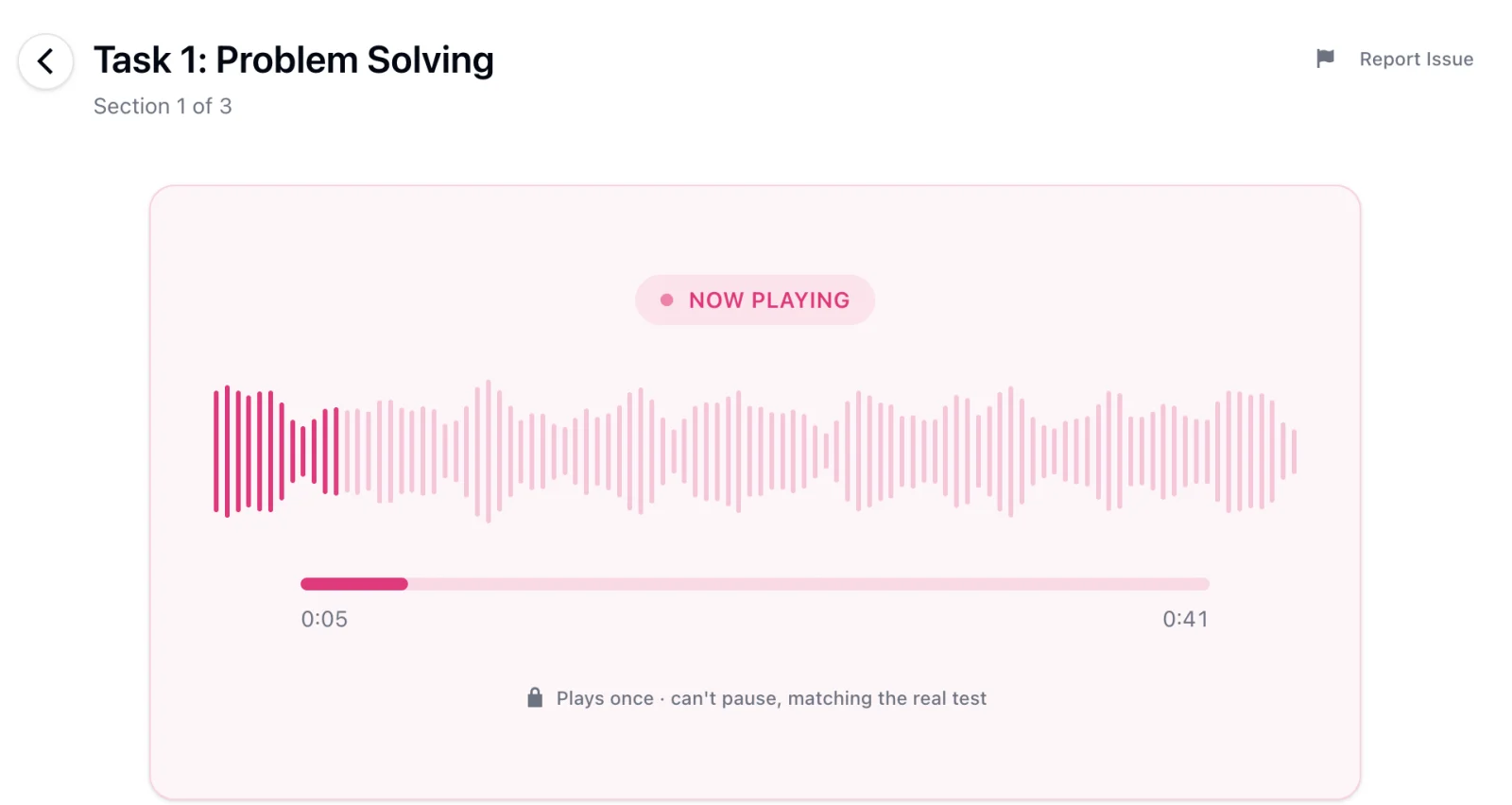
On HelloCelpip the audio behaves the same way. There is no play button and no scrubbing: the recording starts on its own and runs to the end while you take notes.
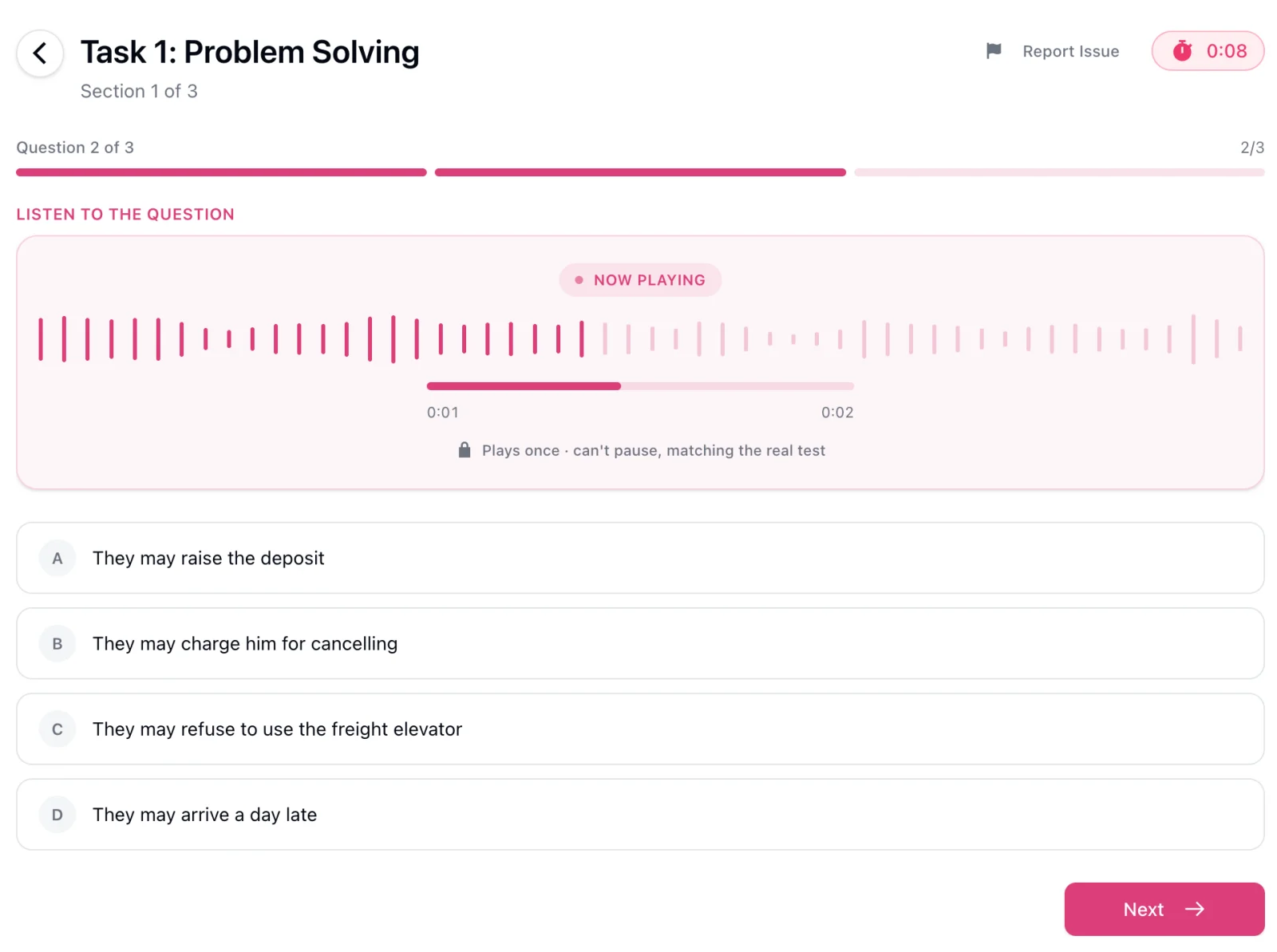
Once the recording ends, the questions arrive and the clock starts. You answer from your notes and your memory, with the audio gone.
#Should you take notes during CELPIP Listening?
Yes, and the test is built for it. You are given paper and a pen at the test centre, and you can ask for more paper if you run out. Nobody reads your notes and they have no effect on your score, so they exist purely to help you.
Two details make notes far more useful than they first look:
- The questions follow the audio in order. Answers turn up in roughly the same sequence as they were spoken, so notes written down the page in order line up with the questions coming down the screen.
- You are writing for a version of yourself who has already forgotten. Point form, abbreviations, and names are what you want. Full sentences take too long and you will not read them.
Practise this with a real pen and paper. Typing notes is a different physical skill, and test day is the wrong moment to discover that.
#What are the three CELPIP Listening question types?
Every Listening question is one of three types, and they are the same three used on the Reading test.
- General meaning is the big picture. It asks what the speakers were talking about, or what they all agreed on. Listen for the shape of the whole clip.
- Specific information is one fact. A date, a name, a place, a number, said once, in one place. This is what notes are for.
- Inference is what nobody says out loud. How a speaker feels, whether they agree, what will probably happen. Listen for tone, not words.
One habit helps on all three: the correct option almost never repeats the words you heard. A speaker says they had trouble staying awake in a lecture; the answer says they almost fell asleep in class. You are matching meaning, not sound.
#Which listening skill do learners find hardest?
Hearing how a speaker feels. We sorted more than 96,000 answered Listening questions on HelloCelpip, anonymised and aggregated, by the exact skill each one tests. Questions about a speaker's attitude are answered correctly about 73% of the time, the lowest of any skill we track, and far below the 96% for questions about a passage's main idea.
| What the question asks you to hear | Answered correctly |
|---|---|
| How a speaker feels about something | 73% |
| Whether two speakers agree | 80% |
| A specific detail, in order, or reworded | about 82 to 84% |
| What a speaker implies will happen | 85 to 87% |
| The main idea of the passage | 96% |
What makes this worth knowing is that CELPIP says so too. Its own Listening study pack tells test-takers that speakers usually will not name a feeling outright, and that tone comes through indirectly instead, in word choice and stress. It names identifying tone as a skill to practise. So this is not a hidden trick: the skill is published, explained, and illustrated with examples. It is still the one learners miss most.
The reason is that tone lives in the delivery. A flat sentence and a sarcastic one are the same words. So while you listen, note not only what somebody said but how they sounded saying it, and whether the person answering them agreed.
At the part level the same story shows up as a slow decline from Part 1 to Part 6, because the later parts have more voices and more disagreement to keep straight. We break that down part by part in the CELPIP Listening score chart.
#Does practising actually help?
Yes, and our data shows exactly where the biggest gains are hiding. There are two effects, and the second is much larger than the first.
The first is repetition. Coming back to the same Listening part on HelloCelpip lifts accuracy from about 77% on a first attempt to about 81% by the fourth. That is a real gain from familiarity alone, before you change anything about how you listen, and it arrives quickly. (Learners who keep practising tend to be the more motivated ones, so treat it as a strong trend rather than a guarantee.)
The second effect is far bigger, and it is the one worth building your study around. The distance between your strongest and weakest area dwarfs anything repetition does on its own. Across our Listening questions, learners answer 96% of main-idea questions correctly and 73% of questions about how a speaker feels. That is a 23-point gap inside the same test. The same thing happens across the parts: 84% on Part 2 against 69% on Part 6, a 15-point spread.
So the fastest way to raise a Listening score is not simply to answer more questions. It is to find which of those areas is costing you, and then answer more questions there. A learner who spends a week on Part 6 and on hearing speaker attitude is working on a 20-point problem. A learner doing another round of Part 2 is polishing something already at 84%.
#What does each Listening part look like?
Each part is a different kind of audio, and each rewards a slightly different way of listening. The shape is the same every time: you get the situation, then the recording once, then the questions.
#Part 1: Listening to Problem Solving
Two people work out what to do about a problem. Follow the problem, the options they raise, and what they settle on, because the questions track that sequence.
#Part 2: Listening to a Daily Life Conversation
An ordinary conversation between two people. This is the most familiar audio on the test and, on our numbers, the part learners handle best. Take the practice anyway, because it is where you build the note-taking habit cheaply.
#Part 3: Listening for Information
A conversation carrying facts: times, prices, names, conditions. Almost pure specific information, so this is the part where notes pay for themselves. Write the numbers down as you hear them.
#Part 4: Listening to a News Item
A short news report with a single speaker and no conversation to follow. Listen for what happened, to whom, where, and what happens next. It is dense, so the useful note is the one you write while the sentence is still being spoken.
#Part 5: Listening to a Discussion
Several people discussing something, and the only part with video, so body language is available as a clue. More voices means more to keep apart. Note each speaker by name or role as they start talking, and mark who agreed with whom.
#Part 6: Listening to Viewpoints
One speaker presenting a position at length, which is the hardest audio on the test. There is no conversation to break it up, so the structure has to come from you. Note each opinion as it arrives and whether the speaker is stating it, questioning it, or arguing against it.
#Common traps, and how to avoid them
- The word you heard. An option that repeats a word from the audio is often the wrong one, because the correct answer usually rewords the idea.
- The detail from the wrong speaker. In Parts 5 and 6 an option may be perfectly true but said by somebody else. Track who said what.
- The plan that changed. Speakers often propose something and then reject it. The answer is usually what they decided last, not what they mentioned first.
- Staying on the question you missed. Dwelling on one lost detail costs you the next three, because the audio does not wait.
- Writing too much. Notes in full sentences take so long that you stop listening. Point form only.
#How to study Listening with practice
-
Listen once, exactly as the test doesResist replaying the audio, even when it is available. Replaying teaches you the clip; listening once teaches you the skill.
-
Take notes on paper every timeSame pen, same layout, every session, so the habit is automatic by test day and you are not inventing a system while a recording plays.
-
Label the type you missedFor each wrong answer, decide whether it was general meaning, specific information, or inference. A pattern points at the exact skill to work on.
-
Drill the parts with more voicesParts 5 and 6 hold 14 of the 38 questions and carry the most disagreement to keep straight, so they usually hold the most points to gain.
-
Listen to Canadian English outside practicePodcasts, radio, and interviews, without subtitles. The test uses Canadian accents, and general listening stamina transfers.
#How HelloCelpip helps you prepare for Listening
HelloCelpip turns this format into focused study. You work through questions in the same computer-delivered style as the real test, across all six parts, with the audio playing once, and then you see exactly where your points went.
- A large set of Listening questions across all six parts, written in the real test format at several levels of difficulty.
- Audio that plays once and cannot be paused, so practice conditions match test day rather than being easier than it.
- A result on every attempt, mapped to an estimated CELPIP level, so progress is visible over time.
- Feedback broken down by part and by question type, so your weakest area is clear at a glance.
- Full-length, timed mock tests that recreate the whole Listening section from the first question to the last.
A simple way to use it: start with a few Listening questions to find your weakest part, take a full mock test when you want a timed run, and check the Listening score chart to see how your level maps to CLB.
#Listening on the CELPIP-General LS test
If you are taking CELPIP for Canadian citizenship, you take a different, shorter test: CELPIP-General LS, which is Listening and Speaking only. It takes about 70 minutes in one sitting, with the same 46 to 55 minutes of Listening described on this page.
That matters for how you prepare. On the LS test, Listening is half of your result rather than a quarter, so the six parts on this page carry twice the weight they do on the full CELPIP-General test. Everything here applies unchanged; there is simply more riding on it.
Which test you need is set by the programme you are applying to, so confirm it on the official IRCC page for your application before you book.
#What your Listening score means
CELPIP reports Listening as a level from 0 to 12, not a percentage. That level lines up with the Canadian Language Benchmarks, so a Listening 9 is CLB 9.
To see what a level means for your goal, use the Score to CLB calculator, and read the full CELPIP Listening score chart for the level-by-level breakdown and what each programme asks for. Requirements change, so always confirm the current one for your programme on the official IRCC site.
#CELPIP Listening practice FAQ
How many parts are on the CELPIP Listening test?
Can you listen to CELPIP Listening audio twice?
Can you take notes during the CELPIP Listening test?
Which CELPIP Listening skill is the hardest?
How long is the CELPIP Listening test?
What accents are used on the CELPIP Listening test?
Can you go back and change a CELPIP Listening answer?
Are these real CELPIP Listening questions?
Will practising on HelloCelpip prepare me for the real Listening test?
Confirm current timing, parts, and question counts on the official CELPIP Test Format page, and check the CELPIP Score Comparison Chart for CELPIP Level and CLB information. The audio rules, note-taking guidance, and question-type definitions on this page are published in the CELPIP Listening Pro study pack. Your HelloCelpip level uses the same 0 to 12 CELPIP scale, so you can track real progress between now and test day. Your official score comes from Paragon Testing Enterprises on test day. HelloCelpip is an independent study resource and is not affiliated with CELPIP or Paragon Testing Enterprises.
Official sources:
- CELPIP Test Format
- CELPIP Score Comparison Chart
- Paragon Testing Enterprises, CELPIP Listening Pro Study Pack (audio rules, note-taking guidance, question types)
Last updated: July 27, 2026