

In CELPIP Listening Part 3, you hear one conversation between a man and a woman. One of them knows about a subject, and the other person needs information about it. After the conversation ends, you hear 6 questions, one at a time. You have about 30 seconds to answer each one.
The name of this part makes many learners write down every number and name. That is not the best plan. This guide shows you what Part 3 really asks about: reasons, rules and changes of plan. It gives you a note table for the two speakers, the mistakes that cost the most marks, and one full example.
#What is CELPIP Listening Part 3?
Part 3 is the third part of the Listening test. Its full name is Listening for Information. You hear a man and a woman. One speaker is the expert: the person who knows the subject, for example a librarian, a doctor's receptionist, a landlord or a club organizer. The other speaker is the asker: the person who needs the information.
Part 3 has 6 questions and takes about 6 minutes. The conversation is about two to two and a half minutes long. You hear it once, from start to end, with no break.
| What you hear or see | What you do | |
|---|---|---|
| Instructions | One line about the two speakers. | Find out who is the expert and who is the asker. |
| The conversation | One recording, about two to two and a half minutes. | Take short notes about what the asker needs, the rules, and any change of plan. |
| Questions 1 to 6 | Six spoken questions, one at a time. You see only the four options. | Choose one option. You have about 30 seconds. |
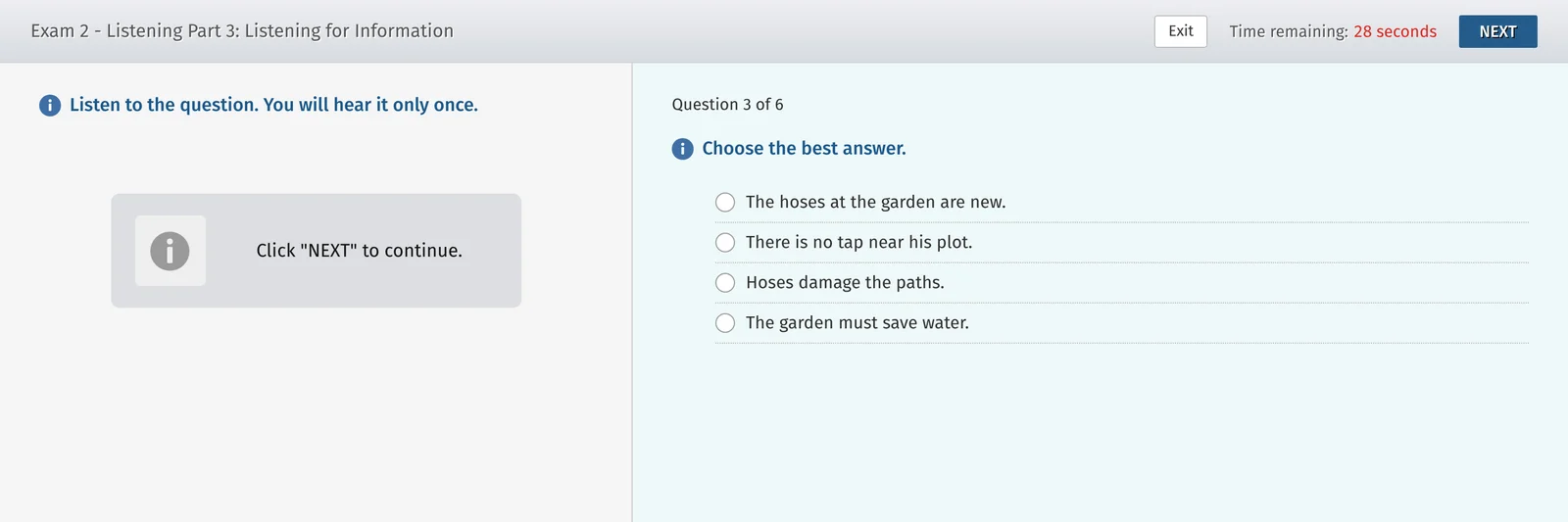
In Part 3, you hear the question. You do not see it. The screen shows only the four options. So you must remember the question while you read the options. The questions come after the whole conversation, so your notes must help you remember the start too.
Two rules from the test are important. First, every recording and every question plays only once. You cannot pause or play it again. Second, a wrong answer does not lose marks, so always choose an option before the time ends.
#Why is Listening Part 3 hard?
Part 3 is in the middle of the six Listening parts. On hellocelpip.com, learners answer 77.2% of Part 3 questions correctly. That is lower than Parts 1 and 2. You hear the whole conversation with no break, and all six questions come after it.
There are four reasons why learners lose marks in Part 3.
1. Part 3 is a "why" test, not a number test. Many questions start with "why". They ask the reason for a rule, a choice or a worry. The speakers say many numbers, times and prices, but the questions rarely ask about them. Learners who write down every number miss the reasons.
2. Both speakers give answers. The expert knows the subject, and the asker needs information. Many learners listen only to the expert. But the asker also says important things: what the asker needs, why, and what the asker decides. Many answers come from the asker.
3. Plans change. A speaker often suggests something, and the other speaker refuses or corrects it. A trap is a wrong option that sounds correct on purpose. In Part 3, the first idea is often the trap, and the changed idea is the answer.
4. Some answers come from two parts of the conversation. A question can need two facts that you hear at different times. For example, the expert says when you can do something, and later the asker says when he is free. The answer puts the two facts together. This is an inference: something that the speakers do not say directly, but that you can work out from clues.
#What happens, screen by screen?
In Listening, the test controls the time, not you. Each screen moves on by itself. So you must know what to do on each screen before the test starts.
-
Instructions: a few secondsRead the line about the speakers. Write who is the expert and who is the asker, for example E = garden organizer and A = new member.
-
The conversation: about two to two and a half minutesFill your note table: need, rules, changes and end. Write each reason with an arrow. Cross out each idea that a speaker refuses or corrects.
-
Questions 1 to 6: about 30 seconds eachListen to the question. Say it to yourself in three or four words, for example why no hose? Then read the four options. Choose one.
When you know the answer, choose it. Then go to the next question. You cannot go back to an earlier question.
#How do you take notes in Part 3?
Write reasons, rules and changes, not every fact. Use a table with four rows. Each row answers one question that Part 3 often asks.
Speakers: E = who the expert is, A = who the asker is
| Row | What to write | Example of a short note |
|---|---|---|
| 1. Need | what the asker wants, and why | A: plot → no garden at home |
| 2. Rules | each rule or condition, and its reason | E: mower 16+ → insurance |
| 3. Changes | each idea that a speaker refuses or corrects | |
| 4. End | what the asker will do, and how he or she feels | A: comes Saturday, happy |
Follow these rules when you take notes:
- Write each reason with an arrow. "mower 16+ → insurance". Many Part 3 questions ask "why".
- Write what the asker says, too. The asker's needs, worries and plans are often the answers.
- Cross out an idea that changes. Then write the new idea next to it. The crossed-out idea is often a trap.
- Write a number only when it is part of a rule or a reason. For example, "water before 9 or after 6" is a rule. "Plot 14" is just a label.
This note table is our own method. It is not an official CELPIP template. CELPIP's own Listening study pack gives a similar question to ask: does one speaker want information, and why?
#How do you listen for reasons?
Listen for the words that join a fact to its reason. In Part 3, the reason often comes just after a rule, a choice or a "no".
| Words that show a reason | Example |
|---|---|
| because, since, so | "It's near the gate, so it gets a lot of afternoon sun." |
| That's for…, It's because of… | "Someone over sixteen has to use the mower. That's for insurance." |
| That's why…, The reason is… | "We have to save water. That's why we use rain barrels." |
A reason does not always use these words. Sometimes the reason is the next sentence. For example, the expert says "please don't bring a hose", and then explains the rain barrels and the water limit. The second sentence is the reason for the first.
When a question starts with "why", find the row in your notes with the arrow. The answer is usually on the right side of the arrow, in different words.
#How do you notice a change of plan?
In Part 3, the first idea is often not the final one. One speaker suggests something. Then the other speaker refuses it, corrects it or adds a condition. Listen for these words:
- A refusal: "Actually, please don't…", "I'm afraid you can't…", "That won't work because…"
- A correction: "Not quite…", "Well, it's actually…", "It used to be…, but now…"
- A condition: "Only if…", "As long as…", "But if you…, it drops to…"
When you hear one of these words, cross out the first idea in your notes. Then write the new idea. A trap option often gives the first idea, because you heard it clearly and it sounds familiar.
#A worked example, from start to finish
This example uses our community garden conversation from the hellocelpip.com full exam. It is our own conversation, and it has the same format as the real test. In the test you only hear it. Here you can read it.
The instruction line says: You will hear a conversation between a man and a woman who runs a community garden. So the woman is the expert, and the man is the asker.
Man: Hi. I’m Mark. I emailed last week about renting a plot. My family just moved into an apartment, and we really miss having a garden.
Woman: Welcome, Mark. I’m Helen. I run the garden. We have one plot left this year. It’s near the gate, so it gets a lot of afternoon sun.
Man: Sun is good. My kids want to grow tomatoes. They’re seven and nine.
Woman: Tomatoes will love that spot. There are just a few rules. Each family has to give two hours a month to the shared jobs, like cutting the grass on the paths or turning the compost.
Man: Two hours a month is fine. Can the kids help with that, or does it have to be an adult?
Woman: Kids can help with the compost, but someone over sixteen has to use the mower. That’s for insurance.
Man: Makes sense. What about water? I was going to bring a hose from home.
Woman: Actually, please don’t. We have rain barrels at the end of each row, and in July we only water before nine in the morning or after six at night. The city limits how much we use.
Man: Oh, I didn’t know that. Then I guess we’ll come in the evenings. I work days anyway.
Woman: Most families do. The evenings are nice here. People share extra vegetables at the table by the shed.
Man: That’s nice. And the fee was sixty dollars?
Woman: Sixty for the season. But if you help with the spring clean-up this Saturday, it drops to forty. We need people to fix the fence.
Man: I’m pretty handy with tools. I can be here Saturday.
Woman: Wonderful. Bring gloves. I’ll put your name on plot fourteen, and your kids can start planting next week.
Notes: E = Helen, runs garden. A = Mark. Need: plot → moved to apartment, miss garden. Rules: 2 h/month shared jobs; kids compost OK, mower 16+ → insurance; water before 9 / after 6 → city limit. Changes: hose → barrels; fee 60 → 40 if he helps Saturday. End: evenings (works days), comes Saturday, happy.
Question 1: Why does the man want a garden plot?
- He wants to sell vegetables.
- His family no longer has a garden at home.
- His children have a school project.
- He wants to meet his new neighbours.
How to decide: The first lines give the reason. The asker says his family moved into an apartment and misses having a garden. The answer is from the asker, not the expert. The answer is “His family no longer has a garden at home.”
Question 2: What does the woman say about the shared jobs?
- Every family must cut the grass.
- They take about two hours a week.
- Only some of the jobs can be done by children.
- Children are not allowed to help.
How to decide: The woman says kids can help with the compost, but only someone over sixteen can use the mower. So children can do some jobs, not all. “Two hours a week” is a trap: she says two hours a month. The answer is “Only some of the jobs can be done by children.”
Question 3: Why does the woman ask the man not to bring a hose?
- The hoses at the garden are new.
- There is no tap near his plot.
- Hoses damage the paths.
- The garden must save water.
How to decide: The man’s idea is a hose. The woman refuses it with “Actually, please don’t.” Then she gives the reason: rain barrels, watering only at certain times, and “The city limits how much we use.” All of this means that the garden must save water. The answer is “The garden must save water.”
Question 4: Why will the man and his family come to the garden in the evenings?
- It suits both the rules and his work.
- The garden is closed in the morning.
- His children are at school all day.
- The woman asks him to come then.
How to decide: This answer comes from two parts of the conversation. The woman says they can only water before nine or after six. The man says he works during the day. Together, the evening suits both the rule and his job. The garden is not closed in the morning. The answer is “It suits both the rules and his work.”
Question 5: How can the man pay less for his plot?
- by sharing a plot with another family
- by bringing his own tools
- by helping with a job this weekend
- by paying for the whole season now
How to decide: The woman adds a condition: the fee drops to forty “if you help with the spring clean-up this Saturday”. The man mentions tools, but tools do not lower the fee. The answer is “by helping with a job this weekend”.
Question 6: How does the man feel at the end of the conversation?
- worried about the cost
- unsure about the rules
- surprised by the fence
- happy to take part
How to decide: At the end, the man offers his skills at once: “I’m pretty handy with tools. I can be here Saturday.” He does not say “I am happy”, but his quick offer shows that he wants to take part. The answer is “happy to take part”.
Look at the numbers in this conversation: sixty, forty, two hours, sixteen, nine, six, fourteen. No correct answer is a number. Numbers help to explain a rule, but the questions ask about the rule and its reason.
#Which mistakes cost the most marks?
In Listening Part 3, a trap is a wrong option that sounds correct on purpose. The expert is the speaker who knows the subject, and the asker is the speaker who needs information. These are seven common mistakes in Part 3.
| Mistake | What it looks like | Ask yourself |
|---|---|---|
| The first idea | You choose an idea that a speaker said first, but the other speaker refused or corrected it. | Did this idea change later? |
| Expert only | You listened only to the expert, so you miss a question about the asker's need or plan. | What did the asker say? |
| Right words, wrong link | The option uses the right people and things, but joins them the wrong way, for example "children are not allowed to help". | Who does what, and to whom? |
| Near number | The option has a number close to the one you heard, for example a week instead of a month. | Is it the same unit and the same amount? |
| Mentioned, but not the answer | You choose something that a speaker really said, but it answers a different question. | Does this option answer this question? |
| Only one half | The answer needs two facts from different times, and you choose an option with only one of them. | Does the answer need two parts of the conversation? |
| Forgot the question | You read the options and forget if the question was "why", "what" or "how". | Did I say the question to myself in a few words? |
#How should you practise Part 3?
Use full Part 3 sets, and practise one skill in each set. A set is one full Part 3 conversation with its 6 questions. You do not need to find your own recordings. Each of the five steps uses one Part 3 set on hellocelpip.com.
-
Step 1: Draw the note table firstOpen a Part 3 set. Before the audio starts, draw the four rows: need, rules, changes and end.
-
Step 2: Write reasons and changesWrite each reason with an arrow. Cross out each idea that changes. Write what the asker says, too.
-
Step 3: Say each question to yourselfWhen you hear a question, say it again in three or four words, for example why evenings? Then read the options. Choose one.
-
Step 4: Learn from each wrong answerAfter the set, open your report. For each wrong answer, read the reason and the trap label, a short name for the mistake. Play the audio again. Find the words in the transcript. Then find your mistake in the Part 3 mistakes table in this guide.
-
Step 5: Do a full Listening mock testWhen you get most Part 3 answers correct, do a Listening mock test. A mock test has all six Listening parts with the real timing, so you practise Part 3 in its real place.
If you make the same mistake two times, practise only that mistake in your next set. For example, you may often choose the first idea. Then, in your next set, listen for "actually", "but" and "only if". Cross out the first idea each time you hear one.
#How hellocelpip.com helps you prepare for Part 3
hellocelpip.com has more than 600 Listening Part 3 questions, in over 100 sets across practice sets, mock tests and full exams. Each set has the CELPIP format: one conversation between an expert and an asker, six spoken questions, and audio that plays only once.
- More than 100 Part 3 sets across practice sets, mock tests and full exams, about many subjects, from easy to hard.
- An explanation for every question, with a short label for the trap behind each of your wrong answers, such as Wrong speaker or Number or time mix-up.
- The audio and the full transcript after each set, so you can find the exact words that give the answer.
- Your score for each type of question, so you can see if inference questions cost you marks.
- Listening mock tests with all six parts, and full exams with all four skills, both with the real timing.
- Ask Alyssa, your AI CELPIP coach, who can go through a wrong answer with you and tell you what to practise next.
Start with a Part 3 set. When you are ready for the full test, take a Listening mock test. To see how Part 3 fits with the other five parts, read the CELPIP Listening practice test guide. To see how your correct answers become a CELPIP level, read the CELPIP Listening score chart. If a question still confuses you, open Ask Alyssa, our AI CELPIP coach. She can go through it with you. When you want the whole test in one sitting, try a full exam with all four skills.
#CELPIP Listening Part 3 FAQ
How many questions are in CELPIP Listening Part 3?
How long does Listening Part 3 take?
Can I see the questions in Listening Part 3?
Should I write down every number in Listening Part 3?
Who are the speakers in Listening Part 3?
What is an inference question?
Is a wrong answer worse than no answer?
Confirm the Part 3 format and number of questions on the official CELPIP Test Format page and in CELPIP’s own Listening study pack. Your hellocelpip.com level uses the same 0 to 12 CELPIP scale, so you can track real progress between now and test day. Your official score comes from Paragon Testing Enterprises on test day. hellocelpip.com is an independent study resource and is not affiliated with CELPIP or Paragon Testing Enterprises.
Official sources:
Last updated: November 14, 2026