

In CELPIP Listening Part 1, you hear a conversation between two people. One person has a problem, and the two speakers talk about what to do. You hear the conversation in three sections. After each section, you hear two or three questions. There are 8 questions in total, and you have about 30 seconds to answer each one.
This guide gives you a simple note table for the three sections. It shows you how to hear the difference between a suggestion and a decision, and how to hear what a speaker feels. It also gives the mistakes that cost the most marks, and one full example.
#What is CELPIP Listening Part 1?
Part 1 is the first part of the Listening test. Its full name is Listening to Problem Solving. You hear two people, a man and a woman. One of them has a problem, for example with a booking, a delivery, a bill or a service. The other person is often someone who works there and tries to help.
Part 1 has 8 questions and takes about 8 minutes. The conversation comes in three sections. A section is one short part of the conversation, about one minute long.
| What you hear or see | What you do | |
|---|---|---|
| Instructions | One line about the speakers and the place. | Learn who the speakers are and where they are. |
| Section 1 | The first part of the conversation. | Listen for the problem. |
| Questions | Two or three spoken questions. You see only the four options. | Choose one option. You have about 30 seconds. |
| Sections 2 and 3 | The next parts of the conversation, each followed by two or three questions. | Listen for the suggestions, the decision and the feelings. |
There is an important difference from Reading. In Part 1, you hear the question. You do not see it. The screen shows only the four options. So you must remember the question while you read the options.
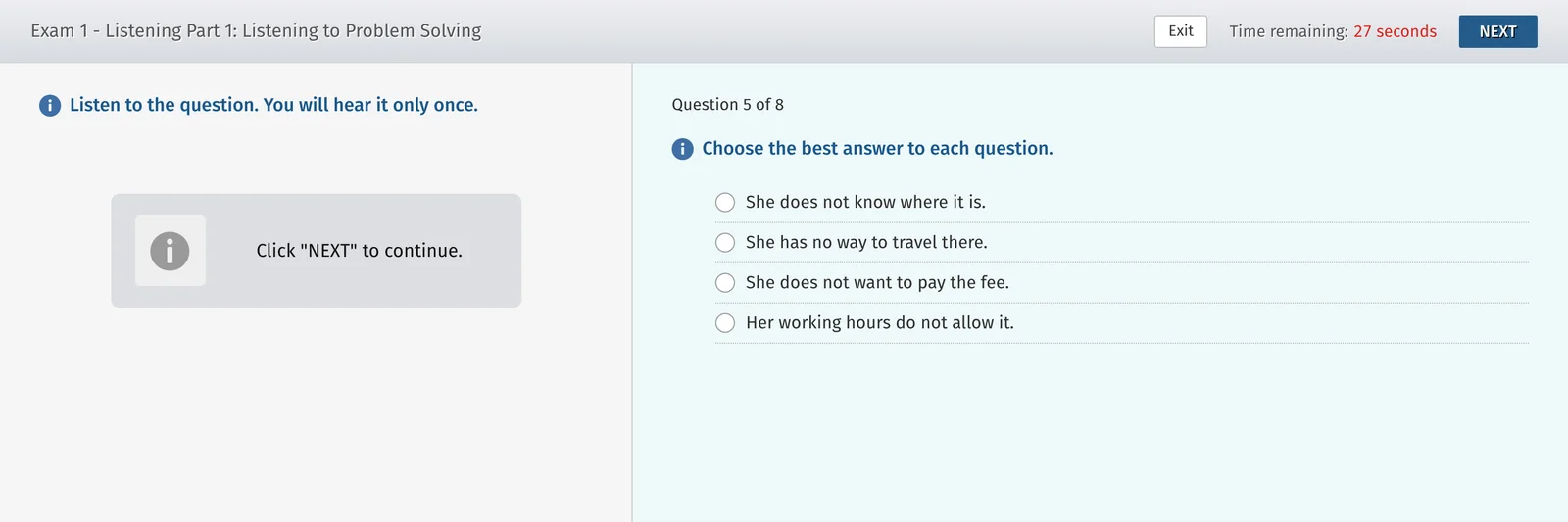
Two rules from the test are important. First, every recording and every question plays only once. You cannot pause or play it again. Second, a wrong answer does not lose marks, so always choose an option before the 30 seconds end.
#How are the three sections of Part 1 different?
Each section has a different job. When you know the job of each section, you know what to listen for. This is the usual pattern, but it can change, as the section on surprises in Part 1 explains.
The usual job of each section in Listening Part 1. Two or three spoken questions follow each section, and each question is about the section you just heard.
- Section 1: the problem. You learn what is wrong and often why. The first question is very often about the problem or the main topic.
- Section 2: suggestions. A suggestion is an idea to fix the problem. One speaker gives one or more suggestions. Often there is a reason why a suggestion does not work for the other person, for example time, money or distance.
- Section 3: the decision. The speakers choose what to do. The questions often ask what someone will do next, or how someone feels at the end.
Each question is about the section that you just heard. You do not need to remember Section 1 to answer the questions after Section 3.
#What can surprise you in Part 1?
Part 1 is not always one smooth conversation with a happy ending. Three things can surprise you if you are not ready for them.
1. The sections can happen at different times. Section 2 can start the next day, with words such as "Hi again" or "You're back". The speakers may now know each other a little. When you hear these words, start a new line in your notes.
2. The problem can change. In Section 2, a new problem can appear, or the person who helps can say no because of a rule. The conversation may not move straight from problem to suggestions to decision.
3. The end can be open. Sometimes the speakers do not fully solve the problem. Do not choose an option only because it gives a happy ending. Choose what the speakers actually say or clearly mean.
#Why is Listening Part 1 hard?
Part 1 has many questions, so every lost mark matters. Part 1 has 8 of the 38 Listening questions. Only Part 5 has as many. On hellocelpip.com, learners answer 77.6% of Part 1 questions correctly. Only Part 2 is higher. So every mark that you lose here is a big part of your Listening score.
There are four reasons why learners lose marks in Part 1.
1. You hear each question only once. The question is not on the screen. If you miss one word, such as "why" or "next", you can choose an option that answers a different question.
2. Many questions ask about feelings and reasons. Questions such as "How does the woman feel?" or "Why does the man mention the signs?" are common in Part 1. The speaker almost never names the feeling, so you must hear it in the words and the voice.
3. A suggestion is not a decision. In Section 2, a speaker often gives a suggestion that the other speaker refuses. A wrong option often gives that suggestion as if it were the decision.
4. Many questions are inference questions. An inference question asks about something that the speaker does not say directly. You use clues in the words and in the voice to work it out. For example, a speaker says "I work until six" when the office closes at five. She does not say "I can't go", but that is what she means.
You can learn to do all of this with a note table and a few listening habits.
#What happens, screen by screen?
In Listening, the test controls the time, not you. Each screen moves on by itself. So you must know what to do on each screen before the test starts.
-
Instructions: a few secondsRead the line about the speakers and the place. Write the two speakers on your paper, for example W = customer and M = desk worker.
-
Section 1: about 1 minuteListen for the problem and its cause. Write a few short words in the Problem row of your notes.
-
Questions: about 30 seconds eachListen to the question. Say it to yourself in three or four words, for example why taken? Then read the four options. Choose one.
-
Preparation screenA short countdown comes before Sections 2 and 3. Look at your notes. Get ready for a new section of the conversation.
-
Sections 2 and 3: about 1 minute eachListen for each suggestion, what is in the way and what the speakers decide. Then answer the questions for that section.
The time for each question is short. Do not wait until the end of the time. When you know the answer, choose it. Then go to the next question. You cannot go back to an earlier question.
#How do you take notes in Part 1?
Write a few words for each section, in three rows: problem, suggestions, decision. You can take notes during the real test. Your notes are only for you, so keep them very short.
Speakers: W = who she is, M = who he is
| Section | What happens | Feeling |
|---|---|---|
| 1. Problem | what is wrong, and why | one word, for example worried |
| 2. Suggestions | each choice, and what is in the way | one word |
| 3. Decision | what they will do next | one word |
Follow these rules when you take notes:
- Write meaning, not every word. Write "bike gone, rack painted", not the full sentence.
- Mark who says what. Write W or M before each note. Many wrong options give the right idea to the wrong speaker.
- Cross out each suggestion that a speaker refuses. Then you will not choose it as the decision.
- Do not write every number. Speakers often say prices, times and street numbers, but the questions almost never ask about them. A number is useful only when it explains the problem, for example "closes at 5, she works until 6".
- Write one feeling word for each section. Feelings are hard to remember later, and one word helps you remember how the speaker sounded.
This note table is our own method. It is not an official CELPIP template. CELPIP's own Listening study pack gives the same advice: find the problem, the possible solutions and the solution that the speakers choose.
#How do you hear a suggestion and a decision?
A suggestion is an idea to fix the problem. A decision is what a speaker agrees to do. The words that speakers use are different. Listen for them.
| Words that often show it | Example | |
|---|---|---|
| Suggestion | You could…, Why don't you…, There is another way…, What about…, One option is… | "There is another way. On Friday, the truck brings all the bikes back here." |
| Problem with a suggestion | The only thing is…, But…, I'm not sure that works…, I can't… | "I work until six every day. I can't get there before it closes." |
| Decision | I'll…, Let's…, I think I'll…, OK, I'll do that…, That should work. | "I'll write him a note tonight, and he can go tomorrow afternoon." |
The decision is often the last suggestion in the conversation, not the first. If a speaker says "I'm not sure" or "the only thing is", that suggestion is probably not the decision. Wait for words such as "I'll" or "let's".
#How do you hear what a speaker feels?
Speakers almost never name their feeling. A speaker does not say "I am relieved". She says "Well, at least it wasn't stolen." You must hear the feeling in the words and in the voice.
Listen for these three clues:
- Words that show a change. "At least", "well" and "I guess" often show that a speaker feels a little better, or accepts a bad situation.
- Words that show surprise or anger. A question that repeats the other speaker, such as "Signs? I didn't see any signs", often shows surprise or annoyance.
- The voice. A speaker who talks fast and loud often feels angry or worried. A speaker who talks slowly with a long "hmm" is often unsure.
When a question asks about a feeling, ask yourself two things. First, who feels it: the man or the woman? Second, when: at the start or at the end of the section? A speaker's feeling can change inside one section. Many wrong options give a feeling that the speaker had earlier.
#A worked example, from start to finish
This example uses our bicycle conversation from the hellocelpip.com full exam. It is our own conversation, and it has the same format as the real test. In the test you only hear it. Here you can read it.
The instruction line says: You will hear a conversation between a woman and a man who works at a train station customer service desk.
Woman: Hi. I locked my bike to the rack by the north entrance this morning, and now it’s gone. The lock is gone too.
Man: I’m sorry to hear that. Was it a blue bike with a basket on the front?
Woman: Yes! Do you know where it is?
Man: I think so. The crew is painting that rack this week. There were signs up on Monday asking people to use the south racks instead. Any bike still there this morning was cut loose and taken to our storage depot.
Woman: Signs? I come in the north door every day. I didn’t see any signs.
Man: They were on the posts at both ends of the rack. But I understand. A lot of people missed them.
Woman: Well, at least it wasn’t stolen. I was sure it was stolen.
Notes: W = customer, M = desk worker. Problem: bike gone, rack being painted, signs (W missed them). Feeling: worried, then relieved.
Question 1: What is the woman’s problem?
- She missed her train.
- She lost the key to her lock.
- She cannot find her bicycle.
- She cannot find the north entrance.
How to decide: The first question is about the problem. The woman says her bike is gone. The speakers talk about the train, the lock and the north entrance, but they are not her problem. The answer is “She cannot find her bicycle.”
Question 2: Why was the woman’s bicycle taken away?
- Work was being done where she parked it.
- It was locked in a no-parking area.
- Someone reported it as stolen.
- The rack was full that morning.
How to decide: The man says the crew is painting the rack. Painting is work. The answer uses different words from the audio, which is normal. “Stolen” is a word from the audio, but nobody reported a theft. The answer is “Work was being done where she parked it.”
Question 3: How does the woman feel at the end of this conversation?
- embarrassed
- confused
- angry
- relieved
How to decide: The question asks about the end. She was surprised about the signs earlier, but her last words are “Well, at least it wasn’t stolen.” “At least” shows that she feels better. The answer is “relieved”.
Woman: Hi again. You helped me yesterday with my bike.
Man: Right, the blue one. I checked, and it’s at the depot on Carlton Road. You can pick it up there. There’s a twenty-five dollar storage fee.
Woman: Twenty-five dollars, for a sign I couldn’t see? And Carlton Road is on the other side of town. What time does the depot close?
Man: Five o’clock, Monday to Friday.
Woman: I work until six every day. I can’t get there before it closes.
Man: There is another way. On Friday, the truck brings all the bikes back here, and there’s no fee for bikes returned to the station. The only thing is, if a bike isn’t collected by Friday evening, it goes back to the depot.
Woman: Friday. So I’d be walking to work for three days. Hmm. I’m not sure that works either.
Notes: “Hi again” = the next day. Suggestion 1: depot, pay fee (crossed out: closes 5, W works till 6). Suggestion 2: wait for Friday, no fee, but collect Friday evening (W not sure). Feeling: annoyed, unsure.
Question 4: What does the man first tell the woman to do?
- wait for the bike to be brought back
- pay a fee and collect the bike from the depot
- fill out a lost property form
- call the depot to book a time
How to decide: The word “first” is the key. The man’s first suggestion is the depot and the fee. Waiting for Friday is his second suggestion, so it is a trap: a wrong option that sounds correct on purpose. The answer is “pay a fee and collect the bike from the depot”.
Question 5: Why is the woman unable to go to the depot?
- She does not know where it is.
- She has no way to travel there.
- She does not want to pay the fee.
- Her working hours do not allow it.
How to decide: This question is in the full exam picture just before these questions. She complains about the fee and the distance, so two options sound possible. But the reason she says she can’t go is “I work until six” when the depot closes at five. She does not say “my working hours”. You must put the two times together. That is an inference. The answer is “Her working hours do not allow it.”
Question 6: What does the man suggest about Friday?
- The depot will stay open later.
- The woman must pick up the bike that same day.
- The storage fee will be higher.
- The north rack will be ready to use.
How to decide: The man says that a bike that is not collected by Friday evening goes back to the depot. So she must pick it up on Friday. He does not say it with these words, but this is what he means. The answer is “The woman must pick up the bike that same day.”
Woman: Hello. I thought about it, and I’d like to ask about one more thing. Can someone else collect the bike for me?
Man: Yes, if they bring a signed note from you and a copy of your ID.
Woman: My brother works near Carlton Road. He finishes at four. I’ll write him a note tonight, and he can go tomorrow afternoon.
Man: That should work. He’ll still need to pay the twenty-five dollars, though.
Woman: I know. I’ll just be happy to have it back. And next time I’ll read the signs.
Question 7: What will the woman most likely do this evening?
- go to the depot after work
- call the depot to complain
- write a note for her brother
- wait for the bike to return on Friday
How to decide: Listen for the decision words “I’ll”. She says “I’ll write him a note tonight.” The depot and Friday were suggestions from Section 2 that she did not choose. The answer is “write a note for her brother”.
Question 8: What does the woman’s last comment suggest?
- She will not pay the fee.
- She plans to stop using the station.
- She thinks the man made a mistake.
- She accepts part of the blame.
How to decide: She says “next time I’ll read the signs.” She means that she should have seen them. She does not say “it was my fault”, but that is what she means. The answer is “She accepts part of the blame.”
Look at the pattern in this example. Most of the correct answers use words that the speakers never say, for example "work was being done", "working hours", "that same day" and "part of the blame". In Part 1, the correct option almost always says the same idea in different words. And a wrong option often uses a word that you heard, such as "stolen", "Friday" or "depot".
#Which mistakes cost the most marks?
In Listening Part 1, a trap is a wrong option that sounds correct on purpose. These are the mistakes that learners make most often when they choose a trap. Each one has a question that you can ask yourself.
| Mistake | What it looks like | Ask yourself |
|---|---|---|
| Suggestion as decision | You choose an idea that a speaker offered, but the other speaker did not accept it. | Did someone say "I'll" or "let's" for this? |
| Same word, wrong answer | You choose the option with a word that you heard, but it answers a different question. | Does this option answer this question? |
| Wrong speaker | The option gives the man's idea or feeling, but the question is about the woman. | Who did the question ask about? |
| Wrong moment | You choose a feeling from the start of the section, but the question asks about the end. | When does the question ask about? |
| The number trap | You choose an option with a time or price that you heard, but a near number or a different fact is correct. | Is the question really about this number? |
| Too strong | The option says more than the speaker means, for example "She will never use the station again". | Did the speaker really say or mean this much? |
| Forgot the question | You read the options and forget if the question was "why", "what" or "how does she feel". | Did I say the question to myself in a few words? |
| Waiting for one story | You expect Section 2 to follow straight after Section 1, and you miss the new day or the new problem. | Did I hear "hi again" or a new problem? |
#How should you practise Part 1?
Use real Part 1 sets, and practise one skill in each set. A set is one full Part 1 conversation with its 8 questions. You do not need to find your own recordings. Every step below uses one Part 1 set on hellocelpip.com.
-
Step 1: Draw the note table firstOpen a Part 1 set. Before the audio starts, draw the table with three rows: problem, suggestions, decision.
-
Step 2: Fill one row for each sectionWrite two or three words in each row. Mark W or M. Cross out each suggestion that a speaker refuses.
-
Step 3: Say each question to yourselfWhen you hear a question, say it again in three or four words, for example why can’t go? Then read the options. Choose one.
-
Step 4: Learn from each wrong answerAfter the set, open your report. For each wrong answer, read the reason and the trap label. Play the audio again. Find the words in the transcript. Then find your mistake in the Part 1 mistakes table in this guide.
-
Step 5: Do a full Listening mock testWhen you get most Part 1 answers correct, do a Listening mock test. A mock test has all six Listening parts with the real timing, so you practise Part 1 in its real place.
If you make the same mistake two times, practise only that mistake in your next set. For example, you may often choose a suggestion that a speaker refused. Then, in your next set, cross out every refused suggestion in your notes. Check your crosses before you answer each question.
#How hellocelpip.com helps you prepare for Part 1
hellocelpip.com has more than 800 Listening Part 1 questions, in over 100 sets across practice sets, mock tests and full exams. Each set has the CELPIP format: a conversation in three sections, spoken questions, and audio that plays only once.
- More than 100 Part 1 sets about many everyday problems, from easy to hard, so you always have a new conversation to practise.
- An explanation for every question, with a short label for the trap behind each of your wrong answers, such as Wrong speaker or Too strong a conclusion.
- The audio and the full transcript after each set, so you can find the exact words that give the answer.
- Your score for each type of question, so you can see if questions about feelings cost you marks.
- Listening mock tests with all six parts, and full exams with all four skills, both with the real timing.
- Ask Alyssa, your AI CELPIP coach, who can go through a wrong answer with you and tell you what to practise next.
Start with a Part 1 set. When you are ready for the full test, take a Listening mock test. To see how Part 1 fits with the other five parts, read the CELPIP Listening practice test guide. To see how your correct answers become a CELPIP level, read the CELPIP Listening score chart. If a question still confuses you, open Ask Alyssa, our AI CELPIP coach. She can go through it with you. When you want the whole test in one sitting, try a full exam with all four skills.
#CELPIP Listening Part 1 FAQ
How many questions are in CELPIP Listening Part 1?
How long does Listening Part 1 take?
Can I see the questions in Listening Part 1?
Can I play the audio again?
Should I take notes in Listening Part 1?
What is an inference question?
Is a wrong answer worse than no answer?
Confirm the Part 1 format and number of questions on the official CELPIP Test Format page and in CELPIP’s own Listening study pack. Your hellocelpip.com level uses the same 0 to 12 CELPIP scale, so you can track real progress between now and test day. Your official score comes from Paragon Testing Enterprises on test day. hellocelpip.com is an independent study resource and is not affiliated with CELPIP or Paragon Testing Enterprises.
Official sources:
Last updated: November 14, 2026