

CELPIP Speaking Task 4 is where many people start guessing too wildly. The answer becomes weaker when the predictions stop matching the image.
The strongest responses stay simple: they use the scene as evidence, make two or three realistic predictions, and explain why those predictions make sense.
#What the examiner wants from Task 4
This task asks you to predict what will happen next based on an image. A strong answer usually includes:
- a brief recap of the current scene
- two or three predictions
- a reason for each prediction
- realistic emotion or outcome language
- a short final wrap-up
#The easiest prediction structure to remember
The safest pattern is:
- Recap the scene.
- Predict action one.
- Predict action two.
- Add one likely feeling or result.
- End with a short summary.
-
Pick visible clues firstIn prep time, identify two or three clues such as body language, location, objects, staff, signs, or where people are standing.
-
Turn each clue into a likely next stepIf someone is already near the cashier, they may pay next. If two people look upset, someone may intervene or walk away.
-
Use realistic languageWords like probably, might, likely, and I think help the predictions sound natural and controlled.
-
Stay close to the imageDo not invent a huge background story. The answer becomes stronger when it stays tied to what the listener can reasonably imagine from the picture.
-
Finish with the likely endingA short final sentence helps you sound complete and prevents the answer from stopping too suddenly.
#A master CELPIP Speaking Task 4 template
Right now, it looks like [brief scene summary].

I think [person A] will probably [next action] because [visible clue].

After that, [person B] might [next action]. As a result, they will likely feel [emotion or reaction].

Finally, I can imagine [group or setting change].

Overall, the situation will probably [how it ends].#What changes depending on the image
#If the scene looks calm
Focus on:
- small next actions
- simple emotional changes
- everyday outcomes
#If the scene looks tense
Focus on:
- who may react first
- how the problem may be resolved
- who may feel embarrassed, upset, or relieved
#If the scene is busy or public
Focus on:
- group movement
- practical next steps
- how the crowd or environment may change
Do not make predictions that are too dramatic
If the image only suggests a small problem, do not suddenly predict a disaster. Realistic predictions sound stronger because they fit the visible clues.
#A worked example
Task 4 uses the same image from Task 3, so here is a matching sample scene to predict from.
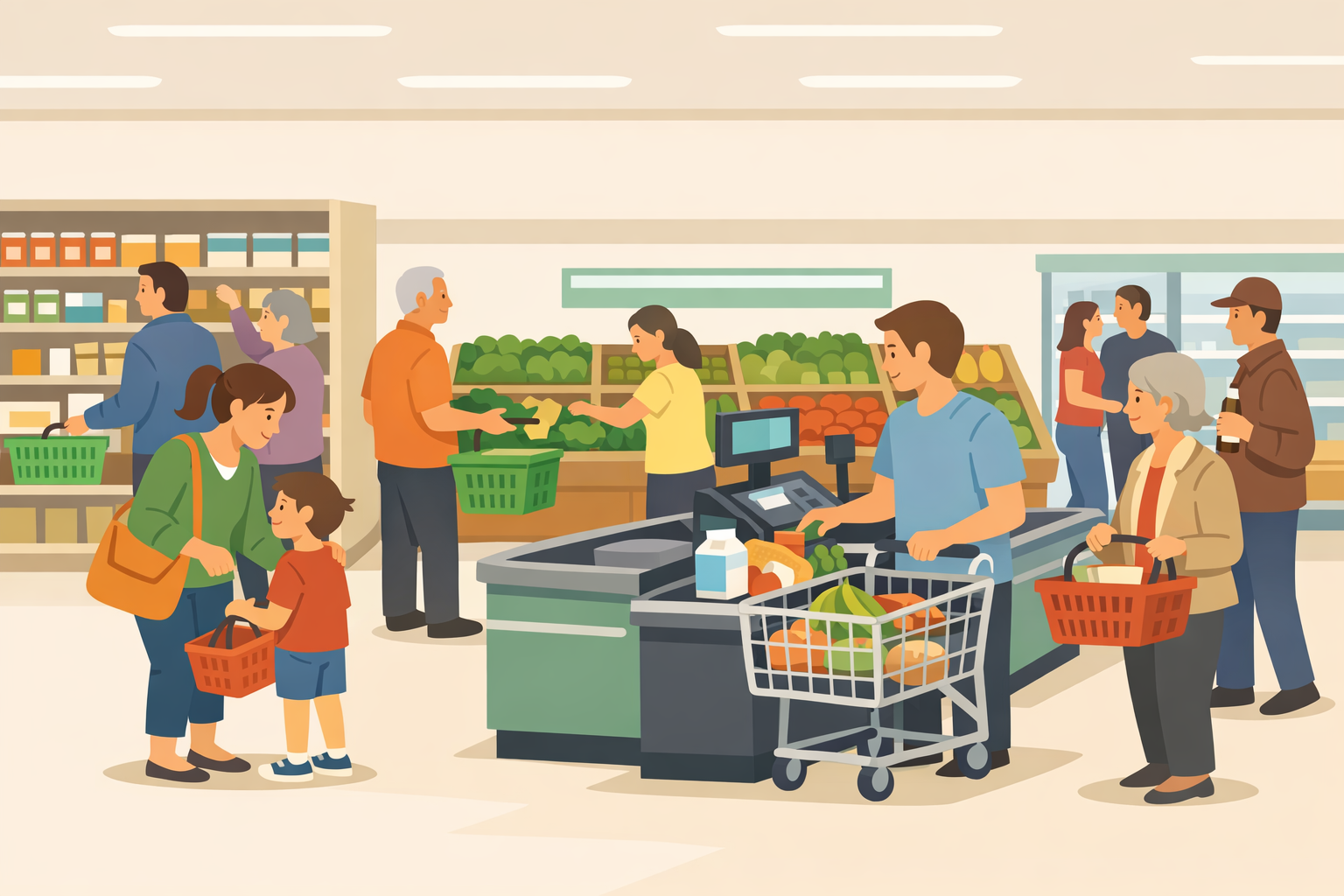
Example image for Task 4. Your predictions should stay realistic and connected to what the people in the scene are already doing.
Recap: Say that several shoppers are already choosing food, talking, and moving toward the checkout area.
Prediction 1: Explain that the cashier will probably finish scanning the groceries in the cart and the shopper at the register will pay soon.
Prediction 2: Predict that the people near the produce section will continue picking vegetables and then move toward the front of the store.
Prediction 3: Add that the parent and child on the left may pick one more item or head toward the checkout once they finish talking.
Wrap-up: End by saying the store will probably stay busy for a few more minutes and then some of the shoppers will leave with their groceries.
#Timing plan for Task 4
You get 30 seconds to prepare and 60 seconds to speak. A reliable prep split is:
- 10 seconds for the scene recap
- 10 seconds for two clue-based predictions
- 10 seconds for one emotion or ending
That is enough if you stay realistic.
#Final checklist before you finish
- Did I briefly explain what is happening right now?
- Did I give two or three clear predictions?
- Did I connect each prediction to a visible clue?
- Did I use realistic language like probably or might?
- Did I end with a short wrap-up instead of stopping suddenly?
#Frequently asked questions
Can I be imaginative in Task 4?
How many predictions do I need?
Do I need to predict emotions too?
What is the most common mistake?
#Final takeaway
For Task 4, good predictions sound logical before they sound creative.
If you remember one thing, remember this:
recap the scene, predict from clues, end realistically.